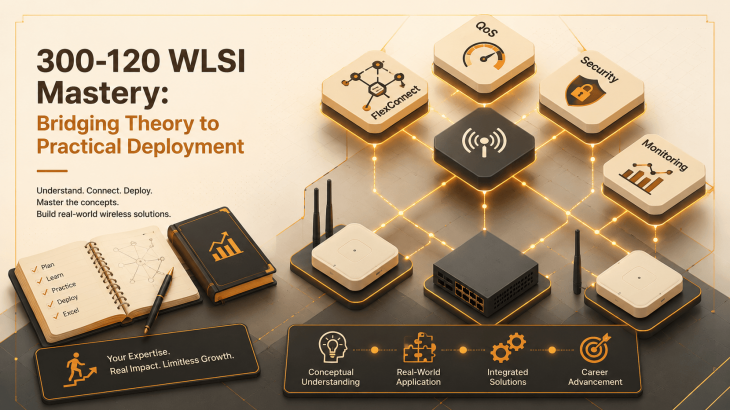
The Cisco 300-120 WLSI exam, formally known as Implementing Cisco Wireless Advanced Solutions, stands as a critical validation for network professionals seeking to demonstrate their expertise in advanced wireless network design, implementation, security, and troubleshooting. This certification targets individuals who manage complex wireless infrastructures and require a deep understanding of Cisco’s advanced wireless technologies. Earning the 300-120 WLSI credential signifies a candidate’s proficiency in deploying robust, scalable, and secure wireless solutions that meet the demands of modern enterprise environments. This comprehensive article delves into key exam areas, offers practical study strategies, and provides essential tips to ensure you are well-prepared to achieve success on this challenging yet highly rewarding certification.
Validating Advanced Wireless Expertise with 300-120 WLSI
The 300-120 WLSI exam assesses a candidate’s capability to implement and maintain advanced Cisco wireless solutions, covering a broad spectrum of topics essential for high-performance, secure, and scalable wireless networks. Professionals pursuing this certification often include network engineers, wireless specialists, and system administrators who design and support complex Wi-Fi environments. This examination is a testament to an individual’s hands-on experience and theoretical knowledge in handling the intricate aspects of Cisco wireless technologies, proving their readiness to tackle real-world deployment challenges.
Exam Structure for Implementing Cisco Wireless Advanced Solutions
Understanding the foundational details of the 300-120 WLSI exam is the first step towards effective preparation. The Implementing Cisco Wireless Advanced Solutions exam is designed to comprehensively evaluate a candidate’s skills across various wireless domains. Familiarity with its format helps in planning your study approach and managing your time efficiently during the actual test. The wireless track is anchored by its own core exam, and the CCNP Wireless core exam explains what that core now covers.
The specific details for this examination include:
- Exam Name: Implementing Cisco Wireless Advanced Solutions
- Exam Code: 300-120 WLSI
- Duration: 120 minutes
- Number of Questions: 55-65 questions
- Passing Score: Variable (typically 750-850 out of 1000, approximate)
- Exam Price: $400 USD
Core Technical Areas Covered by 300-120 WLSI
The Cisco 300-120 WLSI syllabus is meticulously structured to cover the breadth of advanced wireless concepts, ensuring that certified professionals are well-versed in the latest industry practices and Cisco technologies. Each section carries a specific weight, indicating its importance within the exam. A balanced understanding of these domains is crucial for achieving a passing score. For a complete overview of the topics, candidates should refer to the official exam topics provided by Cisco.
The key syllabus topics and their respective weightages include:
- FlexConnect: 15% – Focuses on configuring and troubleshooting FlexConnect deployments, including local switching, centralized authentication, and AVC.
- QoS on a Wireless Network: 10% – Covers the implementation of Quality of Service mechanisms to prioritize traffic over wireless infrastructure.
- Multicast: 10% – Involves understanding and configuring multicast in a wireless environment, including multicast optimization techniques.
- Location Services: 10% – Deals with the principles and deployment of basic location services within a Cisco wireless network.
- Advanced Location Services: 10% – Expands on location services, including advanced features like Wi-Fi-based location tracking, analytics, and CMX.
- Security for Wireless Client Connectivity: 20% – A significant portion dedicated to securing wireless clients, covering authentication methods, encryption, and policy enforcement.
- Monitoring: 15% – Encompasses the tools and methods for monitoring wireless network health, performance, and client activity.
- Device Hardening: 10% – Focuses on securing wireless devices themselves, including controllers, access points, and management interfaces.
Designing Scalable and Secure Wireless Architectures
The ability to design and implement scalable and secure wireless solutions is paramount for any advanced network professional. The 300-120 WLSI exam places significant emphasis on ensuring wireless networks are not only efficient but also resilient against threats and capable of growing with organizational needs. This section explores key architectural considerations and implementation details vital for candidates.
Implementing FlexConnect and Multicast Effectively
FlexConnect, a wireless solution designed for branch offices and remote deployments, minimizes WAN link utilization by allowing access points to locally switch client data traffic. Mastering FlexConnect configurations, including central authentication and local switching, is crucial. This also involves understanding its operational modes and how it optimizes traffic flow in distributed environments. Simultaneously, effective multicast deployment in wireless networks ensures efficient delivery of multimedia and other bandwidth-intensive applications. Candidates must be proficient in configuring multicast settings, including IGMP snooping on wireless LAN controllers (WLCs) and optimizing multicast traffic handling to prevent network congestion and improve application performance.
Securing Client Connectivity and Devices
Wireless security is a cornerstone of the 300-120 WLSI exam, reflecting its importance in real-world deployments. Protecting client connectivity involves implementing robust authentication mechanisms such as 802.1X with RADIUS, EAP methods, and guest access solutions. Encryption protocols like WPA2/WPA3 and understanding their configuration are equally vital to safeguard data in transit. Beyond client connectivity, device hardening focuses on securing the wireless infrastructure components themselves. This includes implementing strong administrative passwords, restricting management access to WLCs and access points, using secure protocols like SSH and HTTPS, and managing certificates. A thorough understanding of these security measures is non-negotiable for passing the exam and maintaining a secure wireless environment.
Enhancing Network Performance with Advanced Wireless Features
Optimizing wireless network performance goes beyond basic connectivity; it involves intelligently managing traffic, prioritizing critical applications, and leveraging location-aware services to enhance user experience and operational efficiency. The 300-120 WLSI curriculum delves into these advanced capabilities, preparing professionals to fine-tune their wireless infrastructure.
Deploying Quality of Service in Wireless Networks
Quality of Service (QoS) implementation is critical for ensuring that applications like voice and video receive preferential treatment over less time-sensitive traffic. In wireless networks, QoS presents unique challenges due to the shared nature of the medium. The exam expects candidates to understand and configure various QoS mechanisms on Cisco wireless platforms, including WMM (Wi-Fi Multimedia), classification, marking, policing, and shaping. This also involves defining QoS profiles, applying them to specific WLANs, and verifying their effectiveness to guarantee an optimal user experience for critical applications. The ability to troubleshoot QoS-related issues is also a key skill, ensuring that traffic prioritization functions as intended across the entire wireless infrastructure.
Leveraging Cisco Location Services
Cisco Location Services transform a wireless network from mere connectivity to a powerful platform for asset tracking, wayfinding, and location analytics. The 300-120 WLSI exam covers both fundamental and advanced aspects of these services. Basic Location Services involve understanding how a wireless network can determine the approximate location of devices, typically through signal strength and triangulation. This knowledge underpins asset visibility and simple location-based applications. Advanced Location Services, however, delve into more sophisticated capabilities provided by Cisco Mobility Services Engine (MSE) or Connected Mobile Experiences (CMX). This includes high-accuracy location tracking, historical location data analysis, presence detection, and integration with third-party applications for rich location-based insights. Candidates must understand the architecture, configuration, and practical applications of these services to effectively implement and manage them.
Monitoring and Troubleshooting Advanced Wireless Deployments
Maintaining a high-performing wireless network requires continuous monitoring and the ability to swiftly troubleshoot complex issues. The 300-120 WLSI curriculum emphasizes practical skills in identifying, diagnosing, and resolving problems within advanced Cisco wireless environments, ensuring network stability and optimal user experience.
Proactive Network Monitoring Strategies
Effective monitoring is foundational to proactive network management, allowing administrators to identify potential issues before they impact users. The 300-120 WLSI exam assesses knowledge of various monitoring tools and techniques available within the Cisco wireless ecosystem, such as Cisco Prime Infrastructure and DNA Center. Candidates should be proficient in configuring and interpreting alarms, generating reports on network health, client performance, and application usage. This also extends to understanding key performance indicators (KPIs) like signal strength, interference levels, client association rates, and bandwidth utilization. Proactive monitoring helps in identifying trends, capacity planning, and maintaining the overall efficiency and reliability of the wireless network.
Addressing Complex Wireless Issues
Troubleshooting advanced wireless solutions often involves navigating intricate interdependencies between various network components and protocols. The exam requires a systematic approach to problem-solving, encompassing areas like client connectivity failures, performance degradation, authentication issues, and RF interference. Candidates should be able to utilize built-in diagnostic tools on WLCs and access points, interpret syslog messages, and analyze wireless packet captures to pinpoint root causes. This practical application of knowledge ensures that professionals can effectively resolve complex issues, minimizing downtime and restoring service quickly. Mastering these troubleshooting methodologies is essential for validating the operational readiness of advanced wireless deployments.
Crafting Your Winning 300-120 WLSI Study Plan
Passing the 300-120 WLSI exam demands more than just rote memorization; it requires a structured and consistent study approach. A well-designed preparation plan maximizes your chances of success by covering all syllabus topics thoroughly and building practical proficiency.
Selecting Official Resources and Practice Materials
Your study journey should begin with the official Cisco documentation and resources. The Cisco’s official certification page provides the most accurate and up-to-date syllabus and exam blueprint. Complementing this, leveraging high-quality practice questions is indispensable. Websites offering quality practice questions can help you assess your understanding, identify weak areas, and familiarize yourself with the exam format. However, it’s crucial to use these tools ethically and avoid “exam dumps,” which undermine the value of certification and do not prepare you for real-world scenarios. Focus on understanding the concepts rather than memorizing answers.
Building Practical Skills Through Lab Exercises
Theory alone is often insufficient for mastering advanced wireless concepts. Hands-on experience is critical for the 300-120 WLSI exam, given its focus on implementation and troubleshooting. Setting up a lab environment, whether physical or virtual, allows you to configure WLCs, access points, and security servers. Practicing configurations for FlexConnect, QoS, multicast, and security features solidifies your understanding. Simulators and emulators can also provide a cost-effective way to gain this practical experience. Engaging with essential wireless training and labs can bridge the gap between theoretical knowledge and practical application, building muscle memory for complex tasks.
Effective Time Management and Review Techniques
Allocate sufficient time for each syllabus domain based on its weight and your current proficiency. Create a study schedule and stick to it, ensuring regular breaks to prevent burnout. Active recall techniques, like flashcards or self-quizzing, can reinforce learning. Regularly review previously studied topics to strengthen retention and make connections between different concepts. As the exam date approaches, shift your focus to timed practice tests to simulate exam conditions and improve your time management skills. Consistent review and self-assessment are key to identifying and addressing any lingering knowledge gaps.
Effective 300-120 WLSI Exam Day Strategies
On exam day, arrive at the test center early to minimize stress. Read each question carefully, paying close attention to keywords and details that might alter the meaning. If you encounter a difficult question, flag it for review and move on to avoid getting stuck. Time management is crucial, so keep an eye on the clock. Trust your preparation and avoid second-guessing yourself too much. A good night’s sleep and a light, nutritious meal before the exam can also contribute to peak cognitive performance. Remember, this exam is a marathon, not a sprint.
Avoiding Common Preparation Pitfalls
One of the most common pitfalls candidates fall into is relying solely on memorizing answers from so-called “exam dumps.” This practice not only violates academic integrity but also leaves you ill-equipped to handle the actual exam, which often features scenario-based questions requiring critical thinking. Instead, invest your time in understanding the underlying principles and practical applications of each topic. Another mistake is neglecting hands-on practice; theory without practical application is insufficient for a certification like WLSI. Lastly, avoid cramming; consistent, spaced repetition is far more effective for long-term retention and true comprehension.
Advancing Your Career with Cisco Wireless 300-120 WLSI Certification
Achieving the 300-120 WLSI certification is more than just passing an exam; it’s an investment in your professional growth and a powerful differentiator in the competitive IT landscape. This credential demonstrates your commitment to specialized expertise in a rapidly evolving field. It opens doors to new opportunities, enhances your credibility, and validates your ability to contribute significantly to an organization’s wireless infrastructure strategy.
Professionals with this certification are recognized for their capability to design, implement, and secure complex wireless solutions, skills highly valued by employers. It can lead to roles such as Senior Network Engineer, Wireless Solutions Architect, or Network Consultant. The knowledge gained through the 300-120 WLSI preparation also translates directly into improved on-the-job performance, allowing you to tackle more challenging projects and drive innovation within your organization’s wireless domain. This certification signifies a mastery of advanced wireless technologies, marking you as an expert in the field.
The Cisco 300-120 WLSI Implementing Cisco Wireless Advanced Solutions exam is a rigorous but attainable goal for dedicated network professionals. By thoroughly understanding the exam structure, meticulously studying the comprehensive syllabus, and actively engaging in hands-on lab practice, you can build the confidence and expertise needed for success. Remember to leverage official resources, avoid unethical shortcuts, and manage your time effectively. This certification not only validates your advanced wireless skills but also significantly enhances your career trajectory in the dynamic world of networking.
Embark on your advanced wireless journey with a strategic mindset and the right resources. Your commitment to mastering advanced wireless solutions will undoubtedly pay off, paving the way for new professional achievements and strengthening your position as a valuable expert in the field.
FAQs on 300-120 WLSI Exam
1. What skills does the Cisco 300-120 WLSI exam validate?
The 300-120 WLSI exam validates a candidate’s skills in implementing and maintaining advanced Cisco wireless solutions, including FlexConnect, QoS, multicast, location services, wireless security, monitoring, and device hardening.
2. How long is the Cisco 300-120 WLSI exam, and how many questions does it have?
The exam duration is 120 minutes, and candidates can expect to answer between 55 and 65 questions.
3. What is the approximate passing score for the 300-120 WLSI exam?
The passing score for the 300-120 WLSI exam is variable but typically falls within the range of 750-850 out of a possible 1000 points.
4. Are there any prerequisites for taking the Cisco 300-120 WLSI exam?
While there are no formal prerequisites to take the 300-120 WLSI exam, Cisco typically recommends a strong understanding of fundamental networking concepts and practical experience with Cisco wireless technologies.
5. How can I best prepare for the Cisco 300-120 WLSI exam?
Effective preparation involves a combination of studying official Cisco documentation, gaining hands-on experience with lab exercises, utilizing quality practice tests, and creating a structured study schedule that covers all syllabus topics thoroughly.


