
Cisco 800-150 FLDTEC certification is a vital credential for field technicians, validating their ability to troubleshoot, maintain, and install Cisco equipment in customer environments. This foundational certification ensures professionals possess the practical skills required for effective on-site support, making them indispensable assets in network deployment and maintenance. Designed for individuals embarking on or advancing their career as a Cisco Field Technician, this certification confirms proficiency in key operational tasks. This comprehensive guide will explore common challenges candidates face, outline structured preparation strategies, and provide actionable advice to help you confidently overcome the hurdles and achieve success in the Cisco 800-150 FLDTEC exam.
Understanding the Cisco 800-150 FLDTEC Mandate
The Cisco 800-150 FLDTEC exam validates the core competencies expected of a Cisco Field Technician. It focuses on the practical aspects of working with Cisco networking equipment, covering topics from basic installation and cabling to more complex troubleshooting scenarios. This certification is crucial for individuals who are responsible for the physical layer and initial setup of network devices, ensuring they can perform their duties efficiently and accurately in diverse customer settings. Achieving this certification demonstrates a commitment to operational excellence and a solid grasp of field service best practices.
For field technicians, the 800-150 FLDTEC certification signifies readiness to handle real-world challenges. It’s not just about theoretical knowledge; it’s about applying that knowledge directly in situations that require immediate and effective solutions. The certification emphasizes hands-on capabilities, which are paramount in roles where network uptime and physical infrastructure integrity are critical.
Who Benefits from This Certification?
Numerous professionals stand to gain significant advantages from acquiring the Cisco 800-150 FLDTEC certification. Primarily, it’s tailored for individuals directly involved in the physical deployment and maintenance of Cisco network infrastructure. This includes entry-level and experienced field technicians, network support specialists, and even some systems engineers who frequently engage in on-site activities. Technicians working on carrier infrastructure often aim next at the service provider core exam, which covers the platforms behind those field visits.
- Field Service Technicians: Those who regularly visit customer sites to install, troubleshoot, and maintain Cisco devices.
- Network Support Engineers: Professionals needing a deeper understanding of physical layer issues and on-site problem resolution.
- Deployment Specialists: Individuals responsible for the initial setup and configuration of Cisco hardware at various locations.
- IT Professionals Aiming for Specialization: Anyone looking to formalize their expertise in hardware-level network operations and gain a recognized credential from Cisco.
The certification enhances career prospects by validating a specialized skill set that is always in demand, particularly as organizations increasingly rely on robust, well-maintained network infrastructures. Gaining this credential can open doors to new opportunities and career progression within the IT field. You can explore further information and resources by visiting the comprehensive preparation offered by CiscoPrep.
Deciphering Common Hurdles with the 800-150 FLDTEC Exam
Many candidates find themselves struggling with the Cisco 800-150 FLDTEC exam, often due to specific challenges unique to its practical and field-oriented nature. Unlike purely theoretical exams, FLDTEC requires a blend of conceptual understanding and operational execution, which can be difficult to replicate in a study environment. Identifying these common hurdles is the first step toward effective preparation and ultimately, success.
A frequent struggle stems from underestimating the practical depth required. Candidates might focus too heavily on memorizing commands or concepts without fully grasping their real-world application or troubleshooting implications. The exam’s focus on hands-on scenarios means that rote learning often falls short, leading to frustration and repeated attempts. It’s essential to shift from passive learning to active engagement with the material.
Overcoming Knowledge Gaps and Conceptual Misunderstandings
A significant challenge lies in ensuring a solid understanding of fundamental networking principles, especially those pertinent to the physical and data link layers. While the 800-150 FLDTEC exam emphasizes practical skills, a strong theoretical foundation is indispensable for effective troubleshooting. Many candidates struggle if they haven’t solidified concepts like cabling standards, OSI model layers, IP addressing basics, and common network protocols. Without this bedrock, interpreting diagnostic outputs or understanding the ‘why’ behind a solution becomes difficult.
- Insufficient Foundational Knowledge: Lack of clarity on networking basics directly impacts the ability to understand complex troubleshooting scenarios.
- Misinterpreting Exam Scenarios: Difficulty in correctly identifying the problem presented in a question, often due to a superficial understanding of symptoms and causes.
- Overlooking Specific Cisco Technologies: While general networking is key, the exam also focuses on Cisco-specific hardware and software behaviors that require dedicated study.
To address these, candidates should revisit core networking textbooks or online courses to reinforce any shaky areas. Active learning techniques, such as drawing network diagrams and explaining concepts aloud, can significantly improve comprehension. Seeking detailed explanations of the detailed exam blueprint on the Cisco Learning Network can also illuminate specific areas where deeper understanding is needed.
Bridging the Gap Between Theory and Practical Application
The Cisco 800-150 FLDTEC exam is designed to test a technician’s ability to apply theoretical knowledge in a hands-on environment. A major hurdle for many is the disconnect between studying concepts from a book and actually implementing them or troubleshooting issues on live equipment. Field technicians operate in dynamic, often unpredictable settings, and the exam attempts to simulate this reality.
- Limited Hands-on Experience: Many candidates struggle if their study is purely theoretical, lacking sufficient time with actual or virtual Cisco equipment to practice configurations and diagnostics.
- Inadequate Troubleshooting Methodology: A common pitfall is not having a structured approach to problem-solving, leading to haphazard attempts rather than systematic diagnosis.
- Time Management in Practical Scenarios: The pressure of performing tasks accurately and efficiently under timed conditions, a skill that often only develops with repeated practice.
To overcome this, aspiring certificants should prioritize lab practice. Utilizing Cisco Packet Tracer, GNS3, or acquiring access to physical labs can provide invaluable experience. Focus on simulating common fault conditions and systematically working through troubleshooting steps, rather than just configuring devices. This iterative practice builds both competence and confidence in real-world application.
Structuring Your 800-150 FLDTEC Preparation
A disorganized approach to studying for the Cisco 800-150 FLDTEC exam can quickly lead to frustration and burnout. To maximize your chances of success, it’s crucial to establish a well-defined and systematic preparation plan. This structure ensures that all necessary topics are covered, practice is integrated effectively, and your progress can be consistently monitored. A strategic framework helps in maintaining focus and making the most of your study hours.
Effective preparation for Cisco 800-150 FLDTEC requires more than just reading through study guides; it demands active engagement and a multi-faceted approach. By breaking down the complex material into manageable segments and allocating specific time for each, you can build a solid foundation and develop the practical skills necessary for the exam. This systematic approach also aids in identifying weak areas early on, allowing for targeted remediation.
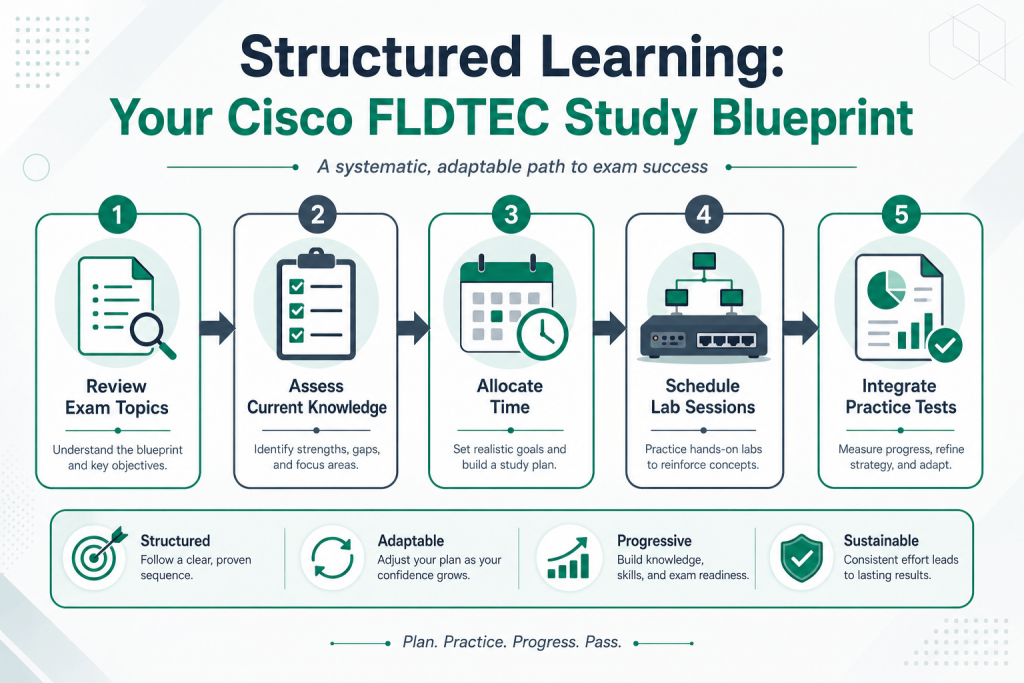
Establishing a Robust Study Plan
The foundation of successful exam preparation is a clear, achievable study plan. This plan should outline what topics you will cover, which resources you will use, and how much time you will dedicate to each area. Given the hands-on nature of the 800-150 FLDTEC, your plan must integrate both theoretical learning and extensive lab practice.
- Review the Exam Topics: Start by thoroughly examining the official 800-150 FLDTEC exam topics provided by Cisco. This blueprint is your primary guide for what to study.
- Assess Current Knowledge: Take a diagnostic test or attempt some sample questions to identify your strengths and weaknesses. This will help you allocate study time more efficiently.
- Allocate Time for Each Domain: Based on the exam topics and your assessment, assign specific time blocks to each major knowledge domain. Ensure more time is given to areas where you are less proficient or which carry higher weight.
- Schedule Regular Lab Sessions: Integrate dedicated time for hands-on practice with network equipment or simulators. This is non-negotiable for the FLDTEC exam.
- Incorporate Review and Practice Tests: Schedule regular review sessions and practice tests to reinforce learning and gauge your readiness.
Remember that consistency is key. Even short, focused study sessions are more effective than sporadic, marathon cramming. Adjust your plan as you progress, adapting to your learning pace and evolving understanding of the material.
Selecting Optimal Preparation Materials
Choosing the right study resources is critical for effective 800-150 FLDTEC preparation. With a plethora of options available, discerning between high-quality, relevant materials and those that may lead you astray is essential. Your chosen resources should align with the official exam objectives and cater to both theoretical understanding and practical skill development.
- Official Cisco Documentation: Cisco’s own technical documentation, whitepapers, and guides are invaluable for deep dives into specific technologies and devices.
- Cisco Learning Network: This platform offers study groups, webinars, and potentially official training courses or learning paths specifically for Cisco 800-150 FLDTEC.
- Reputable Certification Study Guides: Look for books or online courses from recognized authors or training providers that are specifically designed for the 800-150 FLDTEC exam.
- Hands-on Lab Environments: Invest in or gain access to physical lab equipment, Cisco Packet Tracer, or virtual lab platforms like GNS3 for essential practical experience.
- Practice Questions and Exams: Utilize reliable practice tests to simulate the exam environment and identify areas needing further study. High-quality resources offering valuable practice questions can significantly boost your confidence.
Diversifying your study materials ensures a well-rounded understanding. Combining official resources with third-party guides and extensive lab work provides the best chance for comprehensive preparation. Always cross-reference information to ensure accuracy and alignment with Cisco’s current standards.
Leveraging Effective Study Resources for Cisco FLDTEC
Beyond simply acquiring study materials, the way you leverage them profoundly impacts your preparation for the Cisco 800-150 FLDTEC exam. Smart utilization of resources can transform passive learning into active retention and practical skill development, which is paramount for this field-focused certification. Developing strategies for engaging with each type of resource will make your study time more productive and targeted.
The goal is not just to consume information but to internalize it and be able to apply it under pressure. This means actively reading, practicing, and self-testing. For a certification like 800-150 FLDTEC, which assesses real-world readiness, merely reading about a topic isn’t enough; you must be able to perform the related tasks. Therefore, your approach to using each study tool should emphasize practical application and critical thinking.
Utilizing Cisco’s Official Resources
Cisco provides a wealth of official resources that are tailored to their certifications, offering the most accurate and up-to-date information for the 800-150 FLDTEC exam. These resources are designed to align directly with the exam objectives and are indispensable for any serious candidate. Engaging with these materials should be a cornerstone of your study plan.
- Official Exam Page: The official certification details page for the Cisco 800-150 FLDTEC exam provides the most authoritative information regarding exam topics, target audience, and general structure. This should be your first point of reference.
- Cisco Documentation: Delve into Cisco’s extensive online documentation for specific device configurations, troubleshooting guides, and technology explanations. These provide the granular detail often required to answer complex questions.
- Cisco Learning Network (CLN): The CLN is a community-driven platform where you can find study groups, expert discussions, and official study materials, including video series or practice labs that Cisco may offer.
When using these resources, focus on understanding the underlying principles and the ‘why’ behind specific commands or procedures, rather than just memorizing them. Active participation in CLN forums can also clarify doubts and provide alternative perspectives on challenging topics.
Harnessing Practice Exams and Labs
For an exam like the 800-150 FLDTEC, which heavily emphasizes practical application, practice exams and hands-on labs are not merely supplementary; they are foundational to success. These tools allow you to simulate the exam environment, identify knowledge gaps, and develop the muscle memory required for efficient troubleshooting and configuration.
- Simulated Exam Environment: Practice tests offer a close approximation of the actual exam experience, helping you manage time, reduce anxiety, and become familiar with the question formats. Regularly taking these tests under timed conditions is crucial.
- Identifying Weak Areas: Analyzing your performance on practice exams helps pinpoint specific topics where your understanding is lacking, enabling targeted review and more efficient study.
- Hands-on Skill Development: Utilizing lab environments, whether virtual or physical, is essential for translating theoretical knowledge into practical competence. Focus on configuring devices, performing diagnostic commands, and systematically troubleshooting various network issues.
When engaging in labs, don’t just follow instructions. Experiment, break things, and then fix them. This iterative process of discovery and problem-solving is invaluable for developing the intuition of a skilled field technician. Review the explanations for incorrect answers thoroughly, as these often contain critical insights.
The Value Proposition of Cisco FLDTEC Certification
Beyond merely passing an exam, the Cisco 800-150 FLDTEC certification offers a significant return on investment for an individual’s career and for the organizations that employ them. Understanding this value proposition can serve as a powerful motivator, reinforcing why the effort expended in preparation is ultimately worthwhile. The credential signifies not just knowledge, but a validated capability to perform critical on-site network tasks.
In a competitive job market, certifications act as a clear signal of expertise and dedication. For field technicians, the 800-150 FLDTEC badge provides tangible proof of their ability to handle the complexities of Cisco equipment in real-world scenarios. This can lead to enhanced job security, better career opportunities, and often, improved compensation. The benefits extend beyond the individual, impacting team efficiency and overall business success.
Enhancing Career Progression and Employability
Possessing the Cisco 800-150 FLDTEC certification significantly boosts a field technician’s career trajectory and marketability. Employers actively seek candidates who hold recognized industry certifications, as they provide a reliable benchmark of skills and commitment to professional development. The FLDTEC credential specifically signals a technician’s readiness for critical, on-site roles.
- Increased Job Opportunities: Many job descriptions for field technician roles either require or highly prefer candidates with relevant Cisco certifications. This broadens the scope of potential employers and positions available.
- Career Advancement: Certification often serves as a prerequisite or a strong advantage for moving into more senior technician roles, supervisory positions, or even into specialized network engineering tracks.
- Competitive Edge: In a pool of equally experienced candidates, the certified professional often stands out, demonstrating a proactive approach to skill validation and continuous learning.
- Higher Earning Potential: Certified IT professionals generally command higher salaries due to their validated expertise and the value they bring to an organization.
The FLDTEC certification is an investment in your professional future, providing a clear path for growth and recognition within the challenging yet rewarding field of network infrastructure support. It opens doors to roles that demand a higher level of technical proficiency and problem-solving capability.
Driving Operational Efficiency and Reliability
The benefits of a certified Cisco Field Technician extend directly to an organization’s operational efficiency and network reliability. Technicians who have successfully passed the 800-150 FLDTEC exam are equipped with standardized, validated skills that translate into more accurate installations, faster troubleshooting, and reduced network downtime. This directly impacts the bottom line and customer satisfaction.
- Reduced Downtime: Certified technicians can diagnose and resolve physical layer and basic configuration issues more quickly and effectively, minimizing costly service interruptions.
- Improved Installation Quality: Proper installation and cabling, as validated by FLDTEC, reduce the likelihood of future hardware-related issues, leading to a more stable network environment from the outset.
- Standardized Best Practices: The certification ensures adherence to Cisco’s recommended practices, leading to more consistent and reliable operations across different sites and projects.
- Enhanced Customer Satisfaction: Efficient and competent on-site support directly contributes to a positive customer experience, strengthening client relationships and company reputation.
Investing in Cisco 800-150 FLDTEC certified personnel is an investment in operational excellence. These professionals are not just fixing problems; they are actively contributing to a more robust, reliable, and efficient network infrastructure, which is vital for any modern business.
Building a Practical Study Schedule for 800-150 FLDTEC
Creating a study schedule that is both realistic and effective is paramount for passing the Cisco 800-150 FLDTEC exam, especially when juggling other commitments. A practical schedule goes beyond simply listing topics; it involves strategic time allocation, realistic goal setting, and flexibility. The objective is to sustain consistent progress without leading to burnout, ensuring that the extensive material is covered thoroughly.
The intensity of the 800-150 FLDTEC curriculum, particularly its emphasis on hands-on skills, necessitates a schedule that integrates various learning methods. By carefully planning your week, you can ensure adequate time for theoretical study, lab practice, review, and even breaks. This balanced approach helps solidify knowledge and prevents information overload, making your preparation journey smoother and more productive.
Optimizing Your Daily and Weekly Routine
Integrating study into your daily and weekly routine requires careful planning and discipline. The key is to find patterns and dedicate specific, consistent blocks of time for your Cisco 800-150 FLDTEC preparation, treating them as non-negotiable appointments. This consistency builds momentum and ensures continuous progress.
- Identify Peak Learning Times: Determine when you are most alert and productive – whether early morning, late evening, or during lunch breaks – and schedule your most challenging study tasks for these periods.
- Break Down Sessions: Instead of long, exhausting study blocks, opt for shorter, more frequent sessions (e.g., 60-90 minutes). This improves focus and retention.
- Allocate Dedicated Lab Time: Crucially, set aside specific hours each week solely for hands-on lab practice. This is where theoretical knowledge transforms into practical skill.
- Incorporate Review: Schedule short review periods at the end of each day or week to revisit concepts and identify any areas that need reinforcement.
- Plan for Breaks: Regular short breaks during study sessions, and longer breaks on weekends, are essential to prevent fatigue and maintain mental sharpness.
Be realistic about how much you can accomplish each day. Overambitious schedules often lead to demotivation. Start with what’s manageable and gradually increase the intensity as you build stamina and confidence. Consistency trumps intensity in the long run.
Tracking Progress and Adjusting Your Strategy
A static study plan, without any mechanism for monitoring progress or adapting to challenges, is unlikely to be effective for the 800-150 FLDTEC exam. Regularly tracking your learning and being willing to adjust your strategy based on feedback is vital for staying on course and addressing difficulties proactively. This iterative process ensures your efforts remain targeted and efficient.
- Use a Study Tracker: Employ a spreadsheet, app, or even a physical notebook to log the topics you’ve covered, the time spent, and your confidence level in each area.
- Regular Self-Assessment: Periodically take practice quizzes or review questions to assess your understanding. Don’t wait until the full practice exam to test yourself.
- Analyze Practice Exam Results: After each full practice test, thoroughly review both correct and incorrect answers. Understand *why* an answer was right or wrong. This is where significant learning occurs.
- Re-prioritize Weak Areas: If certain topics consistently appear as weaknesses, reallocate more study time and find alternative resources to tackle them.
- Seek Feedback: If possible, discuss challenging topics with peers or mentors. Explaining concepts to others can also expose gaps in your own understanding.
Flexibility is key. Life happens, and sometimes you’ll fall behind schedule. Instead of getting discouraged, simply adjust your plan. The goal is continuous improvement, not rigid adherence to an initial timeline. This iterative approach allows you to optimize your learning journey for the Cisco Field Technician certification.
Mastering Field Technician Skills: Applying Concepts
The true measure of a Cisco 800-150 FLDTEC certified professional lies in their ability to apply theoretical knowledge to practical field scenarios. Mastery isn’t just about knowing commands; it’s about understanding when and why to use them, diagnosing problems systematically, and executing solutions efficiently. This section delves into strategies for cultivating the practical skills that are indispensable for success in the exam and in the field.
Successful field technicians are problem-solvers, often under pressure and with limited resources. The 800-150 FLDTEC exam aims to validate this capability. Therefore, your preparation must extend beyond passive learning to active engagement with simulated and real-world network environments. Developing a strong troubleshooting methodology and refining hands-on execution are critical components of this mastery.
Developing a Systematic Troubleshooting Methodology
Effective troubleshooting is perhaps the most critical skill for a field technician, and the Cisco 800-150 FLDTEC exam will heavily test this ability. A systematic approach prevents haphazard efforts and ensures that problems are diagnosed and resolved efficiently. Without a clear methodology, even knowledgeable technicians can become overwhelmed by complex issues.
- Define the Problem: Clearly understand the reported issue. Gather as much information as possible: what’s working, what’s not, when did it start, what changed?
- Gather Information: Use diagnostic tools and commands (e.g., show interfaces, ping, traceroute, show version) to collect data about the network’s current state.
- Formulate Hypotheses: Based on the gathered information, propose potential causes for the problem. Start with the simplest and most common possibilities.
- Test Hypotheses: Execute tests to confirm or deny your hypotheses. This might involve isolating components, checking physical connections, or adjusting configurations.
- Implement a Solution: Once the root cause is identified, apply the appropriate fix. Always have a rollback plan in case the solution introduces new issues.
- Verify Functionality: After implementing the solution, thoroughly test to ensure the problem is resolved and no new issues have arisen.
- Document Findings: Record the problem, troubleshooting steps, and solution for future reference and knowledge sharing.
Practicing this methodology repeatedly in lab environments, with various simulated faults, will engrain it into your problem-solving toolkit. This structured thinking is what differentiates a truly competent field technician.
Refining Practical Execution and Command Proficiency
While a troubleshooting methodology provides the roadmap, precise and efficient execution is what brings solutions to life. For the Cisco 800-150 FLDTEC exam, this translates to knowing which commands to use, their correct syntax, and how to interpret their output quickly and accurately. This proficiency only comes with extensive hands-on practice.
- Command Syntax Mastery: Practice common Cisco IOS commands related to interfaces, IP addressing, VLANs, basic routing, and device management until their syntax becomes second nature.
- Output Interpretation: Learn to quickly read and understand the output of various show commands. Identify key indicators of status, errors, and configuration details.
- Cable Management Skills: Practice proper cabling techniques, including identifying different cable types, connectors, and their uses, and ensuring correct termination.
- Physical Device Handling: Become familiar with physical installation, removal, and maintenance procedures for common Cisco devices (routers, switches, access points). This includes understanding safety protocols.
- Configuration Management: Practice saving configurations, backing them up, and restoring them. Understand the differences between running and startup configurations.
Regular, deliberate practice in a lab environment is indispensable. Time yourself during exercises to improve efficiency. The more you work with actual or simulated Cisco equipment, the more intuitive these tasks will become, greatly reducing exam day stress and improving your chances of success.
Navigating the Assessment: Exam Day Strategies
The culmination of your dedicated study for the Cisco 800-150 FLDTEC exam is the assessment itself. Even with thorough preparation, exam day pressure can sometimes hinder performance. Employing effective strategies during the test can help you manage anxiety, allocate time wisely, and maximize your score. Knowing how to approach different question types and maintain focus is just as important as the knowledge you’ve acquired.
A successful exam experience is not solely dependent on what you know, but also on how well you perform under test conditions. Strategic thinking, efficient time management, and a calm demeanor are critical for translating your study efforts into a passing grade. Preparing for the exam environment itself is an often-overlooked but crucial component of a comprehensive study plan.
Managing Time and Question Types Effectively
One of the most common challenges on any certification exam, including the 800-150 FLDTEC, is effective time management. Each question type may require a different approach and allocation of time. Developing a strategy to navigate these variations efficiently can significantly impact your overall score.
- Pace Yourself: Before starting, quickly scan the total number of questions and the allotted time to get a rough idea of how much time you can spend per question. Avoid dwelling too long on a single difficult question.
- Identify Question Types: Be prepared for multiple-choice (single and multiple answer), drag-and-drop, fill-in-the-blank, and potentially simulation or simlet questions. Each requires a slightly different mental approach.
- Prioritize Knowns: Answer all questions you are confident about first. Mark difficult questions for review if the exam platform allows, and return to them later with remaining time.
- Read Carefully: Pay close attention to keywords like “NOT,” “ALL,” “EXCEPT,” or “LEAST.” These words can completely change the meaning of a question. Also, note if multiple answers are required.
Approach Simulations Methodically: If the exam includes simulations, treat them as mini-labs. Follow a systematic troubleshooting or configuration process, just as you would in real life.
Practice tests are excellent for refining your time management skills. They help you gauge your speed and build stamina for the duration of the actual exam. Learn when to move on and when to commit more time to a particular problem.
Maintaining Focus and Confidence During the Exam
Exam day can be a high-pressure situation, and maintaining focus and confidence is crucial for performing at your best on the Cisco 800-150 FLDTEC. Anxiety can cloud judgment and lead to mistakes that are otherwise avoidable. Developing mental strategies to stay calm and concentrated will serve you well.
- Get Adequate Rest: Ensure you get a good night’s sleep before the exam. A well-rested mind is more alert and capable of critical thinking.
- Arrive Early: Plan to arrive at the testing center well in advance. This allows time for check-in procedures, reduces rushed feelings, and lets you settle in calmly.
- Deep Breathing Techniques: If you feel overwhelmed or stressed during the exam, take a few slow, deep breaths. This can help clear your mind and reduce physical tension.
- Positive Self-Talk: Replace negative thoughts with positive affirmations. Remind yourself of the hard work you’ve put in and your capabilities.
Don’t Panic on Difficult Questions: Encountering a tough question is normal. Take a moment, re-read it, and if still stumped, mark it and move on. Returning later with a fresh perspective often helps.
Trust in your preparation. You’ve dedicated time and effort to mastering the Cisco Field Technician skills. Approach the exam with a confident mindset, knowing that you have equipped yourself with the knowledge and strategies to succeed.
Maintaining Momentum and Motivation: Long-Term Study Tips
The journey to Cisco 800-150 FLDTEC certification is often a marathon, not a sprint. Sustaining motivation and maintaining momentum over an extended study period can be challenging, but it’s essential for achieving your goals. Implementing long-term strategies for engagement and continuous learning will help you navigate plateaus and setbacks, ensuring you stay committed until you reach certification.
A consistent study routine, coupled with a proactive approach to staying engaged, is critical for any long-term learning endeavor. For the 800-150 FLDTEC, this means finding ways to keep the material interesting and relevant, celebrating small victories, and building a supportive environment. It’s about cultivating habits that foster continuous growth rather than just temporary bursts of effort.
Setting Realistic Goals and Celebrating Milestones
Breaking down the daunting task of preparing for the 800-150 FLDTEC exam into smaller, manageable goals is a powerful motivational tool. Celebrating each milestone, no matter how small, reinforces positive study habits and provides the encouragement needed to push forward. Unrealistic expectations, conversely, can quickly lead to frustration and a loss of momentum.
- Define Micro-Goals: Instead of “pass the exam,” set goals like “complete Chapter 3 this week,” “master VLAN configurations by Friday,” or “score 70% on a specific practice quiz.”
- Track Progress Visually: Use a whiteboard, a spreadsheet, or a project management app to visually track your completed tasks and achieved milestones. Seeing your progress can be highly motivating.
- Reward Yourself: When you hit a milestone, give yourself a small, non-study-related reward. This could be an hour of gaming, a favorite meal, or a short break to do something you enjoy.
- Be Flexible with Deadlines: While deadlines are important, be prepared to adjust them if unexpected events occur. The goal is completion, not perfect adherence to an initial timeline.
Focus on consistent, incremental progress rather than perfection. Each small step completed contributes to the larger objective, and acknowledging these achievements helps build the confidence and resilience required for the entire certification journey.
Building a Supportive Study Environment and Community
Studying in isolation can be demotivating, especially when encountering difficult concepts or experiencing setbacks. Building a supportive environment, whether through peer groups or online communities, can provide invaluable encouragement, diverse perspectives, and accountability. This collaborative approach enhances the learning experience for the Cisco 800-150 FLDTEC.
- Join Study Groups: Connect with other candidates preparing for the 800-150 FLDTEC. Discussing topics, explaining concepts to others, and working through problems together can deepen your understanding.
- Utilize Online Forums: Platforms like the Cisco Learning Network or various Reddit communities offer spaces to ask questions, share insights, and learn from experienced professionals.
- Find a Study Partner: A dedicated study partner can provide accountability, motivation, and a sounding board for challenging concepts.
- Communicate Your Goals: Inform family and friends about your certification goals. Their understanding and support can create a conducive study atmosphere at home.
Leveraging a community can provide a sense of shared purpose and access to a wider pool of knowledge. When you encounter a challenging problem, knowing you can turn to others for help or different viewpoints can prevent frustration and keep your motivation high. Moreover, teaching others what you’ve learned is a highly effective way to solidify your own knowledge.
Post-Certification Growth: What Comes Next?
Achieving the Cisco 800-150 FLDTEC certification is a significant accomplishment, but it marks a new beginning rather than an endpoint. The field of IT and networking is constantly evolving, requiring continuous learning and adaptation. Post-certification, strategic planning for further skill development and career advancement becomes crucial, ensuring the credential remains relevant and valuable throughout your professional journey.
The FLDTEC certification opens doors to new opportunities, but how you leverage it will define your long-term success. This involves exploring advanced certifications, specializing in niche areas, and committing to lifelong learning. Maintaining a proactive approach to professional development will ensure you remain a valuable asset in the rapidly changing technological landscape.

Advancing Your Cisco Certification Path
The Cisco 800-150 FLDTEC certification is an excellent entry point into Cisco’s broader certification landscape. Once you’ve solidified your field technician skills, consider exploring subsequent certifications that build upon this foundation and open up more advanced career opportunities. Cisco offers structured paths tailored for various specializations.
- CCNA (Cisco Certified Network Associate): Often the next logical step, CCNA provides a comprehensive understanding of networking fundamentals, including routing, switching, security, and wireless. It broadens your scope beyond just field operations.
- Specialist Certifications: Cisco offers various specialist certifications in areas like security, collaboration, or data center. Depending on your career aspirations, a specialist certification can provide deep expertise in a particular technology.
- Professional-Level Certifications (CCNP): For those aiming for senior network engineering roles, CCNP (Cisco Certified Network Professional) certifications offer advanced knowledge and skills in enterprise networking.
Mapping out a certification roadmap allows you to strategically plan your learning and gain credentials that progressively enhance your expertise. Each new certification builds on the previous one, creating a powerful portfolio of validated skills. Regularly check the official Cisco website for the latest certification paths and updates to ensure your planning remains current.
Committing to Lifelong Learning and Skill Development
The technology industry is characterized by rapid change, making a commitment to lifelong learning indispensable for any IT professional. For a Cisco Field Technician, staying current with new hardware, software releases, and evolving best practices is not just beneficial—it’s essential for maintaining competence and relevance. Your 800-150 FLDTEC certification is a foundation, not the entire structure.
- Stay Updated with Cisco Technologies: Regularly read Cisco blogs, whitepapers, and product announcements. Understand new features, end-of-life notices, and security advisories relevant to the equipment you manage.
- Participate in Industry Forums: Engage with professional communities, attend webinars, and subscribe to newsletters related to networking and field services.
- Continuous Hands-on Practice: Even after certification, continue to practice with lab environments. Experiment with new configurations, troubleshoot novel problems, and explore unfamiliar features.
- Seek New Challenges: Volunteer for new projects or take on tasks that push you beyond your comfort zone. Practical experience with new technologies is the best way to learn and grow.
Lifelong learning ensures that your skills remain sharp, your knowledge base expands, and you continue to add value to your organization. The 800-150 FLDTEC certification is a testament to your current abilities, but ongoing professional development guarantees your future success in the dynamic world of IT.
The journey to earning your Cisco 800-150 FLDTEC certification can be challenging, but it is undoubtedly a rewarding investment in your career as a field technician. By understanding the common struggles, adopting a structured preparation strategy, and leveraging effective study materials, you can transform perceived hurdles into stepping stones for success. The practical skills and validated expertise gained will not only help you pass the exam but also enhance your ability to deliver efficient and reliable network support in real-world scenarios.
Don’t let past struggles define your future success. Take control of your preparation journey today by implementing these strategies. Embrace the challenge, commit to a consistent study routine, and utilize high-quality resources to build your confidence and competence. For further assistance and to access effective learning tools that can help you master the Cisco 800-150 FLDTEC content, begin your structured preparation now and solidify your expertise.
Frequently Asked Questions
1. What does the Cisco 800-150 FLDTEC certification validate?
The Cisco 800-150 FLDTEC certification validates the skills of field technicians in installing, replacing, configuring, and troubleshooting Cisco network devices and systems in customer environments.
2. Who is the target audience for the Cisco 800-150 FLDTEC exam?
This certification is primarily for field technicians, network support specialists, and other IT professionals responsible for on-site hardware installation, maintenance, and basic troubleshooting of Cisco equipment.
3. What kind of preparation is most effective for the 800-150 FLDTEC exam?
Effective preparation includes a combination of theoretical study from official Cisco documentation and reputable guides, extensive hands-on lab practice with Cisco equipment or simulators, and regular use of practice exams to test knowledge and timing.
4. How long does it typically take to prepare for the Cisco 800-150 FLDTEC exam?
The preparation time varies depending on an individual’s existing knowledge and hands-on experience, but typically ranges from several weeks to a few months of dedicated study and practice.
5. What are the career benefits of earning the Cisco 800-150 FLDTEC certification?
Earning the Cisco 800-150 FLDTEC certification enhances employability, provides a competitive edge in the job market, can lead to career advancement opportunities, and often results in higher earning potential due to validated specialized skills.


