The passing score for 100-150 is not a fixed number. The Cisco Certified Support Technician (CCST) Networking exam runs 40 to 50 questions in 50 minutes, costs $125 USD, is booked through Pearson VUE, and is offered in seven languages. Six sections cover it, from the OSI model through to configuring basic wireless security.
One detail on the specification is worth pausing over. The passing score is not a fixed number. It is variable, published as roughly 750 to 850 out of 1000, which means the question every candidate asks first has no single answer. Alongside that, this supposedly entry-level paper names Wireshark as an examinable tool, lists eleven show commands individually, and expects you to check connectivity on five different client operating systems. It is more hands-on than its tier suggests, and this article works through what that means.
What Does the CCST Networking Credential Prove?
It proves you understand how networks operate at the level a support technician needs: the devices, the media, the protocols, and the diagnostic routine when something stops working. Cisco positions it as validating entry-level networking concepts, and the roles it points at are network support technician, entry-level help desk, and IT support specialist.
The word entry-level is doing real work in that description, but it does not mean theoretical. The syllabus asks you to attach cables from a network diagram, read the status lights on a Cisco device, run a packet capture, and interpret the output of half a dozen diagnostic commands. It is a practical credential aimed at someone who will be standing in front of the equipment.
What makes it different from a vendor-neutral entry credential
Roughly two thirds of the syllabus is vendor-neutral networking. The remaining third is specifically Cisco: device ports and status lights, privilege levels, the show command set, and cloud-managed Meraki as a device access method. That mix is deliberate, because it is what an entry-level technician in a Cisco shop actually touches.
Is CCST Networking Worth Taking Before CCNA?
Cisco itself answers this: the exam is described on its official page as a first step toward CCNA certification. CCST Networking is not a prerequisite and does not earn credit toward CCNA, but it covers the same territory at a shallower depth, so it works as a staging post for someone with no networking background. Support technicians drawn to AI rather than routing can also look at the AI technical practitioner certification, which is built the same way as an entry step.
The honest calculation is about time and confidence rather than credentials. CCNA is a substantial exam that assumes real familiarity. Someone moving into networking from a help desk role can sit CCST Networking within a few months, get a certification that hiring managers recognise, and then take CCNA from a much stronger base.
When to skip it
If you already subnet comfortably, know the difference between a layer 2 and a layer 3 switch, and have used show commands in anger, this exam will not teach you anything. Go straight to CCNA. The credential’s value is concentrated almost entirely in the career-changer case.
Cisco’s own CCST Networking exam page sets out the pathway alongside the exam logistics.
What Do the Six Exam Sections Cover?
Standards and concepts, addressing and subnet formats, endpoints and media types, infrastructure, diagnosing problems, and security. No percentage weightings are published, so all six have to be treated as equally examinable across the 40 to 50 questions on the paper.
| Section | What it covers |
|---|---|
| Standards and Concepts | TCP/IP and OSI models, frames and packets, bandwidth against throughput, network types and topologies, cloud against on-premises, common protocols |
| Addressing and Subnet Formats | Private against public addressing and NAT, IPv4 subnetting and slash notation, IPv6 addresses and prefixes |
| Endpoints and Media Types | Cables and connectors, Wi-Fi against cellular against wired, endpoint devices, checking connectivity on five client operating systems |
| Infrastructure | Cisco device status lights and ports, cabling from a diagram, basic routing and switching concepts |
| Diagnosing Problems | Troubleshooting methodology and help desk practice, packet capture with Wireshark, diagnostic commands, device access methods, show commands |
| Security | How firewalls filter traffic, foundational security concepts, configuring basic wireless security |
With no weightings to steer revision, the practical calibration is question exposure, which is what the CCST Networking practice exam is for. It also gives you a feel for how deep each section actually goes, which the objective list alone does not.
How Much Subnetting Does 100-150 Expect?
Enough to read an address and say what network it belongs to. The objectives name subnet concepts, a subnet calculator, slash notation, subnet masks, and broadcast domains for IPv4, plus address types and prefix concepts for IPv6. What they do not name is designing an addressing scheme from scratch.
That distinction sets the bar usefully. You should be able to look at 192.168.10.37/26 and know the network address, the broadcast address, and the usable range. You are not being asked to plan a VLSM scheme across a campus, which is CCNA territory.
IPv6 gets less depth than IPv4
The IPv6 objective is a single line covering address types and prefix concepts, against several lines for IPv4. Learn the address types, understand what a prefix length means, and recognise the common notations. Do not sink a fortnight into IPv6 subnetting arithmetic for this exam.
NAT appears here too, listed under private against public addresses. Concept only: what NAT does, why private ranges exist, and what changes when a packet crosses that boundary.
Which Cables, Standards and Endpoints Are Named?
The syllabus is specific. Cable types are fiber, copper, and twisted pair. Connectors are coax, RJ-45, RJ-11, and fiber connector types. Wireless is 802.11 across the unlicensed 2.4GHz, 5GHz, and 6GHz bands, set against licensed cellular and against wired, with interference sources for each.
Endpoint devices are enumerated as well: Internet of Things devices, computers, mobile devices, IP phones, printers, and servers. The point of that list is that a support technician meets all of them, and each fails differently.
Five operating systems, one objective
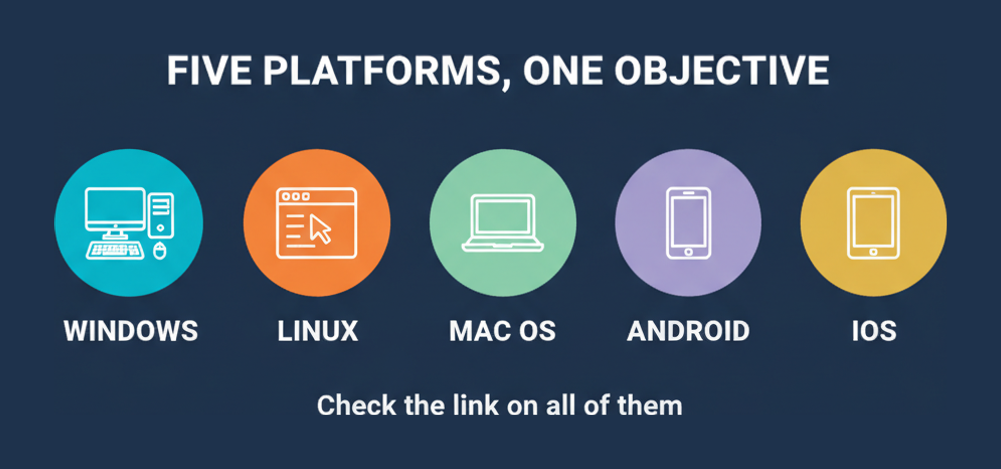
One objective in this section asks you to demonstrate how to set up and check network connectivity on Windows, Linux, macOS, Android, and Apple iOS. That is genuinely five platforms, with their own utilities and their own places to look for wireless client settings such as SSID, authentication method, and WPA mode.
For the wireless standards themselves, the Wi-Fi Alliance’s Wi-Fi standards overview covers the band and generation vocabulary the objective assumes without going deeper than this exam needs.
What Does the Infrastructure Section Ask You to Recognise?
Physical and logical fundamentals in roughly equal measure. On the physical side: identifying the status lights on a Cisco device when an engineer tells you what to look for, using a supplied network diagram to attach the right cables, and identifying ports including console, serial, fiber, Ethernet, SFP, USB and Power over Ethernet.
The framing of the status lights objective is worth noticing. It says “when given instruction by an engineer”, which tells you exactly what role this credential is written for: the person on site, on the phone to someone remote, reporting what they can see.
Basic routing and switching
The logical half covers default gateways, the difference between layer 2 and layer 3 switches, and local against remote networks on the routing side. On the switching side it covers MAC address tables, MAC address filtering, and VLANs. These are concept questions, not configuration questions.
Rack layout and power appear alongside cabling, which again reflects the on-site technician role. Knowing which cable goes where in a small topology is a genuinely examinable skill here.
Which Diagnostic Commands and Tools Appear?
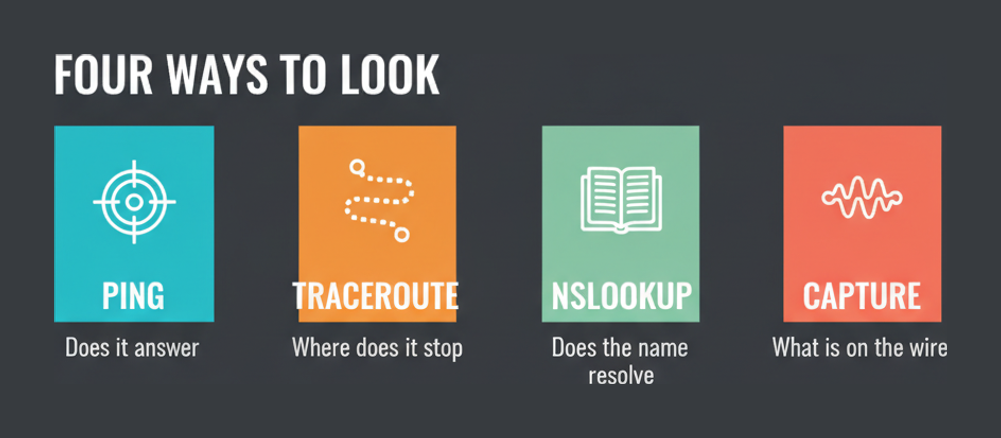
More than any other section names. Diagnostic commands are ping, ipconfig or ifconfig or ip, tracert or traceroute, and nslookup, with an explicit objective about recognising how a firewall can influence the result. Packet capture is examined through Wireshark specifically, including saving a capture to a file.
The show command list is enumerated in full: show run, show cdp neighbors, show ip interface brief, show ip route, show version, show inventory, show switch, show mac address-table, show interface, show interface x, and show interface status. Privilege levels, command help, and auto-complete sit alongside them.
Methodology counts as content
The first objective in this section is not technical at all. It covers troubleshooting methodology and help desk best practice: ticketing, accurate documentation, information gathering, policies and procedures, and prioritisation. Expect questions that describe a support scenario and ask what you do first.
How you reach the device
A separate objective covers the ways to access and collect data: RDP, SSH, telnet, VPN, terminal emulators, direct console, network management systems, cloud-managed networking through Meraki, and scripts. Knowing which one suits which situation, and which are safe over an untrusted network, is the testable part.
Because Wireshark is named by name, working through the Wireshark user guide is time well spent. So is understanding what a TCP conversation looks like on the wire, for which the current specification in IETF RFC 9293 is the primary source behind the TCP against UDP objective.
Candidates who want the common failure patterns before building a plan will find them collected in CiscoPrep’s 100-150 mistakes guide.
How Deep Does the Security Section Go?
Conceptual, with one configuration task. Three objectives: describing how firewalls filter traffic through blocked ports and protocols and deny or permit rules, describing foundational security concepts, and configuring basic wireless security. Nothing here requires a security background.
The foundational concepts objective is a vocabulary list as much as anything: confidentiality, integrity and availability; authentication, authorization and accounting; multifactor authentication; encryption, certificates and password complexity; identity stores such as Active Directory; and the common threat categories of spam, phishing, malware and denial of service.
The one hands-on item
Configuring basic wireless security is the only objective in this section that asks you to do something rather than describe it, and it pairs directly with the wireless client settings named back in the endpoints section. SSID, authentication method, and WPA mode appear in both places, which is a fair signal that they are worth knowing properly. The objective is scoped to a home router and names WPA, WPA2 and WPA3, along with the choice between Personal and Enterprise modes, so know what separates each generation and when Enterprise authentication is the right call.
Readers weighing this against Cisco’s security-flavoured entry credential will find that one covered in CiscoPrep’s CCST Cybersecurity overview, which is a separate exam at the same tier.
What Is the Exam Format, and Why Does the Pass Mark Move?
Between 40 and 50 questions in 50 minutes, at $125 USD, with a variable passing score published as roughly 750 to 850 out of 1000. Both the question count and the pass mark are ranges rather than fixed numbers, which is normal for exams assembled from a pool with scaled scoring.
| Specification | Detail |
|---|---|
| Exam name | Cisco Certified Support Technician (CCST) Networking |
| Exam number | 100-150 |
| Questions | 40 to 50 |
| Duration | 50 minutes |
| Passing score | Variable, approximately 750 to 850 of 1000 |
| Price | $125 USD |
| Languages | English, Arabic, Chinese, Spanish, French, Japanese, Portuguese |
| Registration | Pearson VUE |
What a scaled score actually means for you
Scaled scoring adjusts for the difficulty of the particular set of questions you were served, so two candidates answering the same number correctly can receive different scaled scores. The practical consequence is that you cannot aim for a specific number of correct answers. Aim for competence across all six sections instead, and treat any target percentage you read as approximate.
Fifty minutes across 45 questions is roughly 65 seconds each, which is brisk. That favours recall over reasoning, and it is the strongest argument for drilling the enumerated lists until they are automatic rather than working them out in the room.
How Should You Prepare With No Networking Background?
Build the vocabulary first and the hands-on skills second, because roughly half the paper tests whether you recognise a term and the other half tests whether you have used a tool. Cisco’s named preparation route is the Network Technician career path, which is aimed squarely at this credential.
- Start with the standards and concepts section and learn the two models, the network type acronyms, and the protocol list flatly, since these terms recur in every other section and nothing else makes sense without them.
- Work subnetting next until reading an address in slash notation is automatic, because at roughly 65 seconds per question there is no time to derive a subnet boundary during the exam.
- Install Wireshark and capture your own traffic, then save the file, because the objective names both the tool and the saving step and neither can be learned from reading about it.
- Run every named diagnostic command on your own machine across at least two operating systems, so that ping, traceroute and nslookup output is familiar rather than theoretical when a question shows it to you.
- Finish by drilling the eleven show commands and the security vocabulary as flashcards, since both are pure recall and both are exactly what a 65 second question budget rewards.
Cisco’s Network Technician career path covers the same ground in a structured order and is the route the exam page itself points at.
Frequently Asked Questions
How many questions are on the CCST Networking exam?
Between 40 and 50, with a 50 minute limit. That is roughly 65 seconds per question, which is brisk and rewards recall over working things out in the room.
What score do you need to pass 100-150?
There is no fixed number. The passing score is variable, published as approximately 750 to 850 out of 1000, because the exam uses scaled scoring to adjust for the difficulty of the questions served.
How much does the CCST Networking exam cost?
$125 USD, booked through Pearson VUE. Cisco’s own exam page confirms the same price, and the exam is offered in seven languages.
Is CCST Networking a prerequisite for CCNA?
No. Cisco describes it as a first step toward CCNA rather than a requirement, and it earns no credit toward that certification. It covers similar ground at a shallower depth.
Which languages is the exam available in?
Seven: English, Arabic, Chinese, Spanish, French, Japanese and Portuguese. That is unusually broad language coverage for an entry-level certification.
Does the exam really test Wireshark?
Yes. One objective names it directly and asks you to perform a packet capture and save it to a file, including understanding the purpose of a packet analyser and how to open a saved capture.
How much subnetting is required?
Enough to read addresses and prefixes confidently: subnet concepts, slash notation, subnet masks and broadcast domains for IPv4, plus address types and prefix concepts for IPv6. Designing an addressing scheme is not examined.
Which show commands are on the syllabus?
Eleven are named individually, including show run, show cdp neighbors, show ip interface brief, show ip route, show version, show inventory, show mac address-table and show interface status, plus privilege levels and command help.
Are section weightings published?
No. Six sections are listed with no percentages attached, so no section can safely be treated as low value. Even coverage is the only defensible strategy.
What roles does this certification target?
Network support technician, entry-level help desk technician, and IT support specialist. The objectives reflect that: attaching cables from a diagram, reading device status lights, and following help desk practice all appear.
Conclusion
CCST Networking is a genuine on-ramp rather than a token badge. It covers six sections with no published weightings, scales its pass mark rather than fixing it, and expects you to have actually run a packet capture and read a routing table rather than merely to have read about them.
Prepare it as vocabulary plus hands-on practice, in that order, and drill the enumerated lists until recall is instant, because 65 seconds a question does not leave room for derivation. Check the current objectives and question style on the money site before booking, then take CCNA from a much stronger position afterwards.


