
Most people book 400-007 believing it is a gate. Pass it, and you earn the right to attempt the practical that actually makes you a Cisco Certified Design Expert. That is true, and it is also only a third of what the sitting is worth. Cisco’s own exam page states that passing the CCDE written exam earns the Cisco Certified Specialist – Design Core credential outright, meets the core exam requirement for the full CCDE, and counts toward recertification.
Three outcomes, one paper, $400. That changes the cost-benefit calculation for a lot of senior engineers who had written the exam off as an expensive step toward something they were not planning to finish. The CCDE written exam runs 90 to 110 questions in 120 minutes across five weighted domains, and its pass mark is not a fixed number. This guide covers all five domains, the scoring, and who the paper is genuinely for.
What Does Passing 400-007 Actually Earn You?
Three things rather than one. Cisco states that passing 400-007 earns the Cisco Certified Specialist – Design Core credential in its own right, that it can be used to meet the core exam requirements for the Cisco Certified Design Expert certification, and that it can be used toward recertification goals. All three follow from the same sitting.
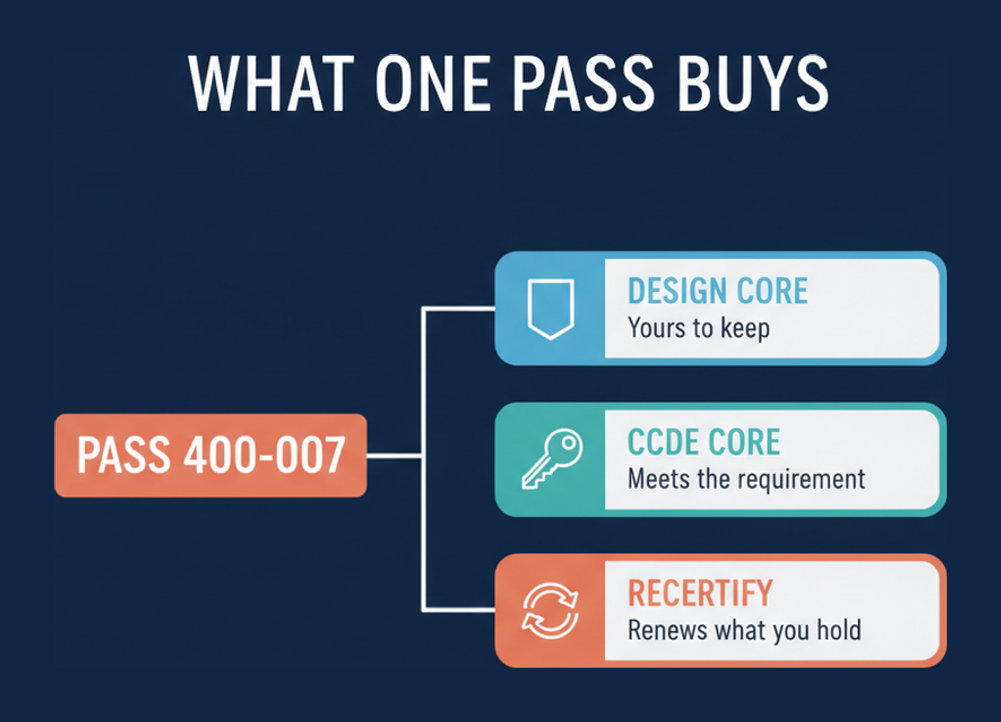
The specialist credential is the one most candidates do not realise they are buying. It is a standalone qualification that exists whether or not you ever attempt the practical, which means an engineer who passes the written and then changes direction still holds something demonstrable rather than a half-finished attempt at something else.
The recertification value is the quiet one
For anyone already holding a Cisco certification that needs renewing, the written exam does that job at the same time. That reframes the fee: it is not $400 spent on a gate, it is $400 spent on a specialist credential plus a recertification plus a core requirement, and the arithmetic only works out badly if you value none of the three.
Cisco’s own listing of how its credentials interlock sits in its certification catalogue, which is worth reading before booking, because the specialist tier is easy to overlook when the expert tier has the more famous name.
How Do the Five CCDE Domains Divide the Marks?
Network Design is the largest domain at 30 percent, followed by the combined control, data, management plane and operational design domain at 25. Business Strategy Design, Service Design and Security Design each carry 15 percent. The five weightings sum to 100, and the split tells you immediately that this is not a protocol exam.
| Domain | Weight | Approximate questions of 100 |
|---|---|---|
| Network Design | 30% | 30 |
| Control, data, management plane and operational design | 25% | 25 |
| Business Strategy Design | 15% | 15 |
| Service Design | 15% | 15 |
| Security Design | 15% | 15 |
Read the domain names again and notice what is missing. There is no configuration domain, no troubleshooting domain, and no protocol domain. Every one of the five is a design domain, and the word appears in all five titles. Whatever else 400-007 is, it is consistent about what it measures.
The other thing the table shows is that 45 percent of the paper sits outside pure network engineering. Business strategy, service design and security design together carry nearly half the marks, and only one of those three is a subject a senior network engineer necessarily works in every week.
What Is the CCDE Written Exam Format?
400-007 is 90 to 110 questions in 120 minutes at $400 USD, delivered through Pearson VUE in English. Cisco describes it as a two-hour multiple-choice test focused on core enterprise network architectures and technologies. The current version is CCDE v3.0, and Cisco Learning Credits can be used in place of the fee.
| Specification | Detail |
|---|---|
| Exam number | 400-007 |
| Version | CCDE v3.0 |
| Questions | 90 to 110 |
| Duration | 120 minutes |
| Passing score | Variable, approximately 750 to 850 out of 1000 |
| Price | $400 USD, or Cisco Learning Credits |
| Language | English |
| Delivery | Pearson VUE |
There is no published pass mark, and that is deliberate
The commonly quoted range of 750 to 850 out of 1000 is an approximation, not a Cisco figure. Cisco does not publish a cut score for this exam. A variable pass mark exists because the question count itself varies between 90 and 110, and because different forms of a paper are not equally difficult, so the standard is held constant by moving the score rather than the questions.
The practical consequence is that no percentage target is safe to aim at. You cannot plan to score 80 percent and assume that clears it. What you can do is remove weak domains entirely, which is the only strategy that works when the bar moves. Practising against the real question style is the fastest way to find those weak domains, and a set of CCDE sample questions will show you where the reasoning breaks down faster than reading will.
The clock is the other constraint. A hundred questions in 120 minutes is roughly 72 seconds each, and design questions are long. Expect scenarios with multiple constraints stated up front, which means reading speed and the ability to hold several requirements in mind at once are being tested alongside the design knowledge.
Why Is Network Design the Largest Domain?
Because it is the one that contains the actual job. At 30 percent, Network Design asks for resilient, scalable and secure modular networks across both traditional and software-defined architectures, considering technical constraints, operational constraints, application behaviour and needs, business requirements, implementation plans, and migration and transformation.
That single objective is written at a deliberately high level of abstraction, and the abstraction is the point. Cisco is not asking which protocol you would configure; it is asking which design satisfies six competing constraint sets at once, and what you would give up to satisfy them. That is a judgement question with defensible and indefensible answers rather than right and wrong ones.
Migration and transformation is the part people underprepare
The objective names implementation plans and migration and transformation explicitly, which means the exam cares about how you get from the network that exists to the network you designed. A design that is correct but unreachable from the current state is not a passing answer, and cutover sequencing, coexistence and rollback are legitimate examinable considerations.
Practically, this domain rewards experience over study more than any other on the paper. Someone who has run a real migration knows why the elegant design lost to the ugly one, and that instinct is difficult to acquire from a book. It is also why the credential is positioned where it is.
What Does the Control, Data and Management Plane Domain Test?
This 25 percent domain is where the concrete technology lives. It covers end-to-end IP traffic flow in a feature-rich network, data, control and management plane technologies, the choice between centralized, decentralized and hybrid control planes, automation and orchestration design, and software-defined architecture including SD-WAN, overlay, underlay and fabric.
The control plane placement question is the heart of it. Centralizing the control plane buys you consistency and a single point of policy, and costs you a dependency and a failure domain. Decentralizing does the reverse. Hybrid is the pragmatic answer that most real fabrics land on, and the exam expects you to be able to say why for a given set of constraints rather than to prefer one in general.
Automation appears as a design concern, not a scripting one
The objectives name interfacing with APIs, model-driven management, controller-based technologies, and evolution to a CI/CD framework. None of that asks you to write code. It asks whether your design can be operated by automation, which is a structural property: consistent naming, predictable topology, machine-readable state and an interface a controller can drive.
Model-driven management in particular has a specific meaning here, built on schema-defined configuration data rather than screen-scraped command line output. The protocol that established the approach is defined in RFC 6241 for NETCONF, and understanding what it changed about network operations is more useful for this exam than knowing any particular vendor’s implementation.
How Much Business Strategy Is on a Design Expert Exam?
Fifteen percent, which is roughly fifteen questions, and it is the domain most likely to be dismissed and then failed. It covers the impact of customer project management methodologies such as waterfall and agile on network design, implementation and optimization, and solutions based on business continuity and operational sustainability including RPO, ROI, CAPEX and OPEX cost analysis, and risk versus reward.
The methodology objective is more practical than it sounds. A design delivered into a waterfall programme is specified once and built to that specification; a design delivered into an agile one has to tolerate its requirements changing between increments. Those produce genuinely different architectures, and the exam asks you to notice that.
The financial vocabulary is examinable vocabulary
RPO, ROI, CAPEX and OPEX are named directly, so the exam expects you to use them correctly rather than approximately. Recovery point objective is how much data you can afford to lose, which is a different question from how long you can afford to be down. The capital versus operating expenditure distinction drives whether a design leans toward owned hardware or consumed service, and that is a design decision made on financial grounds.
This is the domain where a technically excellent candidate can genuinely lose the paper. Fifteen questions is enough to matter, the material is not difficult, and it is entirely learnable in a few evenings. Skipping it because it is not networking is the most avoidable mistake available on 400-007.
What Do Service Design and Security Design Ask For?
Together they carry 30 percent, and they approach the same network from two directions. Service Design asks how the IP network supports what runs on it: voice, video, backups, data centre replication, IoT and storage, plus cloud and hybrid solutions. Security Design asks how the network is segmented, controlled, observed and enforced.
The cloud objectives inside Service Design are the most specific in the whole syllabus. They name regulatory compliance, data governance covering sovereignty, ownership and locale, service placement, SaaS, PaaS and IaaS, and cloud connectivity including direct connect, cloud on ramp, MPLS direct connect and WAN integration. Data sovereignty in particular is a design constraint that overrides technical preference, because where data may legally reside is not negotiable by architecture.
Security Design is short and precise
Its objective names segmentation, network access control, visibility, policy enforcement, the CIA triad, and regulatory compliance where the regulation is provided. That last clause matters: the exam will give you the regulation rather than expecting you to have memorised legislation, so the skill being tested is applying a stated rule to a design rather than recalling the rule.
Visibility deserves attention because it is the objective most often treated as an afterthought. A design that cannot be observed cannot be operated or defended, and placing telemetry and inspection points is a design decision made at the same time as the topology rather than bolted on afterwards.
How Do You Study for an Exam With No Fixed Pass Mark?
You study for coverage rather than for a score, because a moving bar cannot be aimed at. The sequence below works from the largest domain outward, and it is deliberately ordered: the design judgement built in the first stage is what the later stages are applied to.
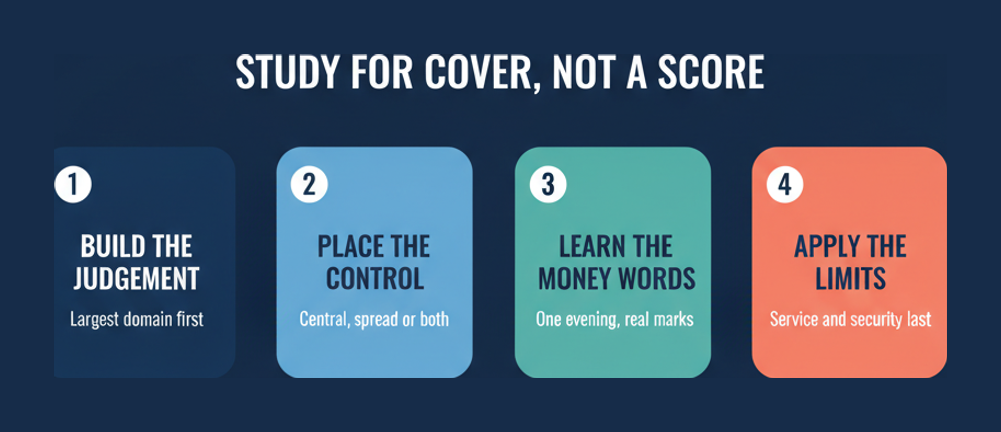
- Start with Network Design and work real scenarios where the constraints conflict, because at 30 percent it is the largest domain and the judgement it builds is what every other domain is then applied to.
- Move to the control, data and management plane domain next, deciding centralized against decentralized against hybrid for specific constraint sets rather than learning a preferred answer.
- Spend a deliberate evening on the business vocabulary of RPO, ROI, CAPEX and OPEX, since fifteen questions rest on terms that are quick to learn and expensive to guess at.
- Finish with service and security design together, working through the cloud connectivity options and the segmentation, access control, visibility and enforcement set as constraints on a design you have already drawn.
Layer timed practice over the whole sequence rather than saving it. Design scenarios are long, and 72 seconds per question means the reading has to be efficient. Cisco’s official cert guide for this exam is a reasonable spine for the theory, though the measured search demand around it is overwhelmingly for pirated copies, which is worth avoiding for the obvious reasons.
For a structured walkthrough of the exam topics themselves rather than the strategy, the site’s own 400-007 exam topics resource collects the material in one place, and it pairs well with sitting practice questions early rather than at the end.
Which Roles Does the CCDE Written Exam Actually Serve?
Cisco frames 400-007 around gathering and clarifying network functional requirements, designing networks to meet them, developing implementation plans, and conveying design decisions and their rationale. That last clause is the role definition: this is a credential for people who have to explain and defend a design to somebody else.
In practice that means network architects, senior design engineers, pre-sales and solution architects, consulting engineers, and senior operations staff moving from running networks to specifying them. The common factor is that the person is accountable for a decision rather than for a configuration.
The career case is reasonable rather than dramatic. Network architect roles sit meaningfully above senior engineer positions on published network architect salary data, and a design credential is one of the clearer ways to signal the transition. It is a signal rather than a qualification for the role, and it works best on a CV that already shows design work.
Where it fits worst is the engineer who wants a harder technical exam. There are better choices for that, because 400-007 deliberately avoids configuration depth. A fuller argument for what the credential does and does not do sits in this look at the value of CCDE certification.
Frequently Asked Questions
How many questions are on the CCDE written exam?
Between 90 and 110, in 120 minutes. The range is genuine rather than an estimate, and it is one reason the passing score is variable rather than fixed.
What is the passing score for CCDE 400-007?
Cisco does not publish one. It is variable, commonly approximated at 750 to 850 out of 1000, and no percentage target is safe to plan against.
How much does the CCDE written exam cost?
Four hundred US dollars, or the equivalent in Cisco Learning Credits. It is delivered through Pearson VUE and offered in English.
Does passing 400-007 give you a certification?
Yes. It earns the Cisco Certified Specialist – Design Core credential outright, meets the core exam requirement for the full CCDE, and counts toward recertification.
Which CCDE domain is the largest?
Network Design at 30 percent, roughly 30 questions. It asks for resilient, scalable and secure modular designs across traditional and software-defined architectures under six constraint sets.
Is the CCDE written exam a configuration exam?
No. All five domains are design domains and the word appears in every title. There is no configuration domain, no troubleshooting domain and no protocol domain on the blueprint.
Does CCDE cover cloud?
Yes, inside Service Design. The objectives name data sovereignty, service placement, SaaS, PaaS and IaaS, direct connect, cloud on ramp, MPLS direct connect and WAN integration.
How much business content is on the exam?
Fifteen percent, covering waterfall and agile methodologies, business continuity, RPO, ROI, and CAPEX versus OPEX analysis. It is the domain technical candidates most often skip.
What version is the current CCDE written exam?
CCDE v3.0, as stated on Cisco’s own exam page for 400-007. That is the version a candidate books against today.
Who should take the CCDE written exam?
Network architects, senior design engineers, solution and consulting architects, and operations staff moving into design. The common factor is accountability for a decision rather than a configuration.
Conclusion
400-007 is a design exam that pays out three times: a specialist credential in its own right, the core requirement for the full CCDE, and recertification. Ninety to 110 questions, 120 minutes, $400, English, CCDE v3.0, and a variable pass mark that Cisco does not publish.
Because the bar moves, study for coverage rather than a score. Build the Network Design judgement first at 30 percent, work the control plane placement decisions second, spend one deliberate evening on the business vocabulary that fifteen questions rest on, and finish with service and security design as constraints on a design you have already drawn. The specification is on Cisco’s own 400-007 exam page, and it is worth reading before booking rather than after.


