One fifth of this exam asks you to build things that did not appear on any Cisco core exam a short while ago. AI in Automation is a full 20 percent domain on 350-901, and it does not stop at describing benefits and risks. It asks you to construct an MCP server in Python and a conversational agent that drives network automation through a language model.
That domain is the clearest signal of what AUTOCOR is: the core exam of Cisco’s Automation track, built around Ansible, Terraform, RESTCONF, Python, GitLab pipelines and now AI tooling, rather than around the application development syllabus that used to sit on this exam number. Candidates who want the AI material on its own can start with the Cisco AI Technical Practitioner, a 60 minute exam with no routing content.
Table of Contents
- What does 350-901 AUTOCOR certify?
- How is the AUTOCOR exam delivered and scored?
- How are the four domains weighted?
- Why does Infrastructure as Code carry as much weight as Network Automation?
- AI in Automation is 20 percent, and it is not theory
- What happened to DEVCOR on this exam number?
- How does the CCNP Automation track fit together?
- How should you prepare for AUTOCOR?
- Frequently Asked Questions
- Conclusion
What does 350-901 AUTOCOR certify?
350-901 AUTOCOR certifies that you can design, deploy and manage network automation systems on Cisco platforms, covering infrastructure as code, operations and AI in automation. Cisco states on its official AUTOCOR exam page that passing it earns the Cisco Certified Automation Specialist Core certification in its own right, and that it satisfies the core requirement for both CCNP Automation and CCIE Automation.
The technologies in scope are broad and specifically named: Cisco IOS XE, Cisco ACI, Cisco Meraki, Cisco Catalyst Center, Cisco SD-WAN, Cisco Identity Services Engine and Webex Messaging. That list matters because it means no single platform specialism carries you. A candidate who automates only Catalyst Center will meet ACI and SD-WAN questions they have never touched.
The underlying skill the exam is testing is systems design rather than scripting. Almost every objective begins with “construct”, “implement” or “diagnose”, and the scenarios describe a requirement plus a constraint rather than a syntax problem.
How is the AUTOCOR exam delivered and scored?
AUTOCOR is a 120 minute exam costing $400 USD, delivered through Pearson VUE in English and Japanese, with no prerequisite and a credential valid for three years. Cisco grades it pass or fail with results available online within 48 hours, and publishes no percentage or scaled pass mark anywhere.
| Field | Value |
|---|---|
| Credential name | Designing, Deploying and Managing Network Automation Systems |
| Exam code | 350-901 AUTOCOR, version 2.0 |
| Duration | 120 minutes |
| Questions | 90 to 110 |
| Price | $400 USD, or Cisco Learning Credits |
| Languages | English and Japanese |
| Prerequisites | None |
| Grading | Pass or fail, results online within 48 hours |
| Passing score | Not published by Cisco; the NWExam syllabus gives roughly 750 to 850 on 1000 as an approximation |
| Validity | Three years, and it counts toward recertification |
| Earns | Cisco Certified Automation Specialist Core, plus the core requirement for CCNP and CCIE Automation |
Ninety to 110 questions in 120 minutes is between 65 and 80 seconds each, a tight budget for a paper that asks you to read code. The question count is a range rather than a fixed number, so you cannot plan around a specific total, and a long scenario item eats the budget for two short ones. Working through a 350-901 practice test under a clock is the only way to find out whether you read code fast enough for that budget.
The absence of a published pass mark is worth taking seriously. Cisco reports the outcome and nothing else, so there is no domain breakdown to learn from after a failure, and no threshold to aim at beyond being comfortably clear.
How are the four domains weighted?
AUTOCOR publishes four domains with weightings: Network Automation at 30 percent, Infrastructure as Code at 30 percent, Operations at 20 percent and AI in Automation at 20 percent. The top two are equal, and the bottom two are equal, which produces an unusually balanced paper.
| Domain | Objectives | Weight |
|---|---|---|
| Network Automation | Construct automation solutions with Ansible, with Terraform, with RESTCONF given the YANG model, and with Python, to manage VLANs, OSPF, asset management, interface settings and ACLs; select the automation approach for technical and business requirements across infrastructure as code frameworks, low code or no code, and custom applications; consume REST APIs including pagination, complex authentication workflows, rate limiting, error handling and persistent authentication | 30% |
| Infrastructure as Code | Git operations including merge with squash and conflict resolution, cherry-pick, reset, checkout and revert; diagnose a GitLab CE pipeline failure; construct a GitLab CE pipeline with build, prevalidation, deploy and post-validation stages; build a network simulation in Cisco Modeling Labs; interpret a Docker Compose file; integrate a source of truth; construct YAML or JSON from a YANG based data model | 30% |
| Operations | Architectural components of model-driven telemetry; a logging strategy targeting syslog or webhooks; diagnose problems from logs and event output; change validation using pyATS CLI tools; obtaining and deploying CA-signed TLS certificates; secure coding for input validation, authentication and secret management | 20% |
| AI in Automation | Benefits and risks of AI-assisted code development including data privacy, IP ownership and code validation; security risks in an AI-based automation solution; construct an MCP server with Python FastMCP; construct a conversational agent using LLMs; evaluate the accuracy of AI recommendations | 20% |
On a paper of 90 to 110 questions, each 30 percent domain is worth roughly 27 to 33 questions and each 20 percent domain roughly 18 to 22. There is no small domain here. The weakest of the four still carries about a fifth of the paper.
Why does Infrastructure as Code carry as much weight as Network Automation?
Infrastructure as Code matches Network Automation at 30 percent because Cisco is testing the delivery pipeline as seriously as the automation itself. Writing a playbook is one skill; getting it reviewed, merged, validated, deployed and rolled back through a pipeline is a different one, and the syllabus spends its largest single block of detail on the second.
The Git objectives are unusually specific. Cisco names merge with squash and conflict resolution, cherry-pick, reset, checkout and revert individually, which means the exam expects you to know what each one does to history rather than to recognise the word. The pipeline objectives are equally concrete: diagnose a GitLab CE failure caused by a missing dependency, an incompatible version or a failed test, and construct a pipeline with build, prevalidation, deploy and post-validation stages.
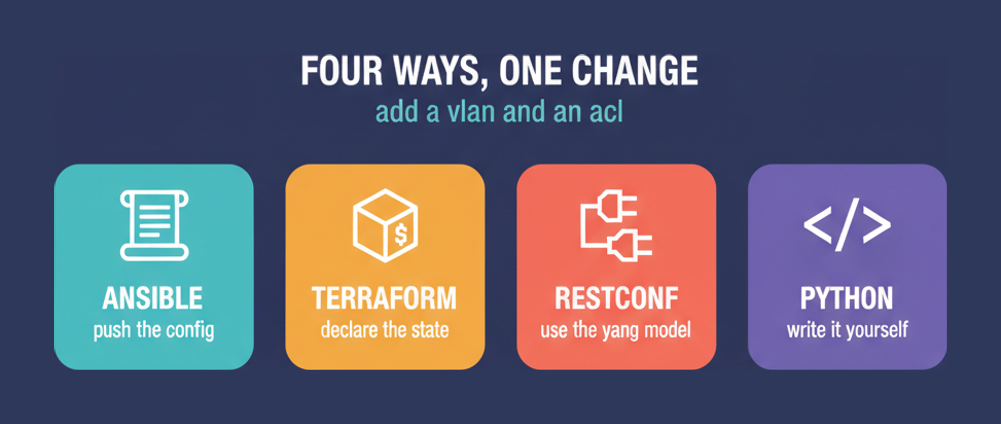
The four ways in on the automation side
Network Automation names four distinct routes to the same outcome, and the exam asks you to pick between them. Each manages the same example configurations: VLANs, OSPF, asset management, interface settings and ACLs.
- Ansible playbooks, for agentless push based configuration management
- Terraform, for declarative state managed infrastructure
- RESTCONF against a YANG model, defined by RFC 8040, which the syllabus cites by number
- Python, for custom applications that neither framework covers
A separate objective then asks you to select between them, weighing an infrastructure as code framework against a low code or no code option against a custom application. That selection question is the one candidates prepare for least and meet most.
AI in Automation is 20 percent, and it is not theory
The AI in Automation domain has five objectives, and only two of them are descriptive. The other three ask you to build or to judge: construct an MCP server that supplies network information to an AI agent using Python FastMCP, construct a conversational agent that uses language models for network automation, and evaluate the accuracy of AI recommendations on an automation solution.
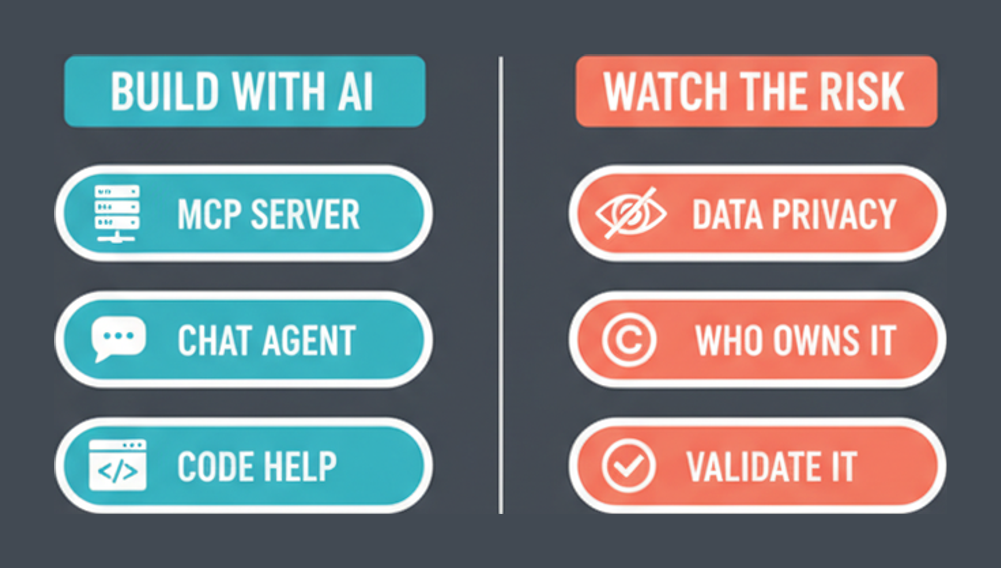
The descriptive pair is narrower than it looks. One asks for the benefits and risks of AI-assisted code development, naming data privacy, intellectual property ownership and code validation specifically. The other asks you to interpret the security risks in a given AI-based automation solution, which is a scenario question rather than a list.
Two things follow for preparation. First, the accuracy evaluation objective implies the exam expects you to treat model output as a proposal to be verified rather than an answer, which is the same discipline the change validation objective applies to pyATS. Second, and more practically, an MCP server is a small, concrete artefact. Building one is an afternoon of work and it converts an abstract domain into something you have actually done.
What happened to DEVCOR on this exam number?
350-901 previously carried DEVCOR, the core exam for CCNP DevNet, which was an application development syllabus. The number now carries AUTOCOR version 2.0, the core exam for CCNP Automation, and the subject matter has moved substantially toward network automation, pipelines and AI.
Anyone holding older study material should treat the code as unreliable and check the domain names instead. Search demand has not caught up either: people still look for DEVCOR exam topics, and what they find under that name describes a syllabus that no longer matches the exam booked against this number. Our earlier 350-901 DEVCOR study guide remains a useful record of what the previous syllabus covered, which is exactly what you need if you are working out how much of your existing preparation still counts.
Some of it does. API consumption, Python, secure coding practices and version control were all present in the old syllabus and are all present in the new one. What is genuinely new is the Terraform and Ansible material, the GitLab pipeline detail, Cisco Modeling Labs, pyATS change validation and the whole AI domain.
How does the CCNP Automation track fit together?
CCNP Automation is earned by passing the core exam plus one concentration exam, and every exam passed also earns a specialist certification on its own. AUTOCOR is the core; the concentrations Cisco publishes on its CCNP Automation page are 300-435 ENAUTO for enterprise and 300-635 DCNAUTO for data centre, each $300 USD over 90 minutes with no prerequisite and the same three year validity.
The concentration exams have moved in the same direction as the core. Cisco’s descriptions of both now name AI in Automation alongside their traditional subject matter, so the AI material is a track wide change rather than a quirk of the core exam. Our guide to 300-435 ENAUTO preparation covers the enterprise concentration in detail.
One planning note. Because AUTOCOR also satisfies the CCIE Automation core requirement and counts toward recertification, passing it does more work than a single credential suggests. If you hold other Cisco professional certifications approaching expiry, the timing of this exam is worth thinking about alongside the certification itself.
How should you prepare for AUTOCOR?
AUTOCOR rewards building over reading, because almost every objective is phrased as construct, implement or diagnose. A network engineer with scripting experience should plan eight to ten weeks; someone coming from a pure routing and switching background should plan longer and start with Python.
- Build the same small change, adding a VLAN and an ACL, four separate times: once in Ansible, once in Terraform, once through RESTCONF against the YANG model, and once in plain Python
- Put all four into Git and practise the named operations deliberately, squashing a merge, resolving a conflict, cherry-picking a commit and reverting one, so the difference between reset and revert is experiential
- Construct a GitLab CE pipeline with all four stages the syllabus names, then break it on purpose with a missing dependency and a failing test so the diagnosis objective is familiar
- Build a topology in Cisco Modeling Labs and run the pipeline against it, adding pyATS change validation as the post-validation stage
- Work through the Operations domain next, implementing logging to syslog and to a webhook, and walking through obtaining and deploying a CA-signed TLS certificate
- Finish with the AI domain by constructing an MCP server with Python FastMCP and a conversational agent over it, then sit timed sets until a hundred questions inside 120 minutes is routine
Step one is the highest value exercise on the list. Doing the identical change through four different mechanisms is precisely what the selection objective tests, and it is the only way to develop a genuine opinion about which approach suits which constraint.
Frequently Asked Questions
What certification does 350-901 AUTOCOR lead to?
Passing it earns the Cisco Certified Automation Specialist Core certification on its own, and it satisfies the core exam requirement for both CCNP Automation and CCIE Automation. Cisco also allows it to count toward recertification.
How many questions are on the AUTOCOR exam?
The NWExam syllabus page gives a range of 90 to 110 questions within the 120 minutes Cisco publishes. Cisco itself states the duration but not the question count, so the range is not an official figure.
What is the passing score for 350-901?
Cisco publishes none. It states that grading is pass or fail with results available online within 48 hours. The NWExam syllabus gives roughly 750 to 850 on a 1000 point scale as an approximation, which should be treated as a planning figure rather than a Cisco number.
How much does the AUTOCOR exam cost?
$400 USD, or the equivalent in Cisco Learning Credits. The two concentration exams in the same track, ENAUTO and DCNAUTO, are $300 USD each.
Is there a prerequisite for 350-901 AUTOCOR?
No. Cisco publishes no prerequisite for the core exam or for either concentration exam in the Automation track.
How long is the certification valid?
Three years. The exam can also be used toward recertification of other Cisco professional level credentials.
Which AUTOCOR domain carries the most marks?
Two domains tie at 30 percent each, Network Automation and Infrastructure as Code. Operations and AI in Automation follow at 20 percent apiece, so the smallest domain still carries about a fifth of the paper.
Does 350-901 really test AI?
Yes, and not only as theory. Three of the five objectives in the AI in Automation domain ask you to construct an MCP server using Python FastMCP, construct a conversational agent using language models, or evaluate the accuracy of AI recommendations.
Is AUTOCOR the same exam as DEVCOR?
No. The exam number is the same but the syllabus is not. DEVCOR was the application development core for CCNP DevNet; AUTOCOR version 2.0 is the network automation core for CCNP Automation. API work, Python, secure coding and version control carried over; Terraform, Ansible, GitLab pipelines, Cisco Modeling Labs, pyATS and the AI domain did not exist on the old syllabus.
Which languages is the exam available in?
English and Japanese, according to Cisco’s own exam page.
Conclusion
AUTOCOR is a build exam with an unusually even shape: 120 minutes, 90 to 110 questions, $400 USD, no prerequisite, three year validity, and four domains weighted 30, 30, 20 and 20 percent. Cisco grades it pass or fail and publishes no threshold, so the target is comfortable rather than borderline.
Treat the exam number with suspicion and the domain names as the truth, because 350-901 no longer means what most published material says it means. Then build: the same change through Ansible, Terraform, RESTCONF and Python, a pipeline that deploys it, a simulation that tests it, and an MCP server that lets an agent ask about it. Six of those artefacts cover most of a paper where almost every objective starts with the word construct.


