CLCOR is behind you, and the next decision is worth more thought than most candidates give it. CCNP Collaboration asks for one core exam and one concentration, and since February 2026 the concentration list has been rebuilt from the ground up. Two of the options you may have been reading about last year no longer exist, one is brand new, and the exam most on-premises engineers end up choosing kept its number while replacing almost everything inside it.
That exam is 300-815 CLACC, Implementing Cisco Advanced Call Control On-Premises. It is a 90 minute exam covering SIP signalling, Cisco Unified Border Element, globalized call routing in Cisco Unified CM, supplementary features and Expressway. The CLACC exam topics are now spread across five weighted sections rather than the six the old CLACCM blueprint used, and the balance between them has shifted considerably. This article sets out what each section actually asks, what changed in the rename, and how the exam fits against the other two concentrations.
Table of Contents
- Which Concentration Exam Should You Book After CLCOR?
- What Happened to CLACCM, and Does 300-815 Still Count?
- What Are the 300-815 CLACC Exam Details?
- How Are the CLACC Exam Topics Weighted?
- Why Does the Gateway Section Carry 30 Percent?
- What Does Advanced Call Control Test Inside Cisco UCM?
- Which Supplementary and Mobility Topics Appear?
- How Much Expressway Is in an On-Premises Exam?
- How Should You Prepare for 300-815 CLACC?
- Frequently Asked Questions
- Conclusion
Which Concentration Exam Should You Book After CLCOR?
CCNP Collaboration needs 350-801 CLCOR plus one concentration, and there are now three to choose from: 300-815 CLACC for on-premises call control, 300-820 CLHCT for hybrid and cloud, and 300-830 CLCCE for contact centre. Each runs 90 minutes and costs 300 USD. The core exam is longer and dearer at 120 minutes and 400 USD.
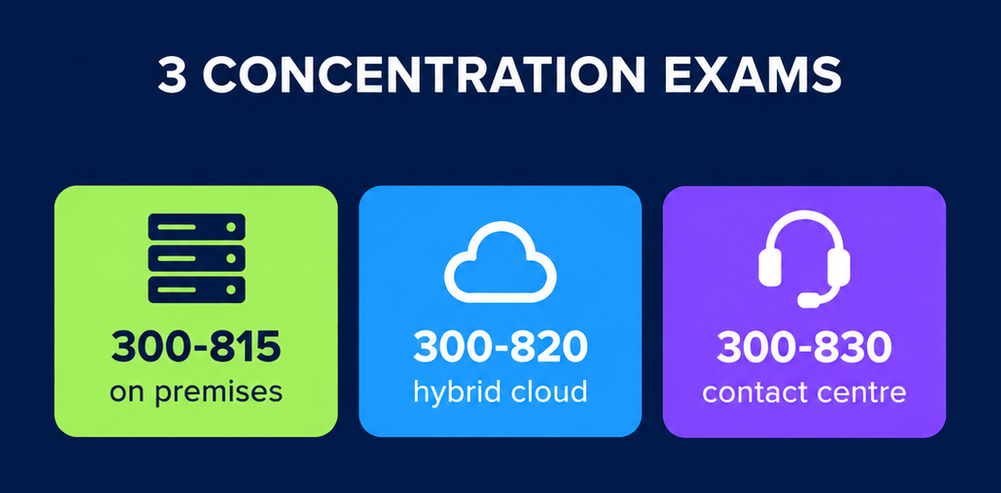
The choice is genuinely about the estate you work on rather than difficulty. If your day involves Cisco Unified CM clusters, SIP trunks and a Cisco Unified Border Element sitting at the edge, CLACC is the exam that matches. If you are migrating users into Webex Calling, CLHCT is aimed at you. CLCCE is the newcomer and covers contact centre work that previously had no concentration of its own.
| Exam | Focus | Duration | Price |
|---|---|---|---|
| 350-801 CLCOR (core) | Collaboration core technologies | 120 minutes | 400 USD |
| 300-815 CLACC | Advanced call control, on-premises | 90 minutes | 300 USD |
| 300-820 CLHCT | Hybrid and cloud collaboration | 90 minutes | 300 USD |
| 300-830 CLCCE | Contact centre | 90 minutes | 300 USD |
Cisco was explicit about why the track was rebuilt this way, and the reasoning helps explain why an on-premises exam still exists at all in 2026. The full option list sits on the CCNP Collaboration track page, which also confirms that no prerequisites apply and that the credential is valid for three years.
“Cisco is evolving its Cisco Certified Network Professional (CCNP) Collaboration track to meet the reality of how we work today: in on-premises only environments, in cloud environments, and in hybrid environments that blend cloud innovation with on-premises infrastructure.”
Passing CLACC earns Cisco Certified Specialist, Collaboration Call Control and Mobility Implementation, in its own right. That specialist badge lands whether or not you go on to complete the full professional certification, and the exam also counts toward recertification.
What Happened to CLACCM, and Does 300-815 Still Count?
300-815 was previously CLACCM, Implementing Cisco Advanced Call Control and Mobility Services. The number did not change, but the blueprint did. The last day for the old topics was 2 February 2026, and version 2.0 went live on 3 February 2026 under the shortened CLACC name. Any study material written for CLACCM is now describing a different distribution of subjects.
The same date cleared out two concentrations entirely. 300-810 CLICA and 300-835 CLAUTO were sunset, and 300-820 moved from CLCEI to CLHCT. If you find a revision plan recommending CLICA, it predates the change.
What actually moved is worth knowing, because it decides which of your old notes are still useful. The old blueprint had six sections; the new one has five.
| Old CLACCM section | Old weight | Where it sits now |
|---|---|---|
| Signaling and Media Protocols | 20% | Same name, cut to 10% |
| CME and SRST Gateway Technologies | 10% | Merged into the 30% gateway section |
| Cisco Unified Border Element | 15% | Merged into the 30% gateway section |
| Call Control and Dial Planning | 25% | Advanced Call Control, 25% |
| Cisco Unified CM Call Control Features | 20% | Supplemental Features and Security, 20% |
| Mobility | 10% | Folded into the 20% supplemental section |
Two shifts matter most. Signalling halved, from 20 percent to 10, so the deep SIP ladder diagrams are worth less than they were. Meanwhile gateway and border element work, previously 10 and 15 percent as separate sections, became a single block worth 30 percent. Expressway, mobile and remote access and business to business calling gained a 15 percent section that the old blueprint did not have as a standalone subject. Cisco set out the whole reshuffle in its own announcement.
“Starting February 3, 2026, Cisco is introducing a 50/50 split between cloud and on-premises collaboration content, giving you a real choice in how you specialize.”
Cisco’s stated reason for keeping a full on-premises path is regulated industry demand, naming government, healthcare and financial services. For context on the other side of that split, Cisco reported 18 million Webex Calling users in October 2025 and 650 million monthly meeting participants.
What Are the 300-815 CLACC Exam Details?
300-815 CLACC runs for 90 minutes and costs 300 USD, which Cisco also accepts in Cisco Learning Credits. It is delivered in English, has no prerequisites, and is graded pass or fail with results available online within 48 hours. The certification it contributes to remains valid for three years.
| Field | Value |
|---|---|
| Exam name | Implementing Cisco Advanced Call Control On-Premises |
| Exam number | 300-815 CLACC |
| Version | v2.0, live 3 February 2026 |
| Duration | 90 minutes |
| Price | 300 USD, or Cisco Learning Credits |
| Language | English |
| Prerequisites | None |
| Grading | Pass or fail, results online within 48 hours |
| Validity | 3 years |
| Registration | Pearson VUE |
Two figures deserve a caveat. Cisco does not publish a question count or a numeric cut score for this exam anywhere on its exam page, its track page or its topics document, and states only that grading is pass or fail. The 300-815 exam syllabus gives the commonly cited figures of 55 to 65 questions and a variable score of roughly 750 to 850 out of 1000. Treat those as a working expectation rather than a published rule, and plan your pacing on the 90 minutes, which is certain.
Cisco’s own page adds one more caution worth respecting. The published topics are described as general guidelines, with a note that other related subjects may also appear. You can read the current specification on the official CLACC exam page.
How Are the CLACC Exam Topics Weighted?
The v2.0 blueprint has five sections weighted 10, 30, 25, 20 and 15 percent, holding 21 top-level objectives between them. The distribution is lopsided on purpose: session border controller and gateway work alone is worth nearly a third of the paper, while the signalling theory that opens the blueprint is the smallest section on it.
| Section | Weight | Objectives |
|---|---|---|
| Signaling and Media Protocols | 10% | 3 |
| Session Border Controller and Voice Gateway Technologies | 30% | 4 |
| Advanced Call Control | 25% | 3 |
| Supplemental Features and Security | 20% | 4 |
| Remote Connectivity and Business to Business Solutions | 15% | 7 |
Objective counts do not track the weightings, and that is the trap. The 15 percent Expressway section lists seven objectives, more than any other, while the 25 percent call control section lists three. A study plan built on ticking off objectives will badly under-serve the two sections that actually carry the marks.
The small opening section is still worth real attention rather than a skim. Its three objectives cover troubleshooting advanced SIP elements such as ring back, PRACK and UPDATE, the NAT traversal protocols STUN, TURN and ICE, and mid-call signalling including hold and resume with new media, blind and consult transfers, conferencing, barge and session timers. Those same mechanics reappear inside the gateway and call control sections, so the 10 percent understates how often the knowledge is needed.
Why Does the Gateway Section Carry 30 Percent?
Session Border Controller and Voice Gateway Technologies is the largest section at 30 percent, and it is where two previously separate subjects were merged. Its four objectives cover Cisco UCME and SIP SRST configuration, dial plan troubleshooting on Cisco Unified Border Element, advanced dial peer features, and advanced SIP interoperability. Sixteen sub-items sit underneath, more than any other section.
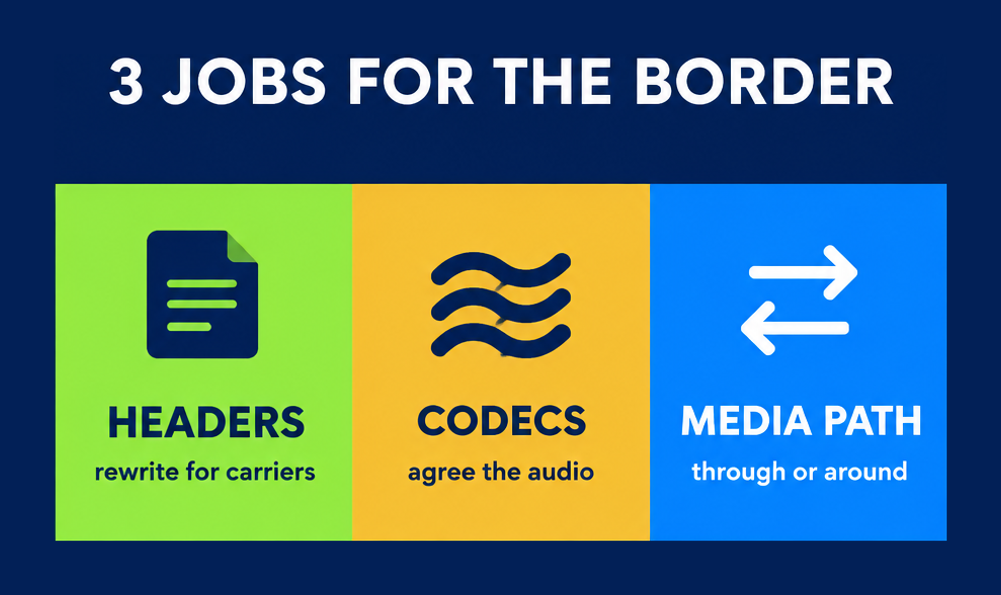
A session border controller is the device that sits between your telephony estate and the carrier, normalising signalling and controlling media as calls cross the boundary. In a Cisco environment that role is played by Cisco Unified Border Element, and almost every awkward interoperability problem in a real deployment lands on it.
Dial plan troubleshooting with VoIP Trace
Cisco names VoIP Trace and debugs explicitly as the troubleshooting method. The sub-items are the things that genuinely break on a carrier trunk: DTMF interoperability, codec preference lists, SIP and SDP header manipulation through SIP profiles, signalling and media bindings, and TLS profiles with SRTP. If you have never rewritten a header with a SIP profile to satisfy a carrier, this is the section to spend laboratory time on.
Advanced dial peer features
The second cluster covers URI matching, dial peer groups, E.164 pattern maps, voice VRF and multi VRF, and hunt stop. These are matching and selection mechanics, and questions tend to describe a call that chose the wrong dial peer and ask why.
SIP interoperability
The last objective covers video interworking, media flow through against media flow around, LTI transcoders, filtering or blocking mid-call signalling, early offer and delayed offer interoperability, and secure SIP trunk interoperability. Media flow through against flow around is a recurring decision point, because it determines whether the border element stays in the media path.
What Does Advanced Call Control Test Inside Cisco UCM?
Advanced Call Control is worth 25 percent and holds only three objectives, which makes each one substantial. They cover advanced SIP interoperability with Cisco Unified CM, call recording options, and globalized call routing. The routing objective alone carries seven sub-items and is the densest single item on the blueprint.
Globalized call routing
This is the classic Cisco Unified CM dial plan material, and the sub-items name it precisely: route patterns in both traditional and plus E.164 form, route groups and route lists, translation patterns, transformations and transformation patterns, local route group, time of day routing, partitions and calling search spaces, forced authorization codes, and urgent priority. Expect scenarios where a call reaches the wrong destination and the fault lies in partition and calling search space design rather than in the pattern itself.
SIP interoperability and recording
On the interoperability side, the topics are early offer and delayed offer behaviour, SIP normalization and transparency, SIP profiles and SIP trunk security profiles. Call recording is a describe-level objective rather than a configure-level one, covering network based gateway recording using XMF, SIPREC, and the built in bridge. Knowing when each approach is appropriate matters more than command syntax here, because the verb Cisco uses is describe.
Reading the verbs across the blueprint is a useful habit. Cisco splits its objectives into configure, troubleshoot and describe, and those words tell you how deep a question is likely to go. Of the 21 objectives, the configure and troubleshoot ones are where laboratory practice pays, while the describe items reward reading.
Which Supplementary and Mobility Topics Appear?
Supplemental Features and Security is worth 20 percent across four objectives, and it absorbed the mobility section the old CLACCM blueprint kept separate. It covers certificate management in Cisco Unified CM, supplementary call functions, mobility troubleshooting, and ILS with URI synchronization and GDPR.
The supplementary functions are the features end users actually notice: call park, call pick-up, hunt groups, call queuing with announcements, music on hold, barge and busy lamp field. The certificate objective covers trust store usage, secure phone registration and phone security profiles. Mobility covers Unified Mobility, excluding dual-mode phones, along with Extension Mobility and Extend and Connect.
One observation is worth passing on from the publicly available sample items for this exam. Of ten sample questions, six sit on mobility topics such as Mobile Voice Access, Extension Mobility logout behaviour, Extension Mobility Cross Cluster roles, Single Number Reach and Device Mobility. Mobility is one objective inside a 20 percent section, so that sample is not proportional to the blueprint, but it does suggest mobility is examined in more depth than its share implies. Some earlier 300-815 tips remain useful on the mobility material specifically, although the weightings quoted there belong to the retired blueprint.
The final objective, configuring ILS along with URI synchronization and GDPR, is easy to overlook and appears in sample material. Intercluster Lookup Service and Global Dial Plan Replication are how multiple clusters learn each other’s directory URIs and enterprise numbers, so hub and spoke replication design is fair ground for a question.
How Much Expressway Is in an On-Premises Exam?
Rather more than the name suggests. Remote Connectivity and Business to Business Solutions is worth 15 percent and lists seven objectives, the most of any section. It covers configuring and troubleshooting mobile and remote access, Expressway media traversal, protocol interworking across IPv4 and IPv6, encrypted calling, Expressway security, and business to business troubleshooting.
Mobile and remote access gets both a configure and a troubleshoot objective, which is a reliable signal that it matters. The encryption objective covers TLS and mutual TLS, zone media encryption modes, and certificate management including the ACME protocol. Security covers toll fraud prevention through local call policy rules, automated intrusion detection, and firewall rules.
The business to business objective is the broadest single item on the blueprint, naming DNS records, certificates, traversal zones, neighbour zones, DNS zones, transforms, search rules and SIP trunk integration with Cisco Unified CM. Business to business calling fails for unglamorous reasons most of the time, and that sub-item list is essentially a checklist of them.
Worth noting if you are still weighing the concentrations: Expressway material also appears in CLHCT. Choosing CLACC does not let you avoid it, and the overlap slightly reduces the cost of changing your mind later.
How Should You Prepare for 300-815 CLACC?
Preparation for 300-815 CLACC works best in blueprint order of weight rather than blueprint order of listing, because the sections are so unevenly balanced. The sequence below front-loads the 30 and 25 percent sections, keeps laboratory time on the configure and troubleshoot objectives, and leaves the describe-level material to reading.
- Download Cisco’s current exam topics document and check it against whatever study material you already hold, discarding anything that still lists six sections.
- Build a laboratory with Cisco Unified CM and a Cisco Unified Border Element, because the two largest sections are both hands-on and together account for 55 percent of the exam.
- Work through the border element objectives first, practising VoIP Trace, SIP profile header manipulation, dial peer group selection and media flow through against flow around.
- Move to globalized call routing in Cisco Unified CM, building route patterns, translation patterns, partitions and calling search spaces until misrouting scenarios are easy to diagnose.
- Cover the supplementary features and mobility material next, giving Extension Mobility, Single Number Reach and ILS more time than their weighting alone would suggest.
- Finish with Expressway, mobile and remote access and business to business calling, concentrating on certificates, zones and search rules.
- Read the signalling section last as revision, since its mechanics will already have appeared throughout the practical work.
Cisco names its own preparation course as Implementing Cisco Advanced Call Control On-Premises, and offers a Cisco U. learning path alongside instructor led training. The authoritative specification is the v2.0 exam topics PDF, which is the document to check every objective against. If you are still deciding how the wider track fits together, the Cisco Collaboration certification hub covers the core exam and the other concentrations too.
Frequently Asked Questions
Is 300-815 CLACC the same exam as CLACCM?
It carries the same exam number but not the same content. CLACCM was retired on 2 February 2026 and CLACC v2.0 went live on 3 February 2026, reducing six sections to five and changing the weightings substantially.
How long is the 300-815 CLACC exam?
90 minutes. Cisco publishes the duration on its exam page and its track page, and it is the one timing figure you can plan against with confidence.
How many questions are on 300-815 CLACC?
Cisco does not publish a question count for this exam. The NWExam syllabus gives a commonly cited range of 55 to 65 questions, which is worth treating as an expectation rather than a published specification.
What is the passing score for 300-815 CLACC?
Cisco states only that grading is pass or fail and does not publish a numeric cut score. A variable range of roughly 750 to 850 out of 1000 is widely quoted, and results are available online within 48 hours.
Are there prerequisites for 300-815 CLACC?
No. Cisco lists no prerequisites for the exam. CCNP Collaboration as a certification requires the 350-801 CLCOR core exam alongside one concentration, but you may sit the concentration in either order.
Which section of the CLACC blueprint is worth the most?
Session Border Controller and Voice Gateway Technologies, at 30 percent. It merged two separate sections from the old CLACCM blueprint and holds sixteen sub-items, more than any other section.
Does passing 300-815 give me a certification on its own?
Yes. It earns Cisco Certified Specialist, Collaboration Call Control and Mobility Implementation, independently of whether you complete CCNP Collaboration, and it counts toward recertification.
Should I choose CLACC or CLHCT after CLCOR?
Choose by estate rather than difficulty. CLACC suits engineers running Cisco Unified CM clusters, SIP trunks and a border element on premises; CLHCT suits hybrid and cloud deployments. Both run 90 minutes at 300 USD.
How much does 300-815 CLACC cost?
300 USD, and Cisco also accepts payment in Cisco Learning Credits. Registration is through Pearson VUE and the exam is delivered in English.
Conclusion
300-815 kept its number through the February 2026 rebuild, which makes it easy to assume nothing much changed. The blueprint says otherwise. Six sections became five, signalling halved to 10 percent, and gateway and border element work consolidated into a single 30 percent block that now dominates the paper alongside the 25 percent call control section. Expressway, mobile and remote access and business to business calling hold their own 15 percent section for the first time.
Plan by weight rather than by objective count, because the two do not agree on this exam. Spend your laboratory time on Cisco Unified Border Element and Cisco Unified CM routing, give mobility more attention than its share suggests, and check every objective against Cisco’s current topics document rather than any material that still names CLACCM. Then book the 90 minutes with confidence.


