One line of the current 300-615 blueprint is missing from almost every syllabus summary you will find for this exam, including the training vendors’ course pages. It is objective 5.3.d, MACsec, and it arrived with version 1.2 of Troubleshooting Cisco Data Center Infrastructure alongside Terraform CLI, Intersight and a rewritten storage section. The DCIT exam is Cisco’s 90 minute troubleshooting concentration for CCNP Data Center, and passing it also earns the Cisco Certified Specialist – Data Center Operations credential. Its five domains and their weights have not moved, which is why the update went unnoticed: Network and Compute Platforms still carry 25 percent each, Management and Operations 20, Storage Network and Automation 15 each. What moved is the list underneath. This article covers the facts Cisco publishes, every domain as v1.2 lists it, the lines that changed, how the questions are written, and a preparation order built on troubleshooting method.
Where the DCIT Exam Sits in CCNP Data Center
The DCIT exam, Cisco 300-615, is one of the concentration exams for CCNP Data Center. The certification needs the 350-601 DCCOR core exam plus one concentration, and 300-615 is the troubleshooting option. Passing it on its own earns the Cisco Certified Specialist – Data Center Operations credential, and Cisco states that a pass can also be used towards recertification.
The other concentrations on the track are design (300-610 DCID), Application Centric Infrastructure (300-620 DCACI), automation (300-635) and AI infrastructure (300-640 DCAI). Each of those asks you to build or design something. DCIT is the only one that starts every scenario with something already broken, which changes how you have to study for it.
Cisco describes the exam as certifying a candidate’s knowledge of troubleshooting a data center infrastructure including network, compute platforms, storage network, automation, and management and operations. That sentence is worth reading as a list of five rooms rather than one subject. A Nexus engineer who has never opened UCS Manager will find half the paper unfamiliar, and the same is true in reverse for a server administrator.
Who the specialist credential suits
Cisco’s own course page for DCIT lists network designers, administrators and engineers, systems and data center engineers, consulting systems engineers, technical solutions architects, server administrators, network managers, and Cisco integrators and partners. The common thread is operations: people who are paged when a fabric, a chassis or a zone set stops behaving. If your work is day two rather than day zero, this is the concentration that matches it.
What Does Cisco Publish About the 300-615 Exam?
Cisco publishes four facts about the 300-615 DCIT exam: it runs 90 minutes, it is delivered in English, it costs $300 USD or the equivalent in Cisco Learning Credits, and it feeds two credentials, CCNP Data Center and Cisco Certified Specialist – Data Center Operations. Cisco does not publish a question count or a passing score for this exam.
| Detail | 300-615 DCIT |
|---|---|
| Exam name | Troubleshooting Cisco Data Center Infrastructure |
| Exam number | 300-615 DCIT |
| Current blueprint | v1.2 |
| Duration | 90 minutes |
| Number of questions | 60 to 70 (NWExam; not published by Cisco) |
| Passing score | Variable, roughly 750 to 850 out of 1000 (NWExam; not published by Cisco) |
| Price | $300 USD or Cisco Learning Credits |
| Language | English |
| Registration | Pearson VUE |
| Credentials | CCNP Data Center concentration; Cisco Certified Specialist – Data Center Operations |
The question count and the pass mark come from NWExam’s 300-615 syllabus page, and both are labelled there as a range rather than a fixed figure. Cisco’s DCIT exam page confirms the duration, language, price and credentials and says nothing about the other two, which is normal for Cisco. Treat 60 to 70 as planning guidance: it works out to a little over a minute per question, and many DCIT items open with three or four sentences of symptoms before the question arrives.
If you want to see that shape before you book, work through the 300-615 sample questions. They follow the exam’s pattern of stating what works, what was already checked, and then asking for the single cause that fits.
Validity and recertification
Cisco’s recertification policy keeps most certifications active for three years from the date you earn them. A specialist certification recertifies with 40 Continuing Education credits; a professional certification such as CCNP Data Center needs 80. The DCIT course itself is worth 50 CE credits, so the training that prepares you for the exam also counts against the next cycle.
What Are the Five DCIT Exam Domains?
The DCIT exam has five domains: Network at 25 percent, Compute Platforms at 25 percent, Storage Network at 15 percent, Automation at 15 percent, and Management and Operations at 20 percent. Every objective in all five begins with the word troubleshoot, and the weights are identical in the v1.1 and v1.2 blueprints.
| Domain | Weight | What the objectives cover |
|---|---|---|
| 1.0 Network | 25% | Routing protocols (OSPFv2, OSPFv3, MP-BGP, PIM, FHRP); switching protocols such as RSTP+, LACP and vPC; overlay protocols such as VXLAN EVPN; ACI fabric discovery, access policies, VMM domain integration, tenant policies, packet forwarding and external connectivity |
| 2.0 Compute Platforms | 25% | UCS rack servers; UCS blade chassis infrastructure, network, storage, server pools and boot policies; packet flow from server to fabric; hardware interoperability (VIC adapters, firmware, I/O modules, fabric interconnects); firmware upgrades, packages and interoperability |
| 3.0 Storage Network | 15% | Fibre Channel physical infrastructure (switched fabric initialization, buffer credit starvation, NPV and NPIV, VSAN); Fibre Channel services (FCID, zoning, device alias, Cisco Fabric Services) |
| 4.0 Automation | 15% | Automation and scripting tools (EEM, Scheduler); programmability and orchestration (Bash shell and guest shell for NX-OS, REST API, JSON and XML encodings, Python, Ansible, Terraform CLI, Intersight) |
| 5.0 Management and Operations | 20% | Firmware upgrades, packages and interoperability; integration of centralized management such as Nexus Dashboard and Cisco Intersight; network security (fabric binding and port security, AAA and RBAC, first-hop security, MACsec); ACI security domains and role mapping; compute security (AAA and RBAC, key management); storage security (AAA and RBAC, port security, fabric binding) |
The table follows NWExam’s 300-615 syllabus page, checked line by line against Cisco’s official v1.2 exam topics. The two agree on every weight and every objective except one: the official document lists MACsec as objective 5.3.d under network security, and the syllabus page does not. It is included above because Cisco states it explicitly.
Two observations follow from the weights. First, Network and Compute together are half the paper, and Compute is UCS, not switching. Second, security is not a domain of its own. It is spread through Management and Operations as four separate objectives covering the network, ACI, compute and storage layers, which means you meet AAA and RBAC three times in three different products.
What Changed Between DCIT v1.1 and v1.2?
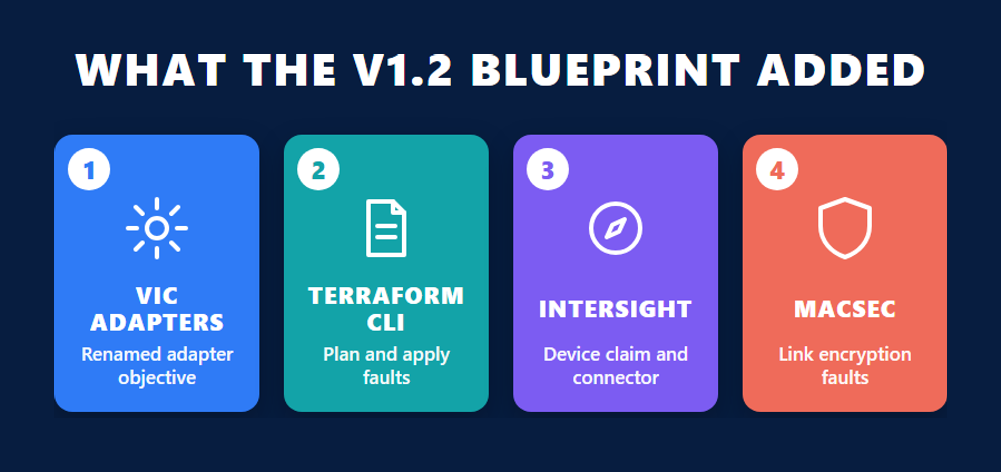
Version 1.2 of the DCIT exam kept the five domains, the weights and the 90 minute duration, and changed the objective list in five places: it added Terraform CLI and Intersight to automation, added MACsec to network security, renamed the adapter objective to VIC adapters, and removed the FCoE objective while splitting Fibre Channel into physical infrastructure and services.
The v1.2 document is Cisco’s current exam topics file for 300-615, and the v1.1 file is still served beside it, so the two can be laid side by side. The differences are these.
- Objective 2.4.a read “Converged Network Adapters / port expanders” in v1.1 and reads “VIC Adapters” in v1.2. Objective 2.4.c drops the “/ FEX” suffix from “I/O modules”.
- v1.1 had a single Fibre Channel objective with eight sub-items plus objective 3.2, “Troubleshoot FCoE Cisco Unified Fabric”. v1.2 removes the FCoE line and reorganises the same Fibre Channel items into 3.1 physical infrastructure and 3.2 services.
- Objective 4.2 was “Troubleshoot programmability” with five sub-items ending at Ansible. It is now “Troubleshoot programmability and orchestration” and adds 4.2.f Terraform CLI and 4.2.g Intersight.
- Objective 5.3, network security, gains 5.3.d MACsec. Fabric binding, AAA and RBAC, and first-hop security were already there.
- Objective 1.1.d is simply “FHRP” in v1.2 where v1.1 spelled out HSRP and VRRP. The protocols tested did not change.
None of these are large, which is exactly why they are easy to miss. A candidate studying from a v1.1 outline would never practise a Terraform plan that fails against an ACI fabric, would not think about an Intersight device claim that will not complete, and would not revise MACsec session establishment on a Nexus link. All three are now fair questions.
Why MACsec is the one to check first
MACsec, the IEEE 802.1AE standard for hop by hop encryption on Ethernet links, is the only item in the v1.2 additions that most summaries omit entirely, so it is the one most likely to be absent from any third-party study material you already own. The IEEE 802.1AE working group page is the standard’s home, and in a troubleshooting context the questions are predictable: a link that comes up but passes no traffic, a key agreement that never completes, or a policy applied to one end of a port channel and not the other.
How Are 300-615 Troubleshooting Questions Written?
A typical 300-615 question gives you a symptom, two or three facts that rule out the obvious causes, and asks which remaining cause best isolates the behaviour. The skill tested is elimination under constraint: you are rarely asked how to configure something, and often asked which of four plausible faults is the only one consistent with everything stated.
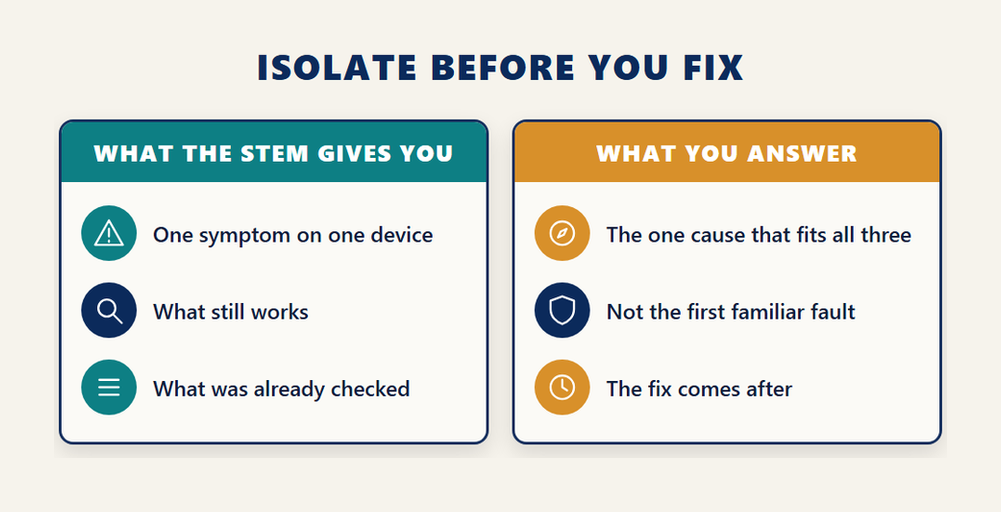
The NWExam sample set shows the pattern clearly. One item describes OSPF adjacencies flapping during a traffic storm while the interfaces stay up, the neighbour configuration is confirmed correct, and a packet capture shows hello packets arriving. Three of the four options are real OSPF faults. Only one, control plane policing dropping punted hellos above its policed rate, survives all three stated facts. Another item has an administrator who authenticates over TACACS+ but cannot enter configuration mode; the shared secret and server reachability are excluded by the fact that authentication succeeded, which leaves the role mapping in the server profile.
Reading the facts as exclusions
Each fact in the stem is there to kill a distractor. “The interfaces stay up” removes physical causes. “Other HTTPS sessions from the same interface succeed” removes routing and DNS. “The pools are confirmed full and every referenced policy exists” removes the most common UCS service profile failures and leaves the one the question wants, a host firmware package the blade’s adapter cannot apply. Candidates who read the stem as background and jump to the first familiar cause lose marks on items they understand perfectly well.
Some items ask for two answers. The sample set includes a checkpoint and rollback question with two correct statements and an NX-API question where two separate causes explain the same selective failure. Read the instruction line; a two-answer item scored as one answer is simply wrong.
What Does the Network Domain Expect You to Isolate?
The Network domain of the DCIT exam covers four areas: routing protocols (OSPFv2 and OSPFv3, MP-BGP, PIM and FHRP), switching protocols such as RSTP+, LACP and vPC, overlays such as VXLAN EVPN, and six ACI objectives from fabric discovery to external connectivity. At 25 percent it is the largest domain alongside Compute, and the only one that spans both NX-OS and ACI.
The routing and switching half is the part most candidates already know from the core exam, but the troubleshooting angle shifts what matters. For OSPF the fault is more often MTU, area type or a timer than a missing network statement. For MP-BGP in a VXLAN EVPN fabric it is the address family, the route target or the next hop. For vPC it is the consistency check, the peer keepalive path or an orphan port. PIM questions turn on the RP: which router thinks it is the RP, whether the group range matches, and whether the RPF check passes.
The six ACI objectives
ACI is where the Network domain gets expensive. The objectives are fabric discovery, access policies, VMM domain integration, tenant policies, packet forwarding for unicast, multicast and broadcast, and external connectivity. The access policy chain, from interface policy group through AAEP to physical or VMM domain to VLAN pool, is the single most productive thing to be able to trace backwards from a fault. If a port shows an encap mismatch, the question is which link in that chain is missing, and the stem will tell you which links are confirmed present. External connectivity questions follow the L3Out: the logical node and interface profiles, the external EPG subnet scope, and the contract between it and the internal EPG.
Candidates who hold the 300-620 DCACI concentration have an advantage here, but DCIT asks a narrower question each time. You do not need to design the tenant; you need to say which object, given what already works, must be wrong.
Why Do Compute and Storage Take Forty Percent of the Paper?
Compute Platforms is 25 percent of the DCIT exam and Storage Network a further 15, so forty percent of 300-615 sits on Cisco UCS and Fibre Channel rather than on switching. The compute objectives cover UCS rack servers, blade chassis, packet flow from server to fabric, hardware interoperability and firmware; the storage objectives cover Fibre Channel physical infrastructure and services.
On the compute side the blueprint names the pieces explicitly: chassis, power and I/O modules; VLANs, pools, policies and templates; SAN connectivity, FC zoning and VSANs as seen from UCS; server pools and boot policies; VIC adapters, firmware, I/O modules and fabric interconnects. Service profile association failures are the classic question, and the stem will usually have excluded pool exhaustion and missing policies so that a firmware package, a boot policy or an adapter placement is what remains. Packet flow from server to fabric is tested as a path: vNIC to VIC to IOM to fabric interconnect, in end host or switching mode, and which hop drops a frame tagged for a VLAN the uplink does not carry.
Fibre Channel, with FCoE gone
The v1.2 storage domain is pure Fibre Channel. Under physical infrastructure it lists switched fabric initialization, buffer credit starvation, NPV and NPIV, and VSANs; under services it lists FCID, zoning, device alias and Cisco Fabric Services. Buffer credit starvation is the item that separates candidates who have run a SAN from those who have read about one: a slow drain device, a port with credits stuck at zero, and a fabric that looks healthy on every link counter except the one that matters.
Zone merge failures appear in the sample set and are a reliable exam topic. Two fabrics joined by a new ISL, E-ports that negotiate and then isolate, zone sets that stop distributing: the cause is an incompatible active zone set on each side, not the default zone policy and not NPIV. The Fibre Channel Industry Association publishes the protocol’s feature and security material if you need background beyond the Cisco MDS configuration guides, but the exam tests Cisco’s implementation: VSAN membership, device alias distribution through CFS, and the difference between an NPV edge switch and an NPIV capable core.
Why Do Automation and Management Carry 35 Percent?
Automation is 15 percent of the DCIT exam and Management and Operations is 20, so a third of 300-615 tests how a data center is operated rather than how its protocols behave. Automation covers EEM, the scheduler, Bash and guest shell, the REST API, JSON and XML, Python, Ansible, Terraform CLI and Intersight; Management covers firmware, centralized management, and security on every layer.
The automation questions are troubleshooting questions about tools, not programming tests. The sample set is a good guide to the level: a Python script whose TCP connection to NX-API is refused before any HTTP response, where the only cause that produces a refused connection rather than a 401 is that the nxapi feature is not enabled; an NX-API session where show commands succeed and configuration commands are rejected, which points at the command type or the RBAC role rather than at TLS or DNS; a telemetry subscription with a valid sensor path and a collector that receives nothing because the collector is unreachable. In each case the exam wants you to map a symptom to the layer that produces it.
Terraform and Intersight, newly on the list
The two v1.2 additions to automation are the Terraform CLI and Intersight. For Terraform expect the plan and apply cycle against ACI or Nexus Dashboard: a provider that cannot authenticate, a plan that shows unexpected changes because state has drifted from the fabric, or a resource dependency that fails on the first apply and succeeds on the second. For Intersight the troubleshooting surface is the device connector: claim codes, proxy settings, connector status, and the target that shows as not connected after a firmware change. Cisco’s DCIT course page lists automation and programmability among the course topics alongside the Nexus, MDS, FEX and UCS labs, which is the practical way to meet these tools before the exam does.
Centralized management and the four security objectives
Objective 5.2 asks you to troubleshoot integration of centralized management such as Nexus Dashboard and Cisco Intersight. The questions here are about onboarding and visibility: a site that will not add, a switch whose telemetry never arrives, an insights job that reports a fabric it cannot reach. Richard Licon, writing on Cisco’s Data Center blog about Nexus Dashboard Insights, put the operational case this way:
“Modern switches have all the telemetry data needed to accelerate problem identification and resolution. But the data has to be pulled together and presented in ways that are helpful and actionable.”
The exam tests the pulling together. If the telemetry is not arriving, something in the path from switch to dashboard is wrong, and the stem will tell you which parts of that path have been verified.
The four security objectives repeat one pattern across four products. Network security means fabric binding and port security, AAA and RBAC, first-hop security such as dynamic ARP inspection and DHCP snooping, and MACsec. ACI security means security domains and role mapping. Compute security means AAA and RBAC and key management on UCS. Storage security means AAA and RBAC, port security and fabric binding on MDS. The TACACS+ item in the sample set, where authentication succeeds but authorization fails, is the shape all four take: a user who can log in but cannot do the thing, and a role or attribute mapping that explains it.
How Should You Prepare for the DCIT Exam?
Prepare for the DCIT exam by studying from the v1.2 blueprint rather than an older outline, building a lab that covers Nexus, UCS and MDS rather than switching alone, and practising elimination against stated facts rather than configuration recall. Cisco publishes no fixed study time, and most candidates arrive from one of the three platforms with real gaps in the other two.
- Download the official v1.2 exam topics and mark every sub-item you could not isolate a fault in today, so the study plan starts from the real list rather than a vendor summary.
- Pass or revise 350-601 DCCOR first, because DCIT assumes the core exam’s configuration knowledge and tests only what goes wrong with it.
- Build or borrow a lab that includes a UCS Manager instance and an MDS or NX-OS SAN switch, since forty percent of the paper is compute and Fibre Channel and neither can be revised from a switching lab.
- Work through the five v1.2 changes deliberately, with a MACsec session, a Terraform plan against ACI and an Intersight device claim each broken and repaired at least once.
- Rewrite each sample question as a list of exclusions before answering it, so that reading the stem as a set of constraints becomes a habit.
- Take the Cisco DCIT course or its Cisco U. learning path if your employer funds it, because the hands-on labs cover all three platforms and the course carries 50 CE credits.
- Finish with timed practice at 60 to 70 questions in 90 minutes, so the pace of long troubleshooting stems is familiar before exam day.
Two older pages on this site are worth reading alongside the plan. The 300-615 exam resource page collects the practice material and study links for this exam in one place, and should be read with the v1.2 changes above in mind.
Sequencing DCIT after the core
If you have not yet sat the core, do it first. The domain weights of the core exam decide how much of DCIT is already familiar: DCCOR puts a quarter of its marks on compute and a fifth on storage, exactly the areas that DCIT then breaks. A detailed breakdown of that core paper is in the 350-601 DCCOR domain guide, and the two articles together map the full CCNP Data Center route for an operations engineer.
Recertification is the last thing to plan. Cisco’s recertification policy gives three years, and the CE credits from the course, plus any later concentration you pass, both count towards the next cycle.
Frequently Asked Questions
How many questions are on the 300-615 DCIT exam?
Cisco does not publish a question count for 300-615. NWExam’s syllabus page lists 60 to 70 questions in the 90 minute sitting, and that range is consistent with other Cisco concentration exams. Plan on a little over one minute per question, with longer troubleshooting stems eating into that average.
What is the passing score for the DCIT exam?
Cisco does not publish a passing score for 300-615. NWExam lists it as variable, roughly 750 to 850 out of 1000. Cisco scales its exam scores, so the number of correct answers needed can differ between forms of the same exam.
Which version of the DCIT exam is current?
Version 1.2 is current. Cisco’s exam topics document for 300-615 is titled Troubleshooting Cisco Data Center Infrastructure v1.2, and NWExam’s syllabus description uses the same version. Training vendors still advertise v1.0 and v1.1 courses, so check the blueprint date before buying material.
What did DCIT v1.2 add to the exam?
Version 1.2 added Terraform CLI and Intersight to the automation domain, added MACsec to network security, renamed the adapter objective to VIC adapters, and removed the FCoE objective from storage. The five domains, their weights and the 90 minute duration did not change.
Does the 300-615 exam earn a certification on its own?
Yes. Passing 300-615 earns the Cisco Certified Specialist – Data Center Operations certification by itself. Combined with the 350-601 DCCOR core exam, it also completes CCNP Data Center, and Cisco states that the pass can be used towards recertification.
Is DCIT harder than the other CCNP Data Center concentrations?
It is broader rather than deeper. Design, ACI and automation concentrations each go deep on one subject; DCIT covers Nexus, ACI, UCS and MDS troubleshooting in one paper, so candidates with experience on only one platform usually find it harder than a specialist exam in their own area.
How much does the 300-615 exam cost?
The exam costs $300 USD, and Cisco also accepts Cisco Learning Credits. It is delivered through Pearson VUE in English only.
How long is the Cisco Certified Specialist Data Center Operations certification valid?
Three years, in line with Cisco’s recertification policy. A specialist certification recertifies with 40 Continuing Education credits or by passing a qualifying exam; the DCIT course alone carries 50 CE credits.
Should I use 300-615 dumps to prepare?
No. Dumps break Cisco’s exam agreement and, for a troubleshooting exam, they teach the wrong skill: memorising answers does nothing for a stem whose facts have been changed. Use the official v1.2 topics, a lab on all three platforms and sample questions that explain why each distractor is excluded.
Do I need the DCCOR core exam before taking DCIT?
No prerequisite is enforced, and you can sit 300-615 first. In practice DCIT assumes the configuration knowledge that DCCOR tests, so most candidates take the core first and treat the concentration as the troubleshooting half of the same syllabus.
Conclusion
The DCIT exam rewards one habit above all others: reading the stated facts as exclusions and choosing the cause that survives them. Its five domains, 25 percent each for Network and Compute, 20 for Management and Operations and 15 each for Storage and Automation, have not moved in years, but the v1.2 blueprint added MACsec, Terraform CLI and Intersight, dropped FCoE and renamed the adapter line, and most summaries of 300-615 still miss at least one of those. Study from Cisco’s own v1.2 document, build a lab that reaches UCS and MDS as well as Nexus, work the sample questions as elimination exercises, and treat the 90 minutes as a troubleshooting shift rather than a configuration test. Do that and the Cisco Certified Specialist – Data Center Operations credential, and the CCNP Data Center it completes, follow from the same preparation.


