A retailer asks for four hundred branches on two transports, a campus that can be split by department without readdressing, voice that survives a link failure, and a migration path to IPv6 that does not stop the stores. Nobody in that conversation types a command. Someone has to decide which routing protocol, which overlay, which WAN service and which QoS model fit, and then defend the choice.
That person is who the ENSLD exam is written for. Cisco’s 300-420 ENSLD, Designing Cisco Enterprise Networks, lists 27 numbered objectives, and 15 of them open with a verb that asks you to decide something: create, design, determine or select. This article walks the five domains through that lens, explains the version and naming confusion around the blueprint, sets out what a pass earns, and ends with a preparation order built for a design exam rather than a configuration exam.
Table of Contents
- What Does the ENSLD Exam Actually Test?
- Why Do the Verbs in the 300-420 Blueprint Matter?
- What Sits in Advanced Addressing and Routing at 25 Percent?
- How Does the Campus Domain Mix Classic Design With SD-Access?
- Which WAN Design Choices Does 300-420 Expect You to Make?
- What Do QoS, Management and Multicast Look Like as Design Questions?
- Is There Really AI in the ENSLD Automation Domain?
- What Does Passing 300-420 Earn You?
- How Should You Prepare for a Design Exam?
- Frequently Asked Questions
- Conclusion
What Does the ENSLD Exam Actually Test?
The ENSLD exam tests enterprise network design across five domains: Advanced Addressing and Routing Solutions and Advanced Enterprise Campus Networks at 25 percent each, WAN for Enterprise Networks and Network Services at 20 percent each, and Automation at 10 percent. Exam 300-420 runs 90 minutes, carries 55 to 65 questions, and costs $300 USD at Pearson VUE.
The figures below come from the NWExam syllabus page for 300-420. Cisco’s own exam page confirms the name, the 90 minute duration and the fee, and adds the two delivery languages. It does not display a question count or a passing score, so those two rows rest on the syllabus page alone.
| 300-420 ENSLD exam fact | Value |
|---|---|
| Exam name | Designing Cisco Enterprise Networks |
| Exam code | 300-420 ENSLD |
| Blueprint version | v1.1 |
| Number of questions | 55 to 65 |
| Duration | 90 minutes |
| Exam fee | $300 USD, or Cisco Learning Credits |
| Passing score | Variable, approximately 750 to 850 out of 1000 |
| Languages | English, Japanese |
| Registration | Pearson VUE |
| Domain | Weight | Numbered objectives |
|---|---|---|
| Advanced Addressing and Routing Solutions | 25% | 6 |
| Advanced Enterprise Campus Networks | 25% | 5 |
| WAN for Enterprise Networks | 20% | 5 |
| Network Services | 20% | 5 |
| Automation and Artificial Intelligence | 10% | 6 |
Half the exam sits in the first two domains, which is where routing and campus experience pays off. The last domain is the smallest by weight but carries six objectives, the joint highest count, so it is broad and shallow rather than easy to skip.
Why Do the Verbs in the 300-420 Blueprint Matter?
The verbs in the 300-420 blueprint tell you what kind of answer each objective expects. Fifteen of the 27 objectives use create, design, determine or select, which means choosing between options against a requirement. The other twelve use describe or differentiate, which means knowing how something works. ENSLD therefore rewards judgement more than recall, and studying it like a configuration exam misses the point.
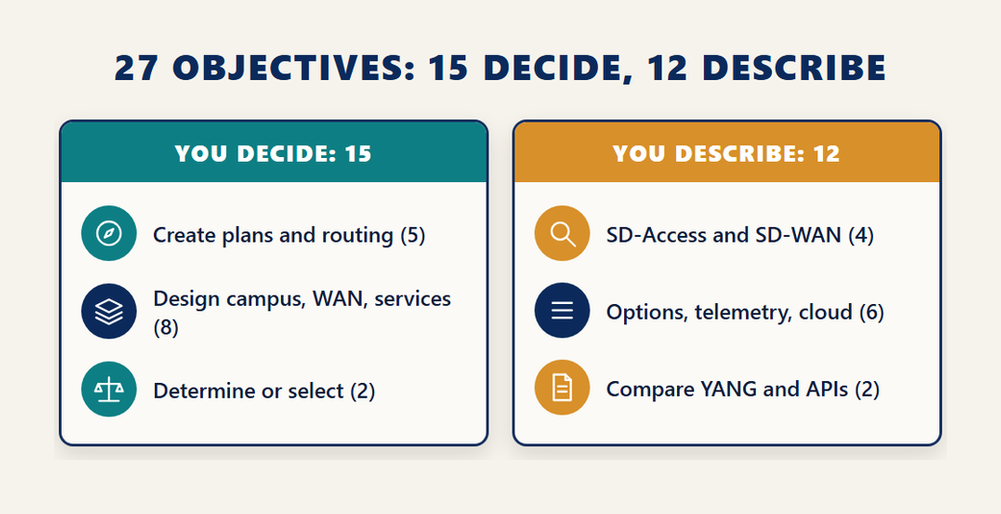
Read the full 300-420 syllabus with that split in mind and the shape of the exam becomes clear. Every routing protocol objective is a design objective. Every SD-Access and SD-WAN objective is a describe objective. The decision work concentrates on classic routing, campus, VPN, WAN resilience, QoS and multicast, while the newer architectures are tested for understanding rather than for design trade-offs.
What a decision objective looks like in practice
A describe objective can be answered by recalling a fact: what the SD-Access control plane does, or which planes Cisco SD-WAN separates. A design objective gives you a set of constraints, such as a merger that brings a second routing domain, a site that must stay up through a single carrier outage, or a campus that needs segmentation without a forklift, and asks which option meets all of them. The wrong answers are usually valid technologies used in the wrong place.
Why the official course leans the same way
Cisco’s ENSLD training overview repeats the phrase “based on customer requirements” in its objectives for routing, BGP, LAN, SD-Access, WAN, QoS and IPv6, and every one of its six labs is a design lab rather than a configuration lab. The course and the exam point the same way: start from what the business asked for and work back to the technology.
What Sits in Advanced Addressing and Routing at 25 Percent?
Advanced Addressing and Routing Solutions carries 25 percent of the ENSLD exam and six objectives. You create structured IPv4 and IPv6 addressing plans, create stable, secure and scalable routing designs for IS-IS, EIGRP, OSPF and BGP, and determine an IPv6 migration strategy. It is the most decision-heavy domain on the blueprint: all six objectives ask you to create or determine something.
Addressing plans
Structured addressing is the foundation every later objective depends on. Summarization, route filtering, segmentation and security policy are all easier when the address plan follows the topology and the organisation. Expect to reason about where hierarchy belongs, how much space each block needs to grow, and how an IPv6 plan differs from simply mirroring the IPv4 one.
Interior and exterior routing
The IS-IS, EIGRP and OSPF objectives share the same wording: stable, secure and scalable. That is a hint about the questions. They ask where area or level boundaries go, how to limit the blast radius of a flap, and how to summarise without black-holing traffic. BGP gets five named sub-items on the syllabus page: address families, basic route filtering, attributes for path preference, route reflectors and confederations, and load sharing.
IPv6 migration
The migration objective lists three strategies: overlay through tunneling, native dual-stacking, and boundaries through IPv4 and IPv6 translation. Know when each fits. A network that must reach IPv6-only services through an IPv4 core needs something different from a campus that can run both stacks everywhere.
How Does the Campus Domain Mix Classic Design With SD-Access?
Advanced Enterprise Campus Networks is the second 25 percent domain on the ENSLD exam. Three of its five objectives are design objectives for high availability, Layer 2 infrastructure and multicampus Layer 3 infrastructure. The remaining two describe Cisco SD-Access architecture and fabric design considerations. Classic campus design is where you make choices; SD-Access is where you show you understand the model.
High availability and Layer 2
The high availability objective names first hop redundancy protocols, platform abstraction techniques, graceful restart with NSF and NSR, and BFD. The Layer 2 objective covers STP scalability, fast convergence, loop-free technologies, PoE and Wake on LAN, and Layer 2 security such as STP security, port security and VLAN access lists. The design question here is usually where the Layer 2 and Layer 3 boundary sits, which Cisco’s course treats as its own decision.
Multicampus Layer 3
Convergence, load sharing, route summarization, route filtering, VRFs, optimal topologies and redistribution make up the Layer 3 list. Redistribution and VRFs together are where merger and segmentation scenarios live, so practise drawing where routes cross between domains and what prevents loops when they do.
SD-Access
The SD-Access objectives cover the underlay and overlay, the control and data plane, automation, wireless and security, then fabric design: control plane and border design, segmentation, virtual networks, scalability, over the top and fabric wireless, and multicast. You need to explain these components and the trade-offs between them, not deploy a fabric.
Which WAN Design Choices Does 300-420 Expect You to Make?
WAN for Enterprise Networks carries 20 percent of the ENSLD exam. You describe WAN connectivity options, design site-to-site VPN, and design high availability for the enterprise WAN, each across on-premises, hybrid and cloud solutions. Two further objectives describe Cisco SD-WAN architecture and its design considerations. The VPN and resilience objectives are where most WAN decisions are tested.
The connectivity options listed are Layer 2 VPN, MPLS Layer 3 VPN, Metro Ethernet, DWDM, 4G and 5G, and SD-WAN customer edge. The VPN design objective names DMVPN, Layer 2 VPN, MPLS Layer 3 VPN, IPsec, GRE and GET VPN. These overlap on purpose: a question may hand you a provider service and ask which overlay belongs on top of it, or ask which VPN type suits a full mesh of branches that all need to reach one another.
Resilience is framed by four words: single-homed, multihomed, backup connectivity and failover. Map each to a site profile you know, such as a small branch on one circuit with cellular backup, or a regional hub on two carriers, because the exam asks which design meets a stated availability requirement at the lowest complexity.
For SD-WAN, the architecture objective covers the orchestration, management, control and data planes, onboarding and provisioning, and security. The design considerations objective adds control plane and overlay design, LAN design, high availability, redundancy, scalability, security design, and QoS and multicast over the fabric. If you passed ENSDWI, this domain will feel familiar, but here the question is why a design choice is right, not how to configure it.
What Do QoS, Management and Multicast Look Like as Design Questions?
Network Services is the second 20 percent domain on the ENSLD exam, with five objectives. You select QoS strategies to meet customer requirements, design end-to-end QoS policies, design network management techniques, describe multicast routing concepts, and design multicast services. Four of the five are decision objectives, so this domain is about policy choices more than protocol detail.
QoS
Strategy selection is framed as DiffServ against IntServ. The end-to-end policy objective lists classification and marking, shaping, policing and queuing. A typical design problem gives you an application mix and a link speed and asks where marking should happen, where traffic should be shaped rather than policed, and which queues the voice and video classes need.
Network management
The management objective names in-band against out-of-band management, segmented management networks and prioritising management traffic. It is short, but it is a design objective, so expect a scenario in which you must keep the network reachable for operators while the production path is congested or down.
Multicast
The concepts objective covers source trees, shared trees, reverse path forwarding and rendezvous points. The services objective asks you to design with SSM, PIM bidirectional, MSDP and service reflection. The protocol behind most of it is defined in RFC 7761 for PIM-SM, which is worth reading for the shared tree to source tree switchover, because rendezvous point placement questions depend on understanding it.
Is There Really AI in the ENSLD Automation Domain?
The final ENSLD domain is listed on the NWExam syllabus page as Automation and Artificial Intelligence at 10 percent, while Cisco’s downloadable 2023 exam topics PDF names the same domain Automation. Both versions list the same six objectives, and none of them names an AI technology. In practice, the domain tests model-driven programmability, telemetry and cloud connectivity, whatever its title.
The six objectives are: differentiate between IETF, OpenConfig and Cisco YANG models; differentiate between NETCONF and RESTCONF; describe the impact of model-driven telemetry, with periodic and on-change publication; describe gRPC and gNMI; describe cloud connectivity options such as direct connect, cloud on ramp, MPLS direct connect and WAN integration; and describe the cloud services model in private, public and hybrid deployments. For the RESTCONF side, RFC 8040 on RESTCONF sets out how it maps YANG data onto HTTP methods, which is most of what the differentiation objective needs.
Three items the 2023 PDF does not list
Comparing the two documents line by line shows three more differences besides the domain name. The syllabus page adds confederations next to route reflectors in the BGP objective, NSF and NSR next to graceful restart in campus high availability, and service reflection in the multicast services objective. Cisco’s live topics page on the Learning Network could not be read for this article, so it is not possible to say which wording it shows today. The safe approach is to study the longer list: the extra items are standard design topics either way.
What Does Passing 300-420 Earn You?
Passing 300-420 ENSLD earns the Cisco Certified Specialist – Enterprise Design credential on its own, and it also meets the concentration exam requirement for CCNP Enterprise, which needs the 350-401 ENCOR core exam as well. The certification is valid for three years, and a pass can also count toward recertification of an existing Cisco certification.
The ENSLD exam page on cisco.com lists both credentials, the English and Japanese delivery options, and the option to pay with Cisco Learning Credits. The official course also earns 40 Continuing Education credits toward recertification, according to Cisco’s training overview, so the course itself has value at renewal time even for someone who has already passed.
The choice of concentration matters for CCNP Enterprise. ENSLD suits engineers moving into design or architecture roles, or presales engineers who produce high-level designs, because the Specialist title names the design skill directly. Engineers whose work is implementing and running advanced routing may find 300-410 ENARSI, Implementing Cisco Enterprise Advanced Routing and Services, a closer match. For a longer resource list on this exam, the earlier 300-420 ENSLD study guide on this site groups reading material by domain.
How Should You Prepare for a Design Exam?
Preparing for the ENSLD exam means practising decisions, not commands. Cisco recommends knowledge from CCNA and ENCOR training before the course, so routing and campus fundamentals should already be solid. From there, work each domain as a set of requirements and trade-offs, write down why you would choose one option over another, and test yourself against scenarios rather than definitions.
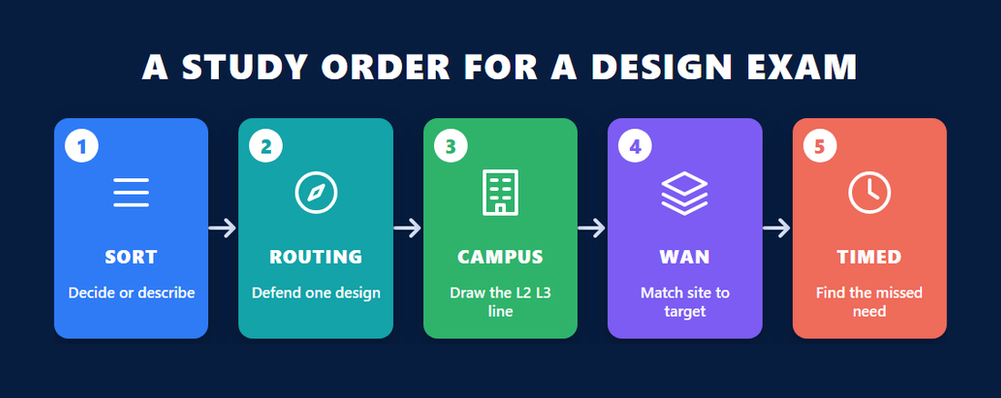
A working order that follows the weightings and the verb split:
- Download the topic list and mark each of the 27 objectives as either a decision objective or a describe objective.
- Start with addressing and routing, and for each protocol write one design you would defend and one you would reject.
- Move to campus design and draw the Layer 2 and Layer 3 boundary for three different building sizes.
- Work through WAN and VPN choices by matching each connectivity option to a site profile and an availability target.
- Build QoS and multicast policies on paper for a stated application mix and link speed.
- Finish with SD-Access, SD-WAN and the automation domain, which are tested mostly by description.
- Sit timed practice questions and review every wrong answer by asking which requirement you missed.
Time matters once you reach the last step. With 55 to 65 questions in 90 minutes you have well under two minutes per item, and design scenarios take longer to read than fact questions. If you are still deciding which concentration to take after ENCOR, the CCNP Enterprise path guide compares the options side by side.
Use the official topics list as your checklist throughout. Cisco’s 2023 ENSLD topics PDF is the version you can download, and the three extra items described above are worth adding to it by hand.
Frequently Asked Questions
What is the ENSLD exam?
ENSLD is Cisco exam 300-420, Designing Cisco Enterprise Networks. It tests enterprise network design across addressing and routing, campus, WAN, network services and automation, and it is one of the concentration exams for CCNP Enterprise.
How many questions are on the 300-420 ENSLD exam?
The NWExam syllabus page lists 55 to 65 questions in 90 minutes. Cisco’s exam page confirms the 90 minutes but does not display a question count.
What is the passing score for ENSLD?
The syllabus page gives a variable passing score of approximately 750 to 850 out of 1000. Cisco does not display a passing score on the exam page.
How much does the ENSLD exam cost?
The exam costs $300 USD, and Cisco also accepts Cisco Learning Credits. You register and sit it through Pearson VUE.
Is there an ENSLD v2.0 exam?
No version 2.0 exam is published. Cisco’s current training overview describes the exam as 300-420 ENSLD v1.1, and the syllabus page describes the same v1.1 exam. The 2.0 label appears on the recommended training course, not on the exam.
Does the ENSLD Automation domain test AI?
The syllabus page titles the domain Automation and Artificial Intelligence, but its six objectives cover YANG models, NETCONF and RESTCONF, model-driven telemetry, gRPC and gNMI, cloud connectivity and cloud service models. None of them names an AI technology.
Should I take ENSLD or ENARSI for CCNP Enterprise?
Both meet the concentration requirement. ENSLD tests design decisions across the enterprise network, while 300-410 ENARSI covers implementing Cisco enterprise advanced routing and services. Choose the one closer to the work you do or want to do.
Do I need ENCOR before taking ENSLD?
No. You can pass ENSLD on its own and earn the Cisco Certified Specialist – Enterprise Design credential. To hold CCNP Enterprise you need both the 350-401 ENCOR core exam and a concentration such as ENSLD.
How long is the ENSLD certification valid?
The certification is valid for three years. You can renew it through Continuing Education credits or by passing qualifying exams, and the official ENSLD course itself earns 40 CE credits.
Conclusion
The ENSLD exam is easiest to understand through its verbs. Fifteen of its 27 objectives ask you to create, design, determine or select, and those decision objectives sit mainly in routing, campus, VPN, WAN resilience, QoS and multicast. SD-Access, SD-WAN and the automation domain are tested mostly by description. The exam runs 90 minutes with 55 to 65 questions at $300, earns the Enterprise Design Specialist credential, and completes CCNP Enterprise alongside ENCOR. Study from the longer syllabus list, practise writing designs you can defend, and finish with timed scenarios. If you work as a network engineer who is moving toward design or architecture, 300-420 is the concentration that names that skill directly.


