One sitting of 350-501 earns two separate things. Cisco awards the Cisco Certified Specialist for Service Provider Core the moment you pass, and that same result counts as the core half of CCNP Service Provider. Neither outcome waits for the other, so the specialist credential lands before you have chosen a concentration exam or booked anything else.
That changes how the SPCOR exam topics are worth reading. This is not a partial credential you rush through on the way to something better. It is a standalone specialist paper covering service provider architecture, networking, MPLS and segment routing, services, and automation, and the weightings are spread widely enough that no domain can be treated as filler. This guide walks the five domains as Cisco and the published syllabus name them, sets out the mechanics, and explains what the two-certification structure means for how you plan the rest of the track. If routing is where you want to go deeper after the core, this SPRI advanced routing guide covers the concentration exam that pairs with 350-501 for CCNP Service Provider.
What Are the SPCOR Exam Topics?
The SPCOR exam topics cover five areas: service provider architecture, networking, MPLS and segment routing, services, and automation and assurance. Together they describe a carrier network end to end, from the transport technologies underneath it through the routing and label plane to the services carried over it and the telemetry watching all of it.
The architecture domain sets the vocabulary for everything else. It names core architectures including Metro Ethernet, MPLS, unified MPLS, segment routing, SR traffic engineering and SRv6; transport technologies including xDSL, DWDM, DOCSIS, TDM and xPON; mobility covering packet core and RAN transport for 5G vRAN and ORAN; and the routed optical network model.
Two things sit inside architecture that candidates often expect elsewhere. Cisco network software architecture is here, meaning IOS, IOS XE and IOS XR as three distinct operating systems rather than three badges on the same thing. So is quality of service architecture, including the MPLS QoS models pipe, short pipe and uniform, the traffic engineering models, DiffServ and IntServ, trust boundaries between enterprise and provider, and the IPv6 flow label.
Control plane security also lands in architecture rather than in a security domain, covering protection techniques such as LPTS and control plane policing. That placement tells you Cisco treats it as a property of how the network is built, not as an add-on.
How Are the Five 350-501 Domains Weighted?
350-501 splits into Networking at 30 percent, MPLS and Segment Routing at 20 percent, Services at 20 percent, Architecture at 15 percent, and Automation and Assurance at 15 percent. Networking is the single largest domain, and the label plane and services domains together match it exactly.
| Domain | Weight | What it is really about |
|---|---|---|
| Networking | 30% | The routing plane a carrier runs on |
| MPLS and Segment Routing | 20% | How traffic is labelled and steered |
| Services | 20% | What the network is actually selling |
| Architecture | 15% | The shapes, transports and models underneath |
| Automation and Assurance | 15% | Programmability and knowing the network is healthy |
The distribution rewards breadth. With the largest domain at 30 percent and the smallest two at 15 each, there is no single area you can protect at the expense of the rest. An engineer strong in routing but blank on automation is giving away 15 percent before the exam starts, and that is on a paper where the pass mark moves.
Rehearsing against SPCOR sample questions is the fastest way to find which of the five is thinnest, because the gap usually shows as slow answers rather than wrong ones.
What Are the 350-501 Exam Details?
350-501 runs for 120 minutes and costs 400 US dollars, delivered through Pearson VUE. The published item count is 90 to 110 questions, and the pass mark is variable rather than fixed, landing somewhere around 750 to 850 out of 1000 depending on the form you receive.
| Detail | Value |
|---|---|
| Exam name | Implementing and Operating Cisco Service Provider Network Core Technologies |
| Exam code | 350-501 SPCOR |
| Questions | 90 to 110 |
| Duration | 120 minutes |
| Passing score | Variable, approximately 750 to 850 out of 1000 |
| Price | $400 USD |
| Delivery | Pearson VUE |
Do the arithmetic on the timing and the pressure becomes obvious. At the top of the range, 110 questions in 120 minutes is roughly 65 seconds each. That is not enough time to reason a configuration out from first principles, which means the material has to be recall-fast rather than merely understood.
The variable pass mark deserves a word. Cisco does not publish a fixed percentage, and the scoring is adjusted for the difficulty of the particular form. In practice that means you cannot calculate a target number of correct answers in advance, and aiming for the top of the published band is the only safe planning assumption.
Why Does One Exam Award Two Certifications?
Cisco restructured its programme so that core exams stand alone. Passing 350-501 awards the Cisco Certified Specialist for Service Provider Core outright, and that credential is valid for three years. It also serves as the core half of CCNP Service Provider, which you complete by adding one concentration exam of your choice.
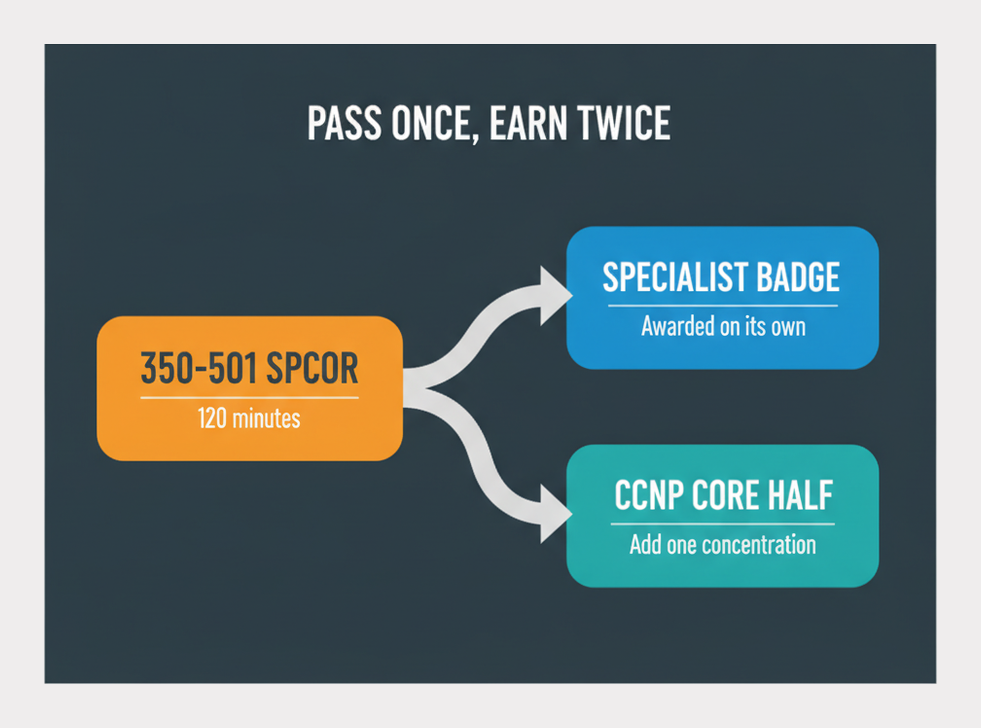
Cisco sets this structure out on its own CCNP Service Provider page, which lists the concentration options including SPRI, SPVI and SPCNI. The choice of concentration is genuinely yours, and it is worth making it deliberately rather than picking whichever is scheduled soonest.
The practical consequence is a sequencing decision. Because the specialist credential lands the moment you pass SPCOR, you get something demonstrable on a CV without waiting for the second exam. That matters if you are certifying under a deadline, or if your employer funds one exam at a time.
It also means a failed concentration attempt does not leave you with nothing. The core certification stands on its own, so the risk profile of the track is front-loaded rather than all-or-nothing.
What Does the Networking Domain Cover at Thirty Percent?
Networking is the largest domain at 30 percent and covers the routing plane a service provider actually operates: interior gateway protocols at carrier scale, BGP as the inter-domain protocol, route policy, multicast, and the high availability and convergence behaviour that separates a provider network from an enterprise one.
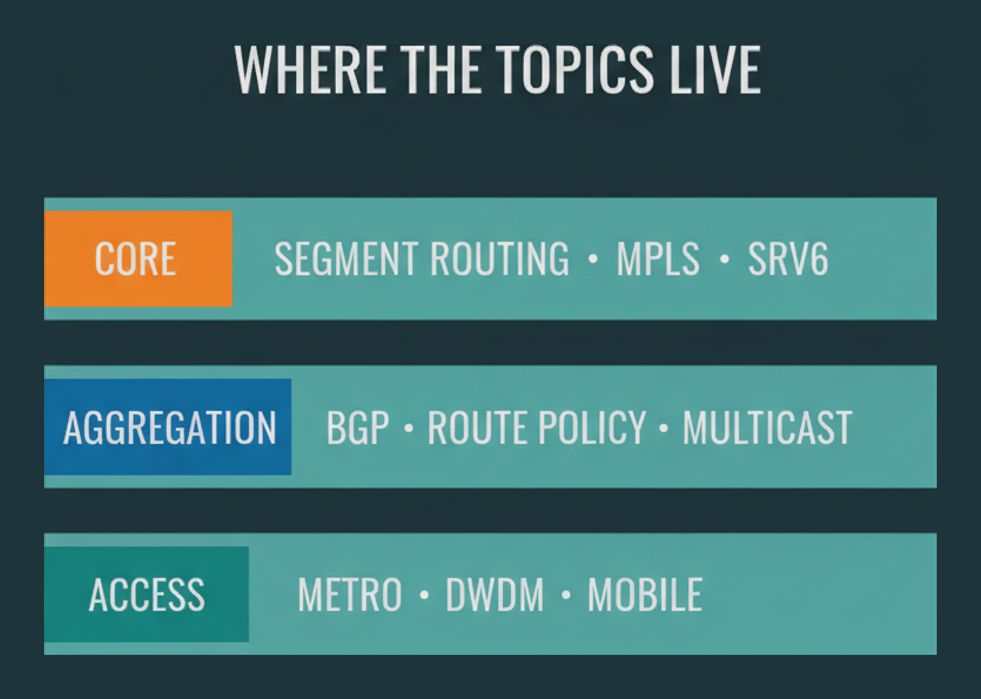
Scale is the difference that catches enterprise engineers. The protocols are the ones you already know, but the questions assume a topology where a full table is normal, where route reflection is structural rather than optional, and where convergence time has a contractual meaning. Knowing how a protocol works is table stakes; knowing how it behaves at provider scale is the exam.
Why this domain decides the outcome
At 30 percent, networking is roughly a third of the paper on its own. It is also the domain the other four lean on: segment routing runs over an IGP, services ride on the routing plane, and assurance measures it. Candidates who under-prepare here tend to lose marks in three domains rather than one, which is why it is worth the largest share of study time as well as the largest share of questions.
How Much Segment Routing Is on the Exam?
MPLS and Segment Routing is a full 20 percent domain, and segment routing is named directly in the architecture domain as well, appearing as SR, SR traffic engineering and SRv6 among the core architectures. It is not an emerging topic on this syllabus. It is examined as current practice alongside classic MPLS.
The two label planes coexist in the objectives for a reason: real carrier networks are mid-migration. You are expected to reason about unified MPLS and about segment routing, and to understand why an operator would move from one to the other. The architecture that underpins it is defined by the IETF in RFC 8402, which is worth reading once properly rather than absorbing second hand.
SRv6 is the part most likely to be unfamiliar. It replaces the MPLS label stack with IPv6 addressing, which changes how you think about the forwarding plane rather than merely swapping an encapsulation. Treating it as MPLS with different syntax is the standard mistake.
Traffic engineering ties the domain together. The QoS models named in architecture, including MAM, RDM, CBTS, PBTS and differentiated services traffic engineering, are the mechanisms by which labelled paths get the treatment they were designed for, so the two domains are best studied against each other.
What Do Services and Automation Actually Test?
Services is 20 percent and covers what the carrier sells over the network it has built: Layer 2 and Layer 3 VPNs, Ethernet services, and the quality of service treatment that makes those services contractually meaningful. Automation and Assurance is 15 percent and covers programmability and the telemetry that proves the network is behaving.
Services is where architecture stops being abstract. A VPN is a set of decisions about the label plane, the routing plane and the QoS policy, all at once, and the questions tend to present a customer requirement and ask which combination delivers it. That is a design question wearing an implementation costume.
Automation is not optional at 15 percent
Fifteen percent is roughly fifteen questions at the middle of the item range, which is more than enough to decide a pass. The domain covers model-driven programmability and the interfaces that make it possible, and the foundational protocol is defined by the IETF in RFC 6241, the NETCONF specification. Assurance sits alongside it, covering the telemetry that turns a configured network into an observed one.
Engineers from a purely CLI background find this domain the hardest, not because it is conceptually difficult but because it is unfamiliar territory. It is also the domain where a few hours of deliberate lab time converts most directly into marks.
How Should You Prepare for 350-501?
Preparation for 350-501 works best when it follows the dependency order of the domains rather than their published order. Architecture supplies the vocabulary, networking supplies the plane everything else runs on, the label plane sits on top of that, services ride the label plane, and assurance observes the whole thing.
- Read the architecture domain first as a glossary, making sure every named transport, core architecture and QoS model means something concrete to you before moving on.
- Give networking the largest single block of study time, working the routing protocols at provider scale rather than at enterprise scale, with route policy and convergence behaviour treated as first-class topics.
- Take MPLS and segment routing together, building both label planes in a lab and migrating a path from one to the other so the difference is something you have done rather than read.
- Layer services on top of that lab, configuring Layer 2 and Layer 3 VPNs over the paths you just built and applying the QoS models from the architecture domain to them.
- Finish with automation and assurance, driving a device through a model-driven interface and streaming telemetry from it, then run a full timed rehearsal at 120 minutes.
Because the pass mark is variable and the item count reaches 110, pace matters as much as coverage. A structured plan helps here, and our SPCOR study plan lays out a phased approach for candidates working around a full-time role.
Once the core is behind you, the concentration choice is the next decision, and it shapes what the CCNP actually says about you. The Cisco service provider track overview covers how the concentration exams differ and which suits which role.
Frequently Asked Questions
What does SPCOR stand for?
Service Provider Core. The full exam name is Implementing and Operating Cisco Service Provider Network Core Technologies, and the exam code is 350-501. It is the core exam of the CCNP Service Provider track.
How many questions are on the 350-501 exam?
Between 90 and 110 questions in 120 minutes. At the top of that range you have roughly 65 seconds per question, which leaves no room to work an answer out slowly from first principles.
What is the passing score for SPCOR?
Variable rather than fixed, landing approximately between 750 and 850 out of 1000. Cisco adjusts the mark for the difficulty of the individual exam form, so you cannot calculate a target number of correct answers in advance.
How much does the 350-501 exam cost?
Four hundred US dollars, or the equivalent in Cisco Learning Credits. Booking runs through Pearson VUE in the usual way, with test centre and online proctored options available.
Which SPCOR domain carries the most marks?
Networking, at 30 percent. MPLS and Segment Routing and Services each carry 20 percent, while Architecture and Automation and Assurance carry 15 percent each.
Does passing SPCOR give you a certification on its own?
Yes. Passing 350-501 awards the Cisco Certified Specialist for Service Provider Core, which is valid for three years and stands independently of whether you go on to complete the CCNP.
What else is needed for CCNP Service Provider?
One concentration exam of your choice alongside the core. Cisco lists several options including SPRI, SPVI and SPCNI, so the concentration is where you choose what the credential says about your specialism.
Is segment routing on the SPCOR exam?
Yes, extensively. It appears in the dedicated MPLS and Segment Routing domain at 20 percent, and again in the architecture domain where SR, SR traffic engineering and SRv6 are named among the core architectures.
Does SPCOR cover automation?
Yes. Automation and Assurance is a full 15 percent domain covering model-driven programmability and telemetry, which is roughly fifteen questions at the middle of the item range and easily enough to decide a pass.
Which operating systems does the exam cover?
IOS, IOS XE and IOS XR. The architecture domain treats Cisco network software architecture as an examinable topic, so the differences between the three platforms are inside scope rather than background.
Conclusion
The SPCOR exam topics describe a carrier network from transport to telemetry, and the weighting spreads across all five domains rather than concentrating in one. Networking takes 30 percent, the label plane and services take 20 each, and architecture and automation take 15 apiece. Between 90 and 110 questions in 120 minutes, at a pass mark that moves.
Study in dependency order rather than published order, build both label planes in a lab instead of reading about them, and give automation the hours it deserves rather than the hours it feels like it deserves. Pass it and you have a specialist certification in hand before you have chosen a concentration at all.


