Ghidra. Radare. Volatility. HxD. XORBruteForces. TCPdump. Those are not suggested study aids from a training provider. They are named inside the exam objectives.
Most certification blueprints describe capabilities and leave the tooling to you. Cisco does the opposite here. The 300-215 CBRFIR exam, Conducting Forensic Analysis and Incident Response Using Cisco Technologies for Cybersecurity, spells out hex editors, disassemblers, deobfuscation utilities, memory forensics tools and packet analysers by name, alongside YARA, MITRE ATT&CK, STIX and TAXII. It runs 55 to 65 questions in 90 minutes at 300 US dollars, and it is one of two concentration exams for the CyberOps Professional certification. This guide sets out the five weighted domains, the tools the blueprint actually names, how much scripting it expects, and where the marks concentrate.
What Does the 300-215 CBRFIR Exam Cover?
300-215 CBRFIR covers five weighted domains: fundamentals, forensics techniques, incident response techniques, forensics processes and incident response processes. The split runs roughly half forensics and half incident response, with the fundamentals domain supplying the shared groundwork of root cause analysis, anti-forensic tactics, encoding and obfuscation, and YARA rules.
Read the domain names together and the exam’s design becomes obvious. Cisco separates techniques from processes in both disciplines. Techniques are what you do with a tool or a log. Processes are the sequence, the decision and the documentation around it. A candidate who is fluent with Volatility and hopeless at writing an incident response playbook will lose 30 percent of the paper.
Where the Cisco products come in
The objectives name Cisco Umbrella, Cisco Secure Endpoint, Cisco Secure Network Analytics, PX Grid, Cisco XDR, Firepower and ThreatGrid. They appear as sources of evidence and as places to apply a mitigation, not as products to configure. This is not a deployment exam, and nobody is being asked to build a policy set.
One objective covers gathering evidence from virtualised environments at the major cloud vendors, which is the part of the syllabus most likely to catch out an experienced responder whose experience is entirely on premises.
What Are the 300-215 Exam Details?
300-215 CBRFIR is 55 to 65 questions in 90 minutes, priced at 300 US dollars and delivered through Pearson VUE. Cisco publishes the current revision as version 1.2 and offers the exam in English. The passing score is variable rather than fixed, sitting at roughly 750 to 850 on a 1000 point scale.
| Field | Value |
|---|---|
| Exam name | Conducting Forensic Analysis and Incident Response Using Cisco Technologies for Cybersecurity |
| Exam number | 300-215 CBRFIR |
| Version | 1.2 |
| Questions | 55 to 65 |
| Duration | 90 minutes |
| Passing score | Variable, approximately 750 to 850 of 1000 |
| Price | $300 USD |
| Language | English |
| Delivery | Pearson VUE |
The variable cut score is worth understanding rather than worrying about. Cisco does not publish a fixed number for this exam, because the threshold moves with the form of the paper a candidate receives. Planning around the top of the published range is the safe approach, and Cisco’s own CBRFIR exam page confirms the version and the duration.
Ninety minutes across up to 65 questions leaves under 90 seconds each. Several objectives ask you to interpret a provided artefact, a code snippet or a log extract, and those take longer than a recall question, so the pace matters.
Which CBRFIR Domain Carries the Most Marks?
Incident response techniques carries 30 percent, half as much again as any other domain on the paper. Fundamentals and forensics techniques take 20 percent each, and the two process domains take 15 percent each. So a third of the exam sits in a single domain about interpreting alerts and recommending what to do next.
| Domain | Weight | What it is really asking |
|---|---|---|
| Incident Response Techniques | 30% | Interpret alerts and logs, correlate by incident type, recommend mitigation and response, read threat intelligence for indicators |
| Fundamentals | 20% | Root cause analysis, anti-forensic tactics, encoding and obfuscation, YARA basics, the tool categories, cloud evidence |
| Forensics Techniques | 20% | Fileless malware analysis, locating artefacts on a host, reading tool output for indicators, scripting against log sources |
| Forensics Processes | 15% | Anti-forensic techniques, web and server log analysis, traffic analysis, next steps when evaluating files, reading binaries |
| Incident Response Processes | 15% | Goals of incident response, playbook elements, ThreatGrid report components, STIX and TAXII intelligence formats |
That 30 percent domain is also the one with the longest objective list, and its verbs are all recommendation verbs. It asks what you would recommend for a zero day exploitation, what response an intelligence artefact justifies, and which Cisco solution detects or prevents a given behaviour. Recall alone will not get you through it.
Because the exam presents artefacts and asks for a judgement, the fastest way to find out whether your reasoning matches Cisco’s is to sit questions in the same shape. A 300-215 practice test built to the blueprint gets you there faster than re-reading the objectives.
Which Tools Does the CBRFIR Blueprint Name?
Cisco names specific tools in the objectives rather than describing tool categories. Hex editors HxD, Hiew and Hexfiend. Disassemblers and debuggers Ghidra, Radare and Evans Debugger. Deobfuscation utilities XORBruteForces, xortool and unpacker. Volatility, Sysinternals, SIFT tools and TCPdump for analysis. Wireshark and NetFlow for traffic. Plus objdump for binaries.
| Category | Named in the objectives | What you are asked to do with it |
|---|---|---|
| Hex editors | HxD, Hiew, Hexfiend | Describe their role in a DFIR investigation |
| Disassemblers and debuggers | Ghidra, Radare, Evans Debugger | Perform basic malware analysis |
| Deobfuscation | XORBruteForces, xortool, unpacker | Recognise and reverse encoding and obfuscation |
| Memory and host analysis | Volatility, Sysinternals, SIFT tools | Recognise their purpose, use and functionality |
| Traffic analysis | TCPdump, Wireshark display filtering, NetFlow | Analyse traffic associated with malicious activity |
| Binary inspection | objdump and other command line tools | Interpret binaries using Linux, Python and Bash |
The verbs matter here. Most of these objectives say describe or recognise rather than perform, which tells you the exam wants informed familiarity rather than deep reverse engineering skill. Knowing that Ghidra decompiles and that Volatility works on memory images is closer to what is being asked than being able to unpack a packer under time pressure.
Two named resources are worth working with directly, because they sit inside objectives rather than beside them. The Volatility Foundation repository is the reference for the memory forensics half, and enterprise attack tactics is the framework the fileless malware objective explicitly points to.
How Much Scripting Does the Exam Expect?
One objective asks candidates to construct Python, PowerShell and Bash scripts that parse and search logs or multiple data sources, naming Cisco Umbrella, Cisco Secure Endpoint, Cisco Secure Network Analytics and PX Grid as those sources. Another asks you to determine the type of code from a provided snippet. Scripting is therefore examinable content, not an assumed background skill.
The realistic level is reading fluency plus basic construction. You need to look at a snippet and know whether it is PowerShell or Bash, understand what a parsing loop is doing, and reason about how you would pull indicators out of a log source. Nobody is compiling anything.
That said, the combination of three languages and several Cisco data sources is unusual breadth for a single objective. A responder who works entirely in one shell should spend deliberate time on the other two rather than assuming the syntax will be recognisable on sight.
What Do the Two Incident Response Domains Ask For?
Together they are 45 percent of the paper. Incident response techniques, at 30 percent, is about interpreting evidence and recommending action. Incident response processes, at 15 percent, is about the framework around that action: the goals of incident response, what belongs in a playbook, how to read a ThreatGrid report, and how threat intelligence arrives in STIX and TAXII formats.
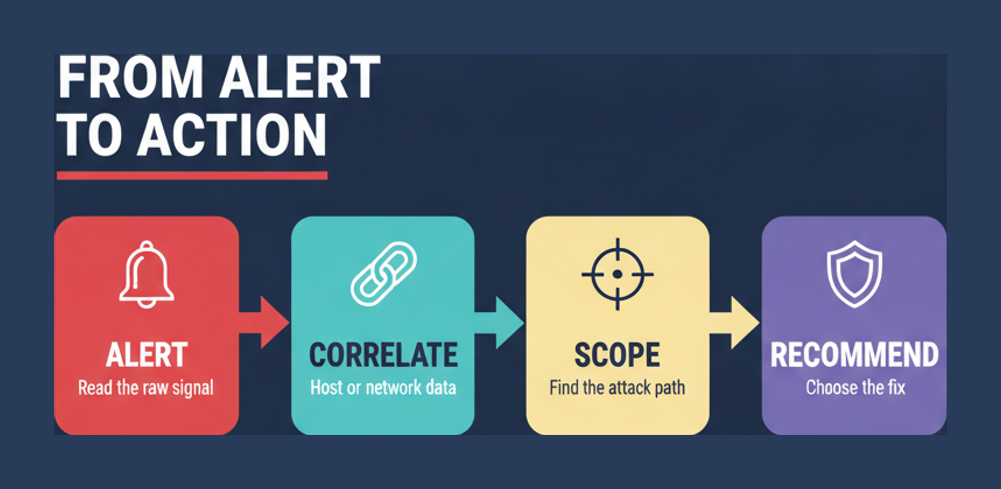
The techniques domain reads like a shift in a SOC. Interpret SIEM, IDS and syslog alerts. Decide what to correlate based on whether the incident is host-based or network-based. Work out the attack vector and recommend a mitigation. Recommend a response to a zero day. Build a threat actor profile from intelligence artefacts.
Why the process domain is the one people skip
Playbook structure and intelligence formats feel like paperwork next to memory forensics, and they are worth 15 percent. STIX and TAXII in particular are easy marks for anyone who spends an hour on them and guaranteed losses for anyone who does not, because they are specific named formats rather than a concept you can reason your way to.
The ThreatGrid objective is similarly concrete. It asks you to evaluate the relevant components of a report, which means knowing what such a report contains rather than holding an opinion about sandboxing.
How Does 300-215 Fit Into CyberOps Professional?
CyberOps Professional requires a core exam plus one of two concentration exams. The core is 350-201 CBRCOR, Performing CyberOps Using Cisco Security Technologies. The two concentrations are 300-215 CBRFIR, this exam, and 300-220 CBRTHD, the threat hunting exam. Passing the core plus either concentration earns the certification, which Cisco says is valid for three years.
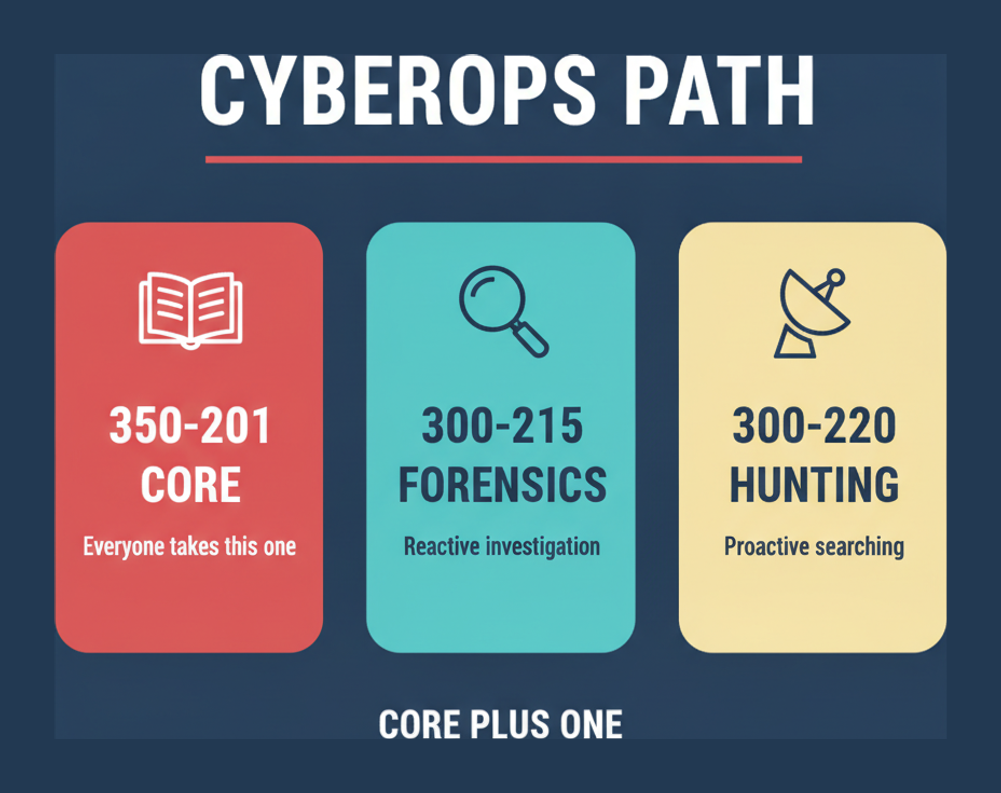
The choice between the two concentrations is a choice between two jobs rather than two difficulty levels. Forensics and incident response is reactive work: something happened, and you establish what, how, and what to do about it. Threat hunting is proactive: nothing has alerted, and you go looking anyway.
If you are weighing them up, our Cisco threat hunting exam breakdown covers the other side of that decision in the same detail. Cisco’s own CyberOps Professional page sets out the recertification options, which run on Continuing Education credits as well as on retaking exams.
How Should You Prepare for the CBRFIR Exam?
Preparation should be led by the weightings and by the unusual specificity of the objectives. With 45 percent of the paper on incident response and a named tool list to work through, the plan is closer to a checklist than to a reading course. Cisco publishes no prerequisite, though the exam assumes real security operations experience.
- Start with incident response techniques, the 30 percent domain, and practise turning an alert into a recommended mitigation rather than only into an explanation.
- Work through the named tool list category by category, confirming you can say what each tool is for and what its output looks like, since most objectives use describe and recognise rather than perform.
- Spend an hour each on STIX, TAXII and YARA, because they are specific named formats where an hour of reading converts directly into marks.
- Read snippets in Python, PowerShell and Bash until you can identify the language on sight and explain what a parsing loop is extracting.
- Practise pulling evidence from a virtualised environment at one of the major cloud providers, which is the objective most likely to be outside an on premises responder’s experience.
- Learn the structure of an incident response playbook and of a ThreatGrid report, since the 15 percent process domain rewards knowing their components.
- Map a handful of real intrusions onto attack tactics and techniques so the framework is a way of thinking rather than a list you have read.
- Sit timed practice at under 90 seconds a question, because the artefact-based items are slower than recall items and the clock is the constraint.
Anyone still building the underlying knowledge should sit the associate exam first. Our CyberOps Associate study guide covers the foundations this exam assumes you already hold.
Frequently Asked Questions
How many questions are on the 300-215 CBRFIR exam?
Between 55 and 65 questions in 90 minutes. Cisco publishes the duration on its own exam page; the question range comes from the exam syllabus, and it leaves under 90 seconds per item at the top of the range.
What is the passing score for CBRFIR?
There is no fixed cut score. The passing mark is variable, sitting at approximately 750 to 850 on a 1000 point scale, so planning around the upper end of that range is the safe approach.
How much does the 300-215 exam cost?
300 US dollars, booked through Pearson VUE. Local taxes and currency conversion apply depending on where the appointment is scheduled.
Which CBRFIR domain is worth the most?
Incident response techniques at 30 percent. Fundamentals and forensics techniques are 20 percent each, and the two process domains are 15 percent each, so a third of the paper sits in one domain.
Do you need to know Ghidra and Volatility for the exam?
Both are named in the objectives, but the verbs are describe and recognise rather than perform. You need to know what each tool does and what its output looks like, not to reverse engineer malware under exam conditions.
Is scripting tested on 300-215?
Yes. One objective asks you to construct Python, PowerShell and Bash scripts that parse and search logs across Cisco data sources, and another asks you to identify the type of code from a provided snippet.
What is the difference between 300-215 and 300-220?
They are the two CyberOps Professional concentration exams. 300-215 covers reactive forensic analysis and incident response; 300-220 covers proactive threat hunting. Either one, plus the core exam, earns the certification.
Which core exam pairs with CBRFIR?
350-201 CBRCOR, Performing CyberOps Using Cisco Security Technologies. CyberOps Professional needs that core exam plus one of the two concentration exams.
How long does CyberOps Professional stay valid?
Three years. Cisco allows renewal through Continuing Education credits or by retaking qualifying exams before the certification expires.
Does CBRFIR cover cloud forensics?
Partly. One fundamentals objective covers the issues around gathering evidence from virtualised environments at the major cloud vendors, which is often the least familiar area for responders with on premises experience.
Conclusion
An exam that names XORBruteForces and Hexfiend in its objectives is telling you something about how it will be marked. This is not a blueprint you can satisfy with general DFIR knowledge and a strong tool of your own choosing.
Work it in the order the weightings imply. Incident response techniques is 30 percent and the whole domain is about recommending an action, so practise turning evidence into a decision rather than into a description. Add the two process domains next, because playbook structure, ThreatGrid report components, STIX and TAXII are 15 percent of specific, learnable content that candidates routinely leave until last and then skip. Then work the named tool list on its own terms, remembering that the objectives mostly ask you to recognise rather than to operate. With under 90 seconds a question and several artefact-based items, timed practice is what turns familiarity into a pass.


