In a traditional data centre network you configure a port. In ACI you configure an endpoint group, and the port learns what to do from the policy attached to that group. Everything difficult about this exam follows from that one inversion, because a candidate who keeps thinking in interfaces will answer plausibly and score badly.
The DCACI v1.2 exam, Cisco 300-620, is 90 minutes and roughly 55 to 65 questions, priced at 300 USD through Pearson VUE, covering six domains from fabric infrastructure to ACI Anywhere. It is the concentration half of CCNP Data Center and it rolled to version 1.2 last month, which is why so much of what you will read about it describes something slightly different.
Table of Contents
- What does ACI change about configuring a network?
- What are the 300-620 exam facts?
- Which version is current, and why do Cisco’s pages disagree?
- What do the six domains cover?
- Why is the object model the real barrier?
- How much do external connectivity and integrations matter?
- What does the ACI Anywhere domain cover?
- How does DCACI pair with DCCOR?
- Who should sit this exam?
- How should you prepare?
- Frequently Asked Questions
- Conclusion
What does ACI change about configuring a network?
ACI moves configuration from the device to the fabric and from the interface to the policy. Instead of logging into a switch and setting a VLAN on a port, you define tenants, application profiles, endpoint groups and contracts on the controller, and the fabric works out which switch needs which configuration to satisfy them.
The consequence for an engineer is that the familiar troubleshooting reflex stops working. When traffic does not pass between two endpoints, the answer is rarely a missing VLAN and usually a missing or wrongly scoped contract. The exam is built on that difference, which is why memorising ACI’s menus produces a worse result than understanding its model.
The fabric underneath is less exotic than the policy layer above it. ACI forwards over a VXLAN overlay, the encapsulation specified in RFC 7348, so the transport concepts will be familiar to anyone who has worked with overlays elsewhere. What is new is that policy, not topology, decides what is allowed to talk.
What are the 300-620 exam facts?
The exam runs 90 minutes with roughly 55 to 65 questions, costs 300 USD, and is booked through Pearson VUE. Cisco’s own exam page confirms the 90 minute duration. It publishes neither a question count nor a passing score, so both of those figures come from the exam catalogue rather than from Cisco.
| Field | Value |
|---|---|
| Exam | Implementing Cisco Application Centric Infrastructure |
| Code | 300-620 DCACI |
| Current version | v1.2 |
| Duration | 90 minutes, confirmed by Cisco |
| Questions | 55 to 65, catalogue figure |
| Fee | 300 USD |
| Delivery | Pearson VUE |
| Counts toward | CCNP Data Center, and the Data Center ACI Implementation specialist credential |
On the passing score, be careful what you believe. Cisco does not publish a cut score for this exam or for its other professional-level papers, and the figure you will see quoted around 750 to 850 out of 1000 is an approximation rather than a published threshold. Treat it as a rough target and not as a number Cisco has committed to.
Because the paper spreads across six domains with no dominant one, the useful readiness signal is coverage rather than depth in a favourite area, and a 300-620 practice test will show which of the six you have quietly neglected.
Which version is current, and why do Cisco’s pages disagree?
Version 1.2 is current. The previous version, v1.1, had its last test date on 26 August 2026, and Cisco’s exam topics page is now titled for v1.2 while the e-learning course and the update notes both carry the 1.2 label. The exam code itself did not change and 300-620 is not retired.
That last point is worth stating plainly, because a search will suggest otherwise. Several pages report a last test date of 26 August 2026 without saying which version it applied to, which reads as though the exam is gone. It is not: Cisco’s retired exam list contains no entry for 300-620 or DCACI, and the exam is still served on the current list.
Cisco’s own pages have not fully caught up with the change. The current-list exam page still describes the exam as v1.1 in its body text while linking the v1.2 update notes immediately above, so a candidate glancing at one paragraph and a candidate glancing at the other will come away with different answers. The reliable check is the exam topics document itself, which carries its version in the title.
What that means for your study material
Cisco describes the change as a minor update rather than a rewrite, and publishes no dated list of moved objectives, so nobody can honestly tell you exactly which lines changed. The practical approach is to study from the v1.2 topics document and to treat older material as broadly useful but unverified at the edges, which is where a 90 minute exam is decided.
What do the six domains cover?
The six domains are ACI Fabric Infrastructure at 20 percent, ACI Packet Forwarding at 15 percent, External Network Connectivity at 20 percent, Integrations at 15 percent, ACI Management at 20 percent and ACI Anywhere at 10 percent. No domain dominates, and three sit level at 20 percent, so a balanced preparation beats a deep one.
| Domain | Weight | What it is really testing |
|---|---|---|
| ACI Fabric Infrastructure | 20% | Architecture, the object model, fabric discovery, access and fabric policies |
| ACI Packet Forwarding | 15% | How endpoints are learned and how traffic actually crosses the fabric |
| External Network Connectivity | 20% | Getting traffic in and out of the fabric |
| Integrations | 15% | Virtualisation and service insertion |
| ACI Management | 20% | Faults, health scores, upgrades, access control and programmability |
| ACI Anywhere | 10% | Multi-pod, multi-site and cloud extension |
The weighting tells you something about Cisco’s intent. Fabric infrastructure, management and external connectivity together make 60 percent of the paper, and all three are about running a fabric in a real network rather than about the theory of application-centric policy. This is an implementation exam, and it is named accordingly.
Why is the object model the real barrier?
ACI’s logical constructs nest in a fixed order, and most exam mistakes are really mistakes about that order. A tenant contains VRFs, a VRF contains bridge domains, a bridge domain contains endpoint groups, and contracts govern which endpoint groups may communicate. Application profiles group endpoint groups that belong to the same application.
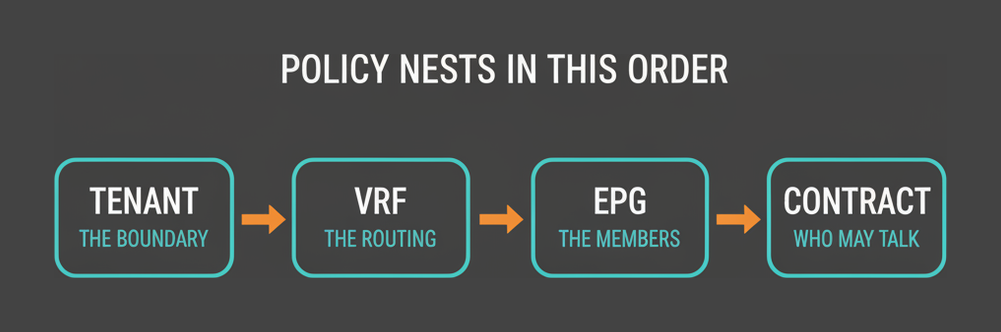
Once that chain is fluent, a whole class of questions becomes straightforward. If two endpoints in different endpoint groups cannot reach each other, the contract is the first suspect. If endpoints in the same endpoint group cannot reach each other, the problem is lower down, in the bridge domain or in fabric discovery. If a subnet behaves oddly across tenants, the VRF scope is where to look.
The fabric infrastructure domain also names faults, events, the audit log and health scores as objectives in their own right. That is deliberate: ACI is unusually good at telling you what is wrong if you know where it keeps that information, and the exam expects you to know which of those four sources answers which kind of question.
Tenancy is not a VLAN
A tenant is an administrative and policy boundary, not merely a segment. The closest classic analogy is the VRF, whose separation model was formalised for BGP and MPLS networks in RFC 4364, and ACI keeps that idea while adding policy on top of it. Candidates who map tenant onto VLAN, rather than onto VRF, get the scoping questions wrong.
How much do external connectivity and integrations matter?
External Network Connectivity is 20 percent of the paper and covers getting traffic into and out of the fabric: external routed networks, external bridged connectivity and the routing that supports them. It is the domain where ACI has to meet the network it did not replace, which is exactly the situation most real deployments are in.
Integrations, at 15 percent, is about the fabric meeting the compute and service layers: virtual machine manager integration and service insertion through device packages and service graphs. The concepts are not difficult, but they are unfamiliar to engineers whose experience stops at the network edge, and they are easy to skip when revising.
Both domains reward the same habit. Rather than memorising the configuration steps, learn what each construct is for and what breaks without it. An exam question about an external routed network almost always describes a symptom and asks which construct is missing, not which menu to open.
What does the ACI Anywhere domain cover?
ACI Anywhere is 10 percent of the exam and covers stretching a fabric beyond one room: multi-pod, multi-site and cloud extension. It is the smallest domain and the newest idea, and it is worth about six questions, which makes it easy to under-prepare and cheap to fix.
The distinction that carries marks is between multi-pod and multi-site, because they solve different problems. Multi-pod keeps one policy domain across pods; multi-site federates separate fabrics with their own controllers under a common policy manager. Confusing the two produces confident wrong answers on failure-domain questions.
How does DCACI pair with DCCOR?
CCNP Data Center is built from one core exam plus one concentration. The core is 350-601 DCCOR, and DCACI is one of the concentration options, so passing 300-620 alone earns the Data Center ACI Implementation specialist credential but not CCNP until the core is also passed.
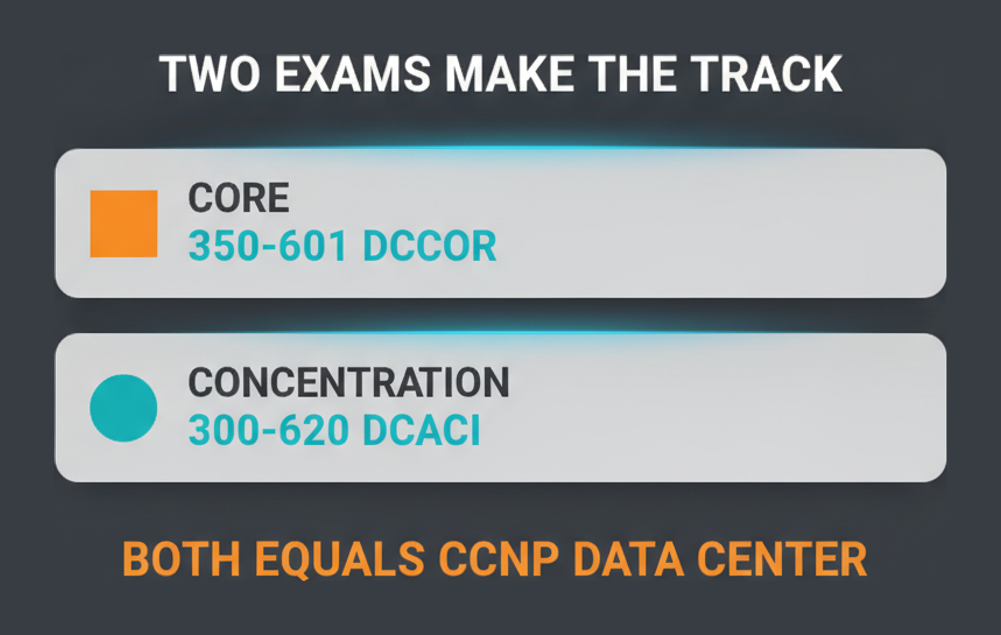
The order is up to you, and there is a practical argument for each. Taking the core first gives you the breadth that makes the concentration easier to place in context; taking the concentration first lets you certify the specialism you already work in while the core material is still being studied.
If the core is the half you have not yet planned for, the 350-601 DCCOR core exam breakdown sets out how much wider its scope is, which is the main thing that surprises engineers who come to it from an ACI specialism.
Who should sit this exam?
DCACI suits data centre network engineers running or deploying ACI, engineers migrating a classic fabric to it, and anyone assembling CCNP Data Center who works on the ACI side. Cisco publishes no formal prerequisite, though the exam clearly assumes working knowledge of data centre switching.
It is a poor fit for engineers with no hands-on fabric access. Several domains, particularly fabric discovery, faults and health scores, and service insertion, are hard to internalise from reading because the whole point is recognising what the system is telling you. A lab, whether physical, virtual or simulated, changes the preparation completely.
If you are earlier in the track and weighing whether the data centre path is the right one at all, the DCACI certification route overview covers the career case rather than the syllabus, which is a different question from the one this article answers.
How should you prepare?
Work from the v1.2 topics document, get hands on a fabric, and practise reading faults rather than configuring features. Ninety minutes for around 60 questions leaves roughly 90 seconds each, so the exam rewards recognising a situation quickly far more than it rewards recalling a command.
- Download the current exam topics and confirm the version in its title before you study anything else.
- Draw the object model from memory until it is automatic: tenant, VRF, bridge domain, endpoint group, contract, application profile.
- Build the smallest working fabric you can reach, then break it deliberately and read what the faults and health scores say.
- Split your time evenly across the three 20 percent domains, then cover forwarding and integrations, then give ACI Anywhere one focused session.
- Practise distinguishing multi-pod from multi-site in writing, because the exam tests the difference rather than the definitions.
- Sit a full timed set before booking, and use the result to find the neglected domain rather than to confirm the strong one.
One more thing worth doing early: check whether your employer’s fabric runs a version close to what the exam assumes. An engineer who works daily on an older release can carry habits that the current topics no longer match, and that gap is easier to close deliberately than to discover in the test centre.
Frequently Asked Questions
Is the Cisco 300-620 exam retired?
No. Version 1.1 had its last test date on 26 August 2026, and v1.2 replaced it. The exam code is unchanged and 300-620 does not appear on Cisco’s retired exam list.
How long is the DCACI v1.2 exam?
Ninety minutes, confirmed on Cisco’s own exam page.
How many questions are on 300-620?
Roughly 55 to 65. Cisco does not publish a question count, so that range comes from the exam catalogue rather than from the vendor.
What is the passing score for 300-620?
Cisco does not publish one. The figure commonly quoted at around 750 to 850 out of 1000 is an approximation, not a published threshold.
How much does the exam cost?
Three hundred US dollars, booked through Pearson VUE.
Does passing 300-620 give me CCNP Data Center?
Not on its own. CCNP Data Center needs the 350-601 DCCOR core exam as well. Passing 300-620 alone earns the Data Center ACI Implementation specialist credential.
Which domain is worth the most?
Three are level at 20 percent: ACI Fabric Infrastructure, External Network Connectivity and ACI Management. No single domain dominates the paper.
Do I need a lab to pass?
It is not required, but several domains are built around recognising what the fabric is reporting, which is difficult to learn from reading alone.
What is the difference between multi-pod and multi-site?
Multi-pod keeps a single policy domain across pods, while multi-site federates separate fabrics that keep their own controllers. The ACI Anywhere domain tests the distinction directly.
Are there prerequisites for 300-620?
Cisco publishes none, though the exam assumes practical data centre switching experience.
Conclusion
300-620 DCACI is the implementation half of CCNP Data Center: 90 minutes, roughly 60 questions, 300 USD, six domains and a fabric that thinks in policy rather than ports. Version 1.2 is current, v1.1 stopped being testable on 26 August 2026, and the code itself is very much alive.
Two habits carry the exam. Learn the object model until the nesting is automatic, because most wrong answers are scoping errors wearing a different hat. Then spread your preparation evenly, since three domains sit level at 20 percent and the paper punishes a specialist who skipped management or external connectivity.
Start from the current exam topics document, check its version in the title, and get access to a fabric you are allowed to break. Reading about health scores teaches you what they are. Breaking something teaches you what they mean.


