There is no router in 810-110, the exam behind the Cisco AI Technical Practitioner certification from Cisco. No switch, no CLI, no subnet and no routing protocol appear anywhere in its six sections, which makes it the first Cisco certification exam many network engineers will sit without touching a single networking objective. The credential is Cisco’s proof that you use AI tools to write code, prepare data, automate workflows and design agents, and 810-110 AITECH v1.0 tests exactly that.
It is a 60 minute paper priced at 150 USD, delivered in English, and passing it earns a Practitioner-level certification that stays valid for three years. The six sections cover generative AI models, prompt engineering, ethics and security, data research and analysis, development and workflow automation, and agentic AI, with weightings that put 40 percent of the marks on the last two. This article explains what each section expects, what the fee buys, how the questions read, how to order your preparation for a one hour sitting, and how the certification differs from Cisco’s AI Business Practitioner learning path.
What Does the Cisco AI Technical Practitioner Certification Actually Test?
The Cisco AI Technical Practitioner certification tests six weighted sections of applied AI work through the 810-110 AITECH exam: Generative AI Models (20 percent), Prompt Engineering (15), Ethics and Security (15), Data Research and Analysis (10), Development and Workflow Automation (20) and Agentic AI (20). Every objective describes using, securing or orchestrating AI tools; none describes configuring network equipment.
Cisco’s own one-sentence description of the exam lists the same six areas, though it calls the fifth one “AI for Code and Workflow Optimization” where the published section heading reads Development and Workflow Automation. The content is the same: how AI fits into writing, testing and shipping software and how workflows built around it are designed and watched.
| Section | Weight | What the objectives name |
|---|---|---|
| Generative AI Models | 20% | LLMs and diffusion models, cloud versus local hosting, context windows and token limits, model hubs, RAG with embeddings and vector databases |
| Prompt Engineering | 15% | Roles, instructions and constraints; iterative, chained and few-shot prompting for text, image and audio; prompt injection; defensive prompting against hallucinations |
| Ethics and Security | 15% | Responsible AI principles, corporate data privacy, AI-specific threats including misinformation, governance and compliance |
| Data Research and Analysis | 10% | AI in exploratory data analysis, automated data preparation, privacy controls, AI-assisted research and drafting |
| Development and Workflow Automation | 20% | AI across the software development lifecycle, code generation and prototyping, workflow design and monitoring, token cost, code quality |
| Agentic AI | 20% | Agentic versus generative use cases, agent design and orchestration, Model Context Protocol primitives, human-in-the-loop, data transformation inside agents |
Two sections carry the most specific technical vocabulary. Generative AI Models expects you to explain Retrieval Augmented Generation and the part embeddings and vector databases play in it. Agentic AI expects you to describe the primitives of the Model Context Protocol, an open standard that did not exist when most current Cisco blueprints were written. The 27 objectives behind the headings are short, but each one hides several testable ideas, so read the full 810-110 objective list before you decide how much of this material you already know.
Who Is 810-110 Written For, and Who Should Skip It?
810-110 is written for technical professionals who already use AI tools in their work and want a Cisco credential that proves it: engineers generating code and test cases with AI, solution architects weighing fine-tuning against RAG, and technical leads rolling AI workflows out to a team. It is not written for anyone hoping to be examined on Cisco networking, and it assumes no prior Cisco certification.
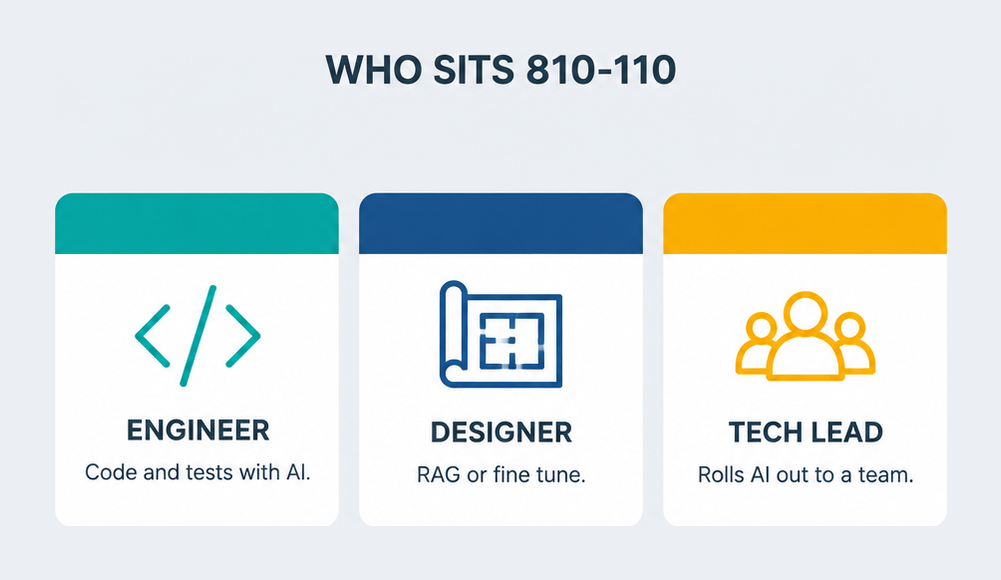
Cisco describes three audiences for the credential on its AI Technical Practitioner page. The first is a technical IT professional who wants to modernise daily work with AI-powered code generation, test case generation and AI-assisted data analysis. The second is a solutions architect who has to evaluate how a model is customised, deployed and wired into a workflow. The third is a technical lead or manager who is leading AI adoption and setting the practices a team follows.
The roles Cisco attaches to the certification follow from that list: AI engineer, prompt engineer and AI workflow coordinator. None of them is a network role, and the exam objectives match. Nothing in the six sections asks about packets, VLANs, OSPF or any Cisco platform.
Who should skip it
If your goal is a Cisco credential that validates network automation, this is not the exam. The CCNP Automation track covers Ansible, Terraform, RESTCONF and pipeline work and reserves its AI content for building automation tooling. If you have never written a prompt in anger, never run a model locally and never looked at a vector database, the Practitioner tier is still reachable, but you will be learning the vocabulary and the judgement at the same time, and the 60 minute limit rewards people who already recognise the trade-offs on sight.
How Much Does the Cisco AI Technical Practitioner Exam Cost, and What Does 150 USD Buy?
The Cisco AI Technical Practitioner exam costs 150 USD, or the equivalent in Cisco Learning Credits, for one 60 minute sitting of 810-110 AITECH booked through Pearson VUE. Passing earns a certification that is valid for three years. At the Practitioner level it renews with 15 Continuing Education credits, a retake, or a pass at a higher level.
| Item | Detail |
|---|---|
| Exam | 810-110 AITECH, Cisco AI Technical Practitioner v1.0 |
| Price | 150 USD or Cisco Learning Credits |
| Duration | 60 minutes |
| Language | English |
| Questions | 40 to 60 on the money-site syllabus page; Cisco publishes no count |
| Pass mark | Variable scaled score, roughly 750 to 850 out of 1000; Cisco publishes no fixed figure |
| Delivery | Pearson VUE |
| Prerequisites | None; one core exam earns the certification |
| Validity | Three years |
| Renewal | 15 Continuing Education credits, or retake, or a higher-level pass |
Two of those rows deserve a caveat. Cisco’s 810-110 AITECH exam page gives the duration, the price and the language, but Cisco does not publish how many questions 810-110 contains or what score passes it. The 40 to 60 range and the 750 to 850 band come from the money site’s syllabus page, and the pass mark is scaled and variable, which is why no fixed percentage exists to aim for. Plan to be comfortable across all six sections rather than targeting a number.
The retake and renewal rules
Cisco’s recertification policy applies to this exam exactly as it does to the rest of the catalogue. Fail, and you wait five calendar days before booking the same exam again at the same price. Pass, and you cannot sit the same exam number again for 180 days. There are no extensions on the three-year expiry, and an expired certification means passing the exam again from scratch. Cisco sends reminders at two years, one year, 90, 60 and 30 days before the date, so the renewal is hard to miss unless the email on your certification profile is stale.
Fifteen CE credits is the lightest renewal load in Cisco’s scheme, which fits a field that will have changed shape twice before the three years are up. Completing CE-eligible learning paths on Cisco U earns those credits.
Generative AI Models and Prompt Engineering: the First 35 Percent
The first two sections of 810-110, Generative AI Models at 20 percent and Prompt Engineering at 15, together carry 35 percent of the Cisco AI Technical Practitioner exam. They test whether you can pick and host a model sensibly, explain how it manages context and tokens, build retrieval around it, and write prompts that get reliable output without opening the door to injection.
Models, hosting and retrieval
The model objectives start with the families: large language models for text, summarisation and code, diffusion models for images. From there the exam moves to the decision an architect actually faces, cloud-hosted against locally hosted, and the four trade-offs it names: cost, latency, privacy and scalability. Expect scenario questions where one of those four is the deciding factor.
Context windows and token limits are tested as practical constraints rather than definitions. The same idea reappears in the Development section as a cost and latency lever, so learn it once and apply it twice. Retrieval Augmented Generation closes the section: a query is embedded, the nearest chunks are pulled from a vector database, and the model answers with those chunks in its context. Know the role of each piece well enough to say which one is missing when a scenario describes stale or invented answers.
Prompts, patterns and injection
Prompt Engineering covers the building blocks of a prompt, roles, instructions and constraints, and the techniques built from them: iterative and sequential prompting, chained prompts, and few-shot examples for specialised tasks. It also extends the same ideas to image and audio generation, where intent has to be signalled more explicitly than in text.
The security half of the section is where candidates lose marks. You need to describe the types of prompt injection attack and the defensive prompting and mitigation strategies for AI-generated errors such as hallucinations. The OWASP Top 10 for LLMs ranks prompt injection as LLM01 and misinformation as LLM09, and its descriptions of each are a compact way to learn the vocabulary the exam uses.
How Does the Exam Treat AI Ethics, Security and Data Analysis?
810-110 gives Ethics and Security 15 percent and Data Research and Analysis 10 percent, a quarter of the paper on how AI is governed and how it handles data. The ethics objectives name fairness, transparency, accountability, bias mitigation and safety; the data objectives cover exploratory analysis, automated preparation and the privacy controls that stop an AI-assisted analysis from exposing what it reads.
The security material here is different from the prompt injection content earlier. This section asks about the threats specific to AI systems as a class, misinformation among them, about protecting corporate data that models are prompted or trained with, and about governance: policy, risk management and compliance. The sample items on the money site show the shape of it. One asks which trade-off a security team is managing when it restricts sensitive customer data from prompts, reducing risk at the cost of usefulness. Another asks which single action most directly mitigates bias in a decision-support model.
Governance questions reward knowing that a published framework exists. The NIST AI Risk Management Framework organises AI risk around governing, mapping, measuring and managing, and its Generative AI Profile from July 2024 lists the risks that are specific to generative systems. You will not be asked to recite it, but a candidate who has read its structure recognises the governance answer faster than one who has not.
Data research and analysis
The smallest section is also the most hands-on. It asks what AI contributes to exploratory data analysis, which preparation tasks it can automate, quality checks, formatting, transformation and cleaning, and what ethical and privacy controls belong around an AI-assisted analysis. The final objective, AI-assisted research, ideation and drafting, is the one most candidates already practise daily and the one least likely to need study time. The first sample question on the money site, where an AI flags missing values and inconsistent formats before modelling begins, is a straight test of the preparation objective.
What Do the Development and Agentic AI Sections Expect You to Know?
Development and Workflow Automation and Agentic AI are the two heaviest sections of the Cisco AI Technical Practitioner exam at 20 percent each. The first asks how AI is used at every stage of the software lifecycle and how an AI workflow is designed, costed and monitored. The second asks how an agent differs from a generative model, how agents are designed and orchestrated, what the Model Context Protocol primitives are, and where a human stays in the loop.
AI across the development lifecycle
The development objectives follow the lifecycle in order: requirements, prototyping, implementation, testing and deployment. Code generation and rapid prototyping get their own objective, as does the way AI improves code quality through debugging help, error handling and documentation. The objective that catches people is the one on cost: how token usage and context-window management change the cost, latency and output quality of a prototype. It is the same context-window idea from the first section, now asked as an engineering decision.
Workflow design and monitoring rounds the section off. Think of a multi-step workflow where a model classifies a ticket, a second call drafts a response and a third checks it against policy. The exam wants you to know what to monitor in that chain and where it can fail quietly.
Agents, MCP and the human in the loop
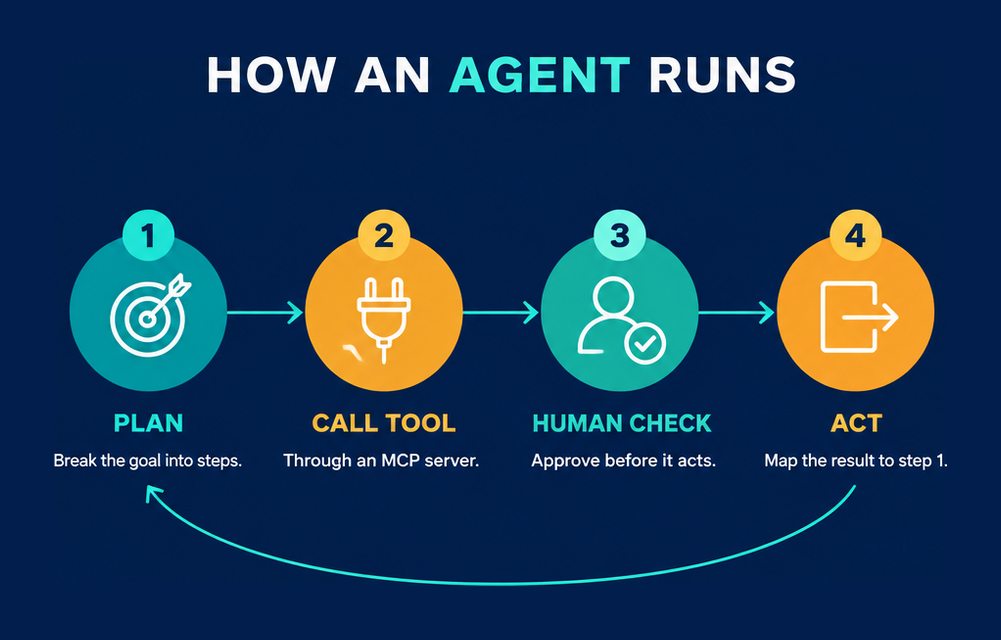
Agentic AI starts by separating agentic from generative use cases. A generative model answers; an agent plans, calls tools, checks results and acts. From there the objectives cover agent design principles, autonomous capabilities and orchestration, then the Model Context Protocol. The MCP specification defines an open protocol in which hosts, clients and servers exchange JSON-RPC messages, and servers expose three primitives: prompts, resources and tools. Those three words are the ones to know.
Human-in-the-loop strategies decide when an agent pauses for approval, and the final objective covers data transformation and mapping inside an agent, the plumbing that turns a tool’s output into the next step’s input. Candidates coming from the automation side of Cisco will find this the most familiar section; candidates coming from a pure prompting background should budget the most time here.
How Do 810-110 Questions Read on the Day?
810-110 questions read as short scenarios. A typical item describes a situation in one to three sentences, a team restricting sensitive data from prompts or an AI flagging missing values before modelling, then asks a single question about it with four options and one correct answer. Pure recall items exist but are the minority; most items ask you to name a trade-off, a category or a mitigation.
The ten sample questions published on the money site give a fair preview. Two are definitional: the role of a context window, and which use case suits a diffusion model rather than an LLM. The other eight are judgement calls dressed as scenarios: which task category an AI is performing during automated preparation, why few-shot examples help on domain-specific work, which threat is specific to AI rather than traditional IT, which mitigation addresses AI misinformation. That ratio matches a Practitioner exam that wants to see applied understanding rather than memorised lists.
The 60 minute clock shapes tactics more than the content does. With the money site’s 40 to 60 question range, you have roughly one minute to ninety seconds per item, enough to read a scenario twice but not enough to agonise. Answer, flag anything you want to revisit, and keep moving. Section weights are not printed on the question, so do not try to count domains as you go.
Cisco’s blueprint for the exam has been covered on this site before, and the earlier 810-110 blueprint breakdown includes a week-by-week plan that pairs well with the section-level reading above.
How Should You Prepare for a Six-Section, 60 Minute Paper?
Prepare for the Cisco AI Technical Practitioner exam by working the six sections in weight order and finishing with timed practice. Start with the two 20 percent technical sections you know least, Agentic AI and Development, then Generative AI Models, then the prompt and governance material, and only then the 10 percent data section. Cisco U carries the official AITECH learning path, and the AITECH course is the training Cisco recommends for the exam.
Par Merat, who leads Cisco’s learning organisation, described the purpose of the AI certification programme this exam belongs to in plain terms.
“We are focused on reskilling engineers around AI and how that can help them with their current jobs while preparing for the future.”
That framing is a useful guide to how to study: every objective maps to something you can do at a keyboard this week. A sequence that respects the weights and the one hour format looks like this.
- Read all 27 objectives on the syllabus page and mark each one as known, half-known or new, so your plan starts from your actual gaps rather than the section order.
- Build one small agent that calls a tool through an MCP server, then write down the prompts, resources and tools it exposes and where a human approval step would sit.
- Set up a minimal RAG pipeline with a vector database and watch how chunk size and context window change the answers, which covers the model section and the token cost objective together.
- Work through the OWASP LLM Top 10 and the NIST AI RMF structure once each, writing a one-line mitigation for prompt injection, misinformation, data exposure and bias.
- Use an AI assistant for one real data preparation task and one real debugging task, noting what it automated and what you had to check.
- Finish with timed practice at one minute per question until the pace feels comfortable, then book the Pearson VUE slot.
Readers who completed the AI domain of 350-901 will recognise most of step two. The AUTOCOR AI in Automation domain asks candidates to build an MCP server and a conversational agent, and that hands-on work is more than enough background for the agentic section here.
AITECH or AIBIZ: Which Cisco AI Programme Fits You?
Cisco announced the AI Technical Practitioner certification and the AI Business Practitioner learning path together in September 2025, and they are built for different people. AITECH is a proctored exam and a certification for technical staff who build with AI. AIBIZ is a learning path for business professionals, managers and leaders who need AI literacy rather than a technical exam.
The practical test is what you want to be able to show afterwards. A certification carries a three-year validity, a renewal requirement and a verifiable record; a learning path shows that you completed the material. A technical lead who manages an AI rollout but also reviews the code that comes out of it belongs on the AITECH side. A programme manager who sponsors the rollout and signs off the budget belongs on the AIBIZ side.
| Programme | Type | Built for | Outcome |
|---|---|---|---|
| Cisco AI Technical Practitioner (810-110 AITECH) | Certification, proctored exam | Engineers, architects, technical leads using AI tools | Practitioner certification valid three years |
| Cisco AI Business Practitioner (AIBIZ) | Learning path | Business professionals, managers, leaders | Completion of the learning path |
For a network engineer the honest comparison is with the automation track rather than with AIBIZ. AITECH certifies that you can use AI well; the CCNP Automation core certifies that you can build network automation tooling, including AI tooling, and it carries Professional-level weight. The two complement each other. AITECH is the faster, cheaper way to put an AI credential on a profile this quarter, and its agentic section is a direct run-up to the AI work the automation core now asks for.
Frequently Asked Questions
Is the Cisco AI Technical Practitioner a networking exam?
No. None of the six sections of 810-110 AITECH contains a routing, switching, protocol or CLI objective. The exam covers generative AI models, prompt engineering, AI ethics and security, data research and analysis, development and workflow automation, and agentic AI, and Cisco aims it at engineers, architects and technical leads who use AI tools.
How much does the 810-110 AITECH exam cost?
The exam costs 150 USD, and Cisco also accepts Cisco Learning Credits. The fee covers one 60 minute sitting booked through Pearson VUE. A retake after a fail costs the same amount and can be booked after a five calendar day wait.
How many questions are on the Cisco AI Technical Practitioner exam?
Cisco does not publish a question count for 810-110. The money-site syllabus page lists 40 to 60 questions in the 60 minute window, which works out to roughly one minute to ninety seconds per item. Plan your pacing on that range rather than on a fixed number.
What is the passing score for 810-110?
Cisco publishes no passing score for the exam. The mark is scaled and variable, and the money-site syllabus page gives an approximate band of 750 to 850 out of 1000. Because the cut score moves, there is no fixed percentage to target; aim for solid coverage across all six sections.
How long is the Cisco AI Technical Practitioner certification valid?
Three years from the date you earn it. At the Practitioner level you renew by earning 15 Continuing Education credits, retaking the exam, or passing a higher-level Cisco exam before the expiry date. Cisco grants no extensions, and an expired certification requires passing the exam again.
Does 810-110 have any prerequisites?
No. Cisco states that one core exam earns the certification, and no prior Cisco certification or course completion is required. Cisco recommends the AITECH course and the Cisco U learning path as preparation, but neither is mandatory to book the exam.
Which section of the AITECH exam is the hardest?
For most candidates it is Agentic AI, worth 20 percent, because it asks for Model Context Protocol primitives, orchestration and human-in-the-loop design that few people have used in a structured way. Candidates with automation experience often find Prompt Engineering harder, because its injection and defensive-prompting objectives are security questions dressed as writing questions.
Is AITECH the same as AIBIZ?
No. AITECH is the Cisco AI Technical Practitioner, a proctored 810-110 exam that earns a three-year certification. AIBIZ is the Cisco AI Business Practitioner, a learning path for business professionals, managers and leaders. Cisco announced both in September 2025, and only AITECH is a certification.
Is AITECH related to the company Aitech or to generic AI tech courses?
No. AITECH is Cisco’s exam acronym for the AI Technical Practitioner, and searches for the bare word also return an unrelated company and general AI technology content. When you search or book, use the full name or the exam number, 810-110, to reach the Cisco credential.
Can I use 810-110 to recertify another Cisco certification?
Cisco’s recertification policy lets you renew a certification by advancing to the next level or earning Continuing Education credits, and the eligible options are listed on its recertification page. Whether a Practitioner-level pass counts toward a specific higher certification depends on that list, so check it for your own credential rather than assuming.
Conclusion
The Cisco AI Technical Practitioner is the rare Cisco exam that asks nothing about the network and everything about how you use AI around it: which model to host where, how to prompt it safely, how to govern its data, how to build it into a development workflow, and how to hand it tools through MCP without losing the human from the loop. For 150 USD and an hour, it earns a three-year Practitioner certification that renews with 15 CE credits, and its two 20 percent sections on development and agents are the ones that decide most results. Read every objective, build one agent and one retrieval pipeline, learn the OWASP and NIST vocabulary, and then practise at exam pace. Start with the full objective list on the syllabus page linked above and plan your six sections from there.


