Cisco publishes two version numbers for the same exam. The 300-510 SPRI exam page still labels Implementing Cisco Service Provider Advanced Routing Solutions as v1.0, while the exam topics document Cisco links candidates to is titled v1.1, and the v1.1 list names SRv6, NAT64, MAP-T and Phantom RP. If you are studying for the Cisco service provider advanced routing exam, the v1.1 blueprint is the document to plan from.
SPRI is the routing concentration of CCNP Service Provider: a 90-minute, $300 exam that sits beside the 350-501 SPCOR core exam and also earns its own specialist credential. Its four domains are Unicast Routing at 35 percent, Routing Policy and Manipulation at 25 percent, MPLS and Segment Routing at 25 percent, and Multicast Routing at 15 percent. This article explains what each domain asks of you beyond the core exam, how SPRI compares with the other two concentrations, and how to prepare in a sensible order.
Table of Contents
- What Is the 300-510 SPRI Exam?
- How Are the Four SPRI Domains Weighted?
- What Does SPRI Add After the SPCOR Core Exam?
- Why Is Routing Policy a Quarter of the Marks?
- What Does the 35 Percent Unicast Routing Domain Test?
- How Deep Does SPRI Go Into Multicast?
- How Much Segment Routing and SRv6 Does 300-510 Cover?
- SPRI, SPVI or SPCNI: Which Concentration Fits?
- How Should You Prepare for 300-510?
- Frequently Asked Questions
- Conclusion
What Is the 300-510 SPRI Exam?
300-510 SPRI, Implementing Cisco Service Provider Advanced Routing Solutions, is a 90-minute Cisco exam with 55 to 65 questions and a $300 fee. It tests routing protocols, routing policy, multicast, MPLS and segment routing in service provider networks. Passing it earns a specialist certification and satisfies the concentration requirement for CCNP Service Provider.
The exam is delivered in English through Pearson VUE, and Cisco lists no prerequisites. Cisco grades it as pass or fail, with results available online within 48 hours, and the specialist certification you earn is valid for three years.
| 300-510 SPRI exam fact | Value |
|---|---|
| Exam name | Implementing Cisco Service Provider Advanced Routing Solutions |
| Exam code | 300-510 SPRI |
| Blueprint version | v1.1 |
| Number of questions | 55 to 65 |
| Duration | 90 minutes |
| Exam fee | $300 USD, or Cisco Learning Credits |
| Passing score | Variable, approximately 750 to 850 out of 1000 |
| Language and registration | English, scheduled through Pearson VUE |
| Credential earned | Cisco Certified Specialist Service Provider Advanced Routing Implementation |
| Validity | Three years |
The question count and passing score come from the NWExam syllabus page; Cisco itself publishes no fixed cut score and reports only the pass or fail result. Everything else above matches the Cisco SPRI exam page, which also notes that a pass counts toward recertification of an existing Cisco professional credential.
How Are the Four SPRI Domains Weighted?
The 300-510 blueprint has four domains: Unicast Routing 35 percent, Routing Policy and Manipulation 25 percent, MPLS and Segment Routing 25 percent, and Multicast Routing 15 percent. On a paper of 55 to 65 questions that works out to roughly 19 to 23 unicast questions, 14 to 16 each on policy and on MPLS with segment routing, and 8 to 10 on multicast.
The objectives below are listed as the syllabus states them. Most begin with Troubleshoot or Implement, which tells you the exam expects configuration and diagnosis skills rather than definitions.
| Domain | Weight | Objectives |
|---|---|---|
| Unicast Routing | 35% | Compare OSPF and IS-IS routing protocols; Troubleshoot OSPF multiarea operations (IPv4 and IPv6); Troubleshoot IS-IS multilevel operations (IPv4 and IPv6); Describe the BGP scalability and performance; Troubleshoot BGP; Describe IPv6 tunneling mechanisms; Implement fast convergence |
| Multicast Routing | 15% | Compare multicast concepts; Describe multicast concepts; Implement PIM-SM operations; Troubleshoot multicast routing |
| Routing Policy and Manipulation | 25% | Compare routing policy language and route maps; Describe conditional matching; Troubleshoot route manipulation for IGPs; Troubleshoot route manipulation for BGP |
| MPLS and Segment Routing | 25% | Troubleshoot MPLS; Implement segment routing; Implement segment routing traffic engineering; Implement segment routing v6 (SRv6) |
Each objective carries its own list of sub-topics in the Cisco SPRI v1.1 exam topics document, and the sections that follow work through them. Cisco adds that other related topics may appear on any delivery of the exam, so treat the list as the core of the paper rather than its outer limit.
Because the verbs are mostly Troubleshoot and Implement, the fastest way to see how questions are framed is to work through the 300-510 sample questions early, then note which domain each one belongs to. A wrong answer usually points straight at a sub-topic you have read about but never configured.
What Does SPRI Add After the SPCOR Core Exam?
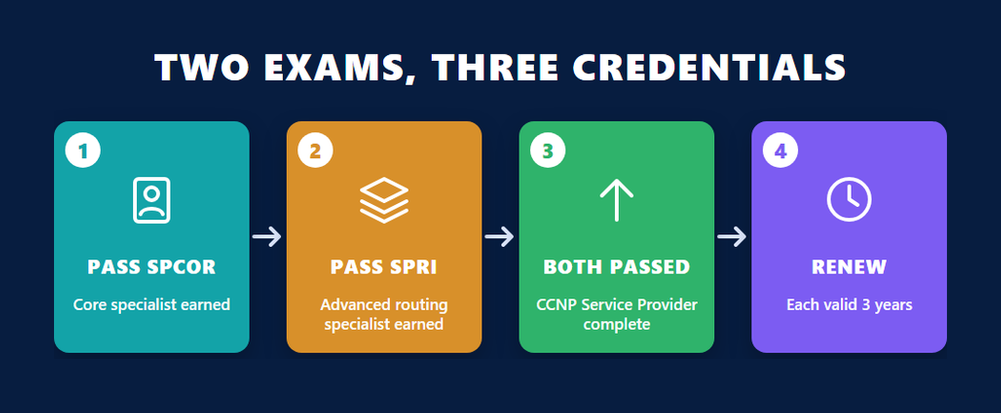
SPRI adds depth where the 350-501 SPCOR core exam stays broad. CCNP Service Provider requires one core exam and one concentration, and 300-510 is the concentration focused entirely on routing: policy language, protocol troubleshooting, fast convergence, multicast and segment routing traffic engineering. Each exam you pass also earns a separate specialist certification.
One track, two exams, three credentials
Cisco structures the professional level so that every exam stands on its own. Passing SPCOR earns the Cisco Certified Specialist Service Provider Core certification. Passing SPRI earns the Service Provider Advanced Routing Implementation specialist certification. Cisco lists each specialist certification as valid for three years, and holding both completes CCNP Service Provider. The order is up to you, though taking the core exam first builds the vocabulary SPRI assumes.
Where the two exams overlap, and where they do not
SPCOR is the longer and dearer exam: Cisco lists it at 120 minutes and $400, against 90 minutes and $300 for SPRI. The core exam touches routing, MPLS and segment routing as part of a wider syllabus that also covers architecture, services, automation, quality of service, security and assurance. SPRI drops all of that and spends its whole paper on routing behaviour. Topics that appear once in the core blueprint, such as BGP or segment routing, return in SPRI with long lists of sub-topics and troubleshooting verbs attached.
Cisco describes the skills behind the full track on its CCNP Service Provider page, and two items on that list belong to SPRI almost entirely: troubleshooting routing protocols, and implementing routing policy language and route maps.
Why Is Routing Policy a Quarter of the Marks?
Routing Policy and Manipulation is 25 percent of 300-510 because in a provider network, policy decides which routes are accepted, how attributes are set and where traffic leaves. The domain compares routing policy language with route maps, tests conditional matching in detail, and asks you to troubleshoot route manipulation for IS-IS, OSPF and BGP, including route filtering and traffic steering.
Routing policy language and route maps
Route maps are the familiar policy tool on IOS and IOS XE. Cisco IOS XR uses Route Policy Language instead, where route policies are applied at BGP neighbour import and export points and at redistribution boundaries to control which routes are accepted and to change attributes such as local preference, MED and communities. The exam asks you to compare the two approaches, so practise writing the same filter both ways and notice where the structure differs.
Conditional matching, item by item
The conditional matching objective is the longest in the domain. It lists operations, the semantics of policy applications and statements, regular expressions, policy sets, tags, ACLs, prefix lists and prefix sets, route types, BGP attributes and communities, and hierarchical and parameterized structures. Hierarchical policies, where one policy calls another, and parameterized policies, where a single policy accepts a value when it is applied, are the items most candidates have never configured.
Troubleshooting manipulation in IGPs and BGP
The last two objectives turn the syntax into diagnosis. For IGPs the exam names IS-IS and OSPF; for BGP it names route filtering and traffic steering. A typical task is working out why a prefix that should have been filtered is still in the table, or why traffic exits through the wrong peer after a policy change. Reading the matching order correctly is usually the whole answer.
What Does the 35 Percent Unicast Routing Domain Test?
Unicast Routing is the largest SPRI domain at 35 percent. It covers OSPF and IS-IS comparison and multiarea or multilevel troubleshooting for IPv4 and IPv6, BGP scalability and a ten-item BGP troubleshooting list, IPv6 tunneling and translation mechanisms, and a fast convergence toolkit that runs from BFD to BGP PIC and loop-free alternates.
OSPF and IS-IS at provider scale
Both IGP objectives focus on route advertisement and summarization across areas or levels, in IPv4 and IPv6. Expect to compare the two protocols directly and to explain why a summary did or did not appear where it should.
BGP scale and BGP troubleshooting
The scalability objective names BGP confederations and route reflectors. The troubleshooting objective is far longer: route advertisement, route reflectors, confederations, multihoming, TTL security and inter-domain security, maximum prefix, route dampening, dynamic neighbors, communities and FlowSpec. Ten sub-topics under one objective means BGP alone could account for a large share of this domain.
IPv6 tunneling and translation
The IPv6 objective lists static IPv6-in-IPv4 tunnels, dynamic 6to4 tunnels, IPv6 provider edge (6PE), IPv6 policy enforcement, and NAT64 and MAP-T. These are the mechanisms a provider uses to carry IPv6 across an IPv4 core or to connect IPv6-only customers to IPv4 content.
The fast convergence toolkit
Fast convergence is listed as an Implement objective with seven parts: bidirectional forwarding detection, Nonstop Forwarding, NSR, timers, BGP PIC for edge and core, LFA and IP fast reroute, and BGP additional and backup paths. The common thread is shortening the time between a failure and traffic finding a working path, so learn which tool detects the failure, which keeps forwarding alive during a control plane restart, and which pre-computes the backup.
How Deep Does SPRI Go Into Multicast?
Multicast Routing is the smallest SPRI domain at 15 percent, roughly 8 to 10 questions, but it reaches well past the basics. It compares multicast concepts, describes protocol operations including MSDP and mLDP, implements PIM sparse mode with several rendezvous point methods, and asks you to troubleshoot multicast in a single domain and across multiple domains.
Concepts the exam expects you to compare
The comparison objective covers multicast domains, distribution trees and IGMP operations, Any-Source Multicast against Source Specific Multicast, and intra-domain against inter-domain multicast routing. The describe objective adds mapping multicast IP addresses to MAC addresses, Multiprotocol BGP for IPv4 and IPv6, the principles of PIM-SM, MSDP operations, MLDP and P2MP, and IGMP, IGMPv3 and MLD.
Rendezvous points and PIM variants
The implement objective is where hands-on time pays off: Auto-RP, PIMv2 BSR, anycast RP and Phantom RP, then BIDIR-PIM, SSM and MSDP operations. Four ways to place or discover a rendezvous point is a lot to keep straight under time pressure, so build each one in a lab and compare what the routers show.
How Much Segment Routing and SRv6 Does 300-510 Cover?
MPLS and Segment Routing is 25 percent of 300-510, and three of its four objectives are about segment routing. Candidates troubleshoot MPLS with LDP, LSPs, unified BGP, BGP free core and RSVP TE tunnels, then implement segment routing, segment routing traffic engineering, and segment routing over IPv6, including flexible algorithm and micro-segments.
From LDP to segment routing
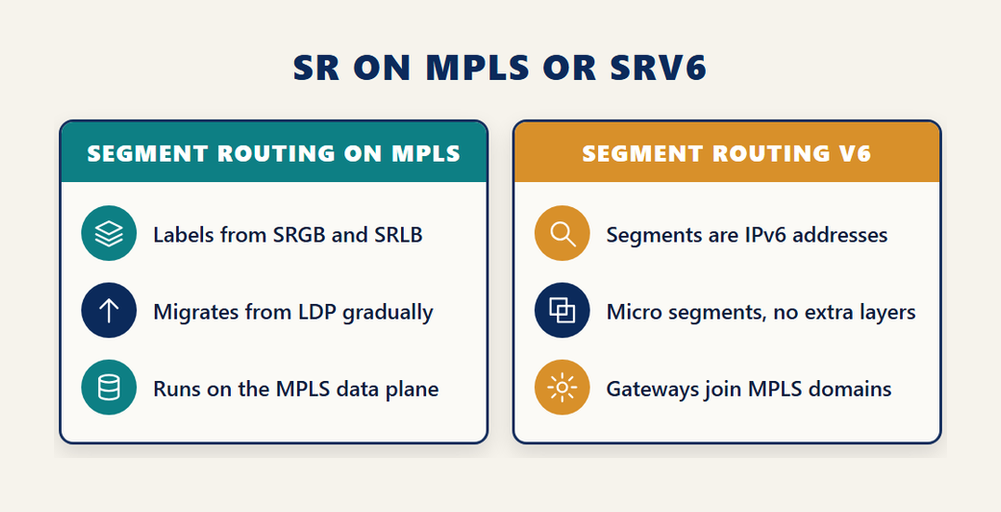
The implement segment routing objective lists routing protocol extensions for BGP, OSPF and IS-IS, the SRGB and SRLB label blocks, Topology-Independent Loop-Free Alternate, and migration procedures using SR prefer and a mapping server. The migration item matters because real networks rarely move from LDP to segment routing in one step, and the exam tests how the two coexist. The architecture itself is defined in the IETF Segment Routing Architecture specification, which is worth reading for the terminology alone.
Traffic engineering with segment routing
The traffic engineering objective covers automated steering and coloring, policies with constraints, metrics and attributes, PCE-based path calculation, SRLG and Tree SID. Automated steering is the piece to understand first, because it is how a service route is mapped onto a policy without per-prefix configuration.
SRv6 and micro-segments
The SRv6 objective names control plane operations, data plane operations, flexible algorithm, and locators, micro-segments, encapsulation and interworking gateways. In SRv6 the segments are IPv6 addresses rather than MPLS labels, and the behaviours a node can apply to a packet are described in the SRv6 Network Programming RFC. Cisco has been direct about why micro-segments matter.
“Segment Routing over IPv6 micro-segment (SRv6 uSID) enables the delivery of any service end-to-end across domains leveraging the IPv6 protocol with no extra layers and without the need for any gateway.”
The interworking gateway sub-topic is the counterpart to that ambition: until every domain runs SRv6, something has to connect an SRv6 domain to an MPLS one, and the exam expects you to know where that function sits.
SPRI, SPVI or SPCNI: Which Concentration Fits?
Choose 300-510 SPRI if your work is routing design and troubleshooting in a provider core. Cisco currently lists three CCNP Service Provider concentrations, all at 90 minutes and $300: SPRI for advanced routing, 300-515 SPVI for Layer 2, Layer 3 and IPv6 VPN services, and 300-540 SPCNI for cloud network infrastructure. Any one of them completes the certification with SPCOR.
| Concentration | Focus | Specialist credential | Languages |
|---|---|---|---|
| 300-510 SPRI | Routing protocols, policy language, MPLS and segment routing | Service Provider Advanced Routing Implementation | English |
| 300-515 SPVI | VPN services, including Layer 2, Layer 3 and IPv6 | Service Provider VPN Services Implementation | English |
| 300-540 SPCNI | Virtualized architecture, cloud interconnect, high availability, security, service assurance | Service Provider Cloud Network Infrastructure | English, Japanese |
If you have just passed the core exam, the SPCOR exam topics guide is a useful reminder of what you already covered, and it makes the overlap with SPRI easy to see: the routing and segment routing parts of the core syllabus are where SPRI begins.
SPRI suits engineers who spend their days in BGP tables, IGP databases and traffic engineering policies. SPVI suits those who build customer services on top of that core, and SPCNI suits those working on virtualized and cloud-connected infrastructure. Older guides sometimes mention an automation concentration for this track; it is not among the concentrations Cisco lists today, so plan around the three above.
How Should You Prepare for 300-510?
Prepare for 300-510 by working from the v1.1 exam topics in weighting order, with lab time at the centre. Cisco offers a Cisco U. learning path with pre and post assessments plus instructor-led training, and the blueprint names the course Implementing Cisco Service Provider Routing Solutions. Lab every Implement and Troubleshoot objective before you book the exam.
- Download the v1.1 exam topics and mark every sub-topic you have never configured, so the plan starts from real gaps rather than from page one.
- Build a small multi-router lab that runs IS-IS and OSPF with multiple areas and levels, and add BGP with route reflectors and a confederation.
- Work through the ten BGP troubleshooting sub-topics one at a time, breaking each feature on purpose and fixing it from the show commands.
- Write the same filters in routing policy language and in route maps, then add policy sets, hierarchical policies and parameterized policies.
- Migrate the lab from LDP to segment routing using SR prefer and a mapping server, then add TI-LFA and an SR-TE policy with automated steering.
- Add an SRv6 domain with a flexible algorithm and test how it interworks with the MPLS side.
- Finish with multicast: configure each rendezvous point method, then SSM, BIDIR-PIM and MSDP between two domains.
- Sit timed practice sessions at the real pace of 90 minutes and review every miss against the domain it belongs to.
Pacing on the day
Ninety minutes for 55 to 65 questions leaves well under two minutes per question. Answer the compare and describe items quickly, and save time for troubleshooting scenarios, where reading a policy or a routing table carefully is what separates the right answer from the plausible one.
For a second view of the same exam, the CiscoPrep 300-510 exam guide walks through the topics and question style from another angle, which helps once you have a draft study plan of your own.
Frequently Asked Questions
What is the Cisco 300-510 SPRI exam?
300-510 SPRI is Implementing Cisco Service Provider Advanced Routing Solutions, the routing concentration exam for CCNP Service Provider. It tests routing protocols, routing policy, multicast, MPLS and segment routing, and passing it earns the Cisco Certified Specialist Service Provider Advanced Routing Implementation certification.
How many questions are on the 300-510 exam?
The NWExam syllabus page lists 55 to 65 questions in 90 minutes. The exam fee is $300 USD, or Cisco Learning Credits, and it is delivered in English through Pearson VUE.
What is the passing score for 300-510 SPRI?
The syllabus page gives a variable passing score of approximately 750 to 850 out of 1000. Cisco does not publish a fixed cut score; it grades the exam as pass or fail and makes results available online within 48 hours.
Is 300-510 version 1.0 or version 1.1?
Cisco’s exam page labels the exam v1.0, but the exam topics document Cisco publishes is titled v1.1, and the NWExam syllabus describes v1.1 as well. Study from the v1.1 topics, which include SRv6, NAT64 and MAP-T, and Phantom RP.
Do I need to pass SPCOR before taking SPRI?
No. Cisco lists no prerequisites for 300-510, and it can be taken before or after 350-501 SPCOR. You need both, the core exam and one concentration, to earn CCNP Service Provider.
Which SPRI domain carries the most weight?
Unicast Routing is the largest domain at 35 percent. Routing Policy and Manipulation and MPLS and Segment Routing are 25 percent each, and Multicast Routing is 15 percent.
How long is the SPRI specialist certification valid?
The Service Provider Advanced Routing Implementation specialist certification is valid for three years. Passing 300-510 can also be used toward recertification of an existing Cisco professional credential.
What are the alternatives to SPRI for CCNP Service Provider?
Cisco lists two other concentrations: 300-515 SPVI for VPN services and 300-540 SPCNI for cloud network infrastructure. Each is 90 minutes and $300, and any one of them completes CCNP Service Provider alongside SPCOR.
What is the best way to prepare for 300-510?
Work from the v1.1 exam topics in weighting order and lab every Implement and Troubleshoot objective. Spend the most time on unicast routing, policy and segment routing, which together are 85 percent of the exam, and finish with timed practice at the 90-minute pace.
Conclusion
The Cisco service provider advanced routing exam rewards engineers who can configure and diagnose, not just define. 300-510 SPRI packs 55 to 65 questions into 90 minutes, puts 35 percent on unicast routing, splits half the paper between routing policy and MPLS with segment routing, and keeps 15 percent for multicast. It earns a three-year specialist certification and completes CCNP Service Provider with SPCOR.
Plan from the v1.1 exam topics, not the version label on the exam page, and build a lab that covers BGP at scale, routing policy language, segment routing migration and SRv6. Then measure yourself against the sample questions linked earlier before you book a date with Pearson VUE.


