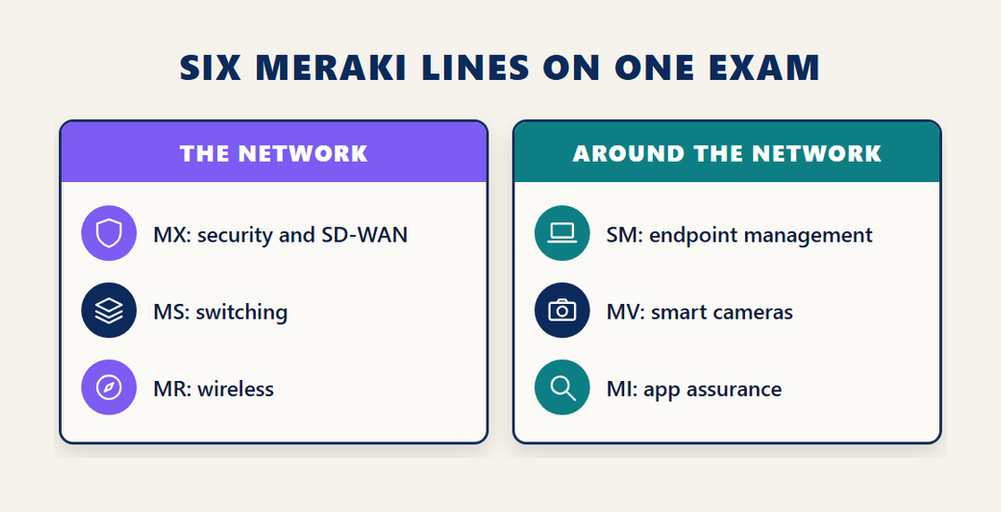
MX, MS, MR, SM, MV and MI. Six two-letter product codes appear on the blueprint for the Cisco Meraki certification, and the exam behind it, 500-220 ECMS, expects you to configure every one of them. That breadth is the first surprise for engineers who know Meraki mainly as a wireless brand: security appliances, switches, access points, endpoint management, cameras and application monitoring all sit on the same 90-minute paper.
The second surprise is where the marks are. Configuration is only a quarter of the exam. Design carries 30 percent, Monitoring and Troubleshooting carries another 30 percent, and Cisco Meraki Cloud Management takes the remaining 15 percent. This article works through each of the four domains, shows what the six product lines contribute, sets out who the credential suits and what it costs, and ends with a preparation order built around the dashboard.
Table of Contents
- Is There More Than One Cisco Meraki Certification?
- How Are the Four 500-220 ECMS Domains Weighted?
- What Does the Cloud Management Domain Expect You to Explain?
- Why Does Design Carry 30 Percent of the Exam?
- Which Meraki Product Lines Do You Have to Configure?
- How Is Monitoring and Troubleshooting Tested?
- Who Is the Credential For, and How Long Does It Last?
- How Should You Prepare for 500-220 ECMS?
- Frequently Asked Questions
- Conclusion
Is There More Than One Cisco Meraki Certification?
No. Cisco offers one technical Cisco Meraki certification, the Cisco Meraki Solutions Specialist, and it is earned by passing a single exam: 500-220 ECMS, Engineering Cisco Meraki Solutions. The exam runs 90 minutes, costs $300 USD, is delivered in English and has no formal prerequisites. There is no associate or professional tier above or below it.
Cisco itself describes the credential as the only available Cisco Meraki technical certification, which settles a question many searchers arrive with. You do not choose between levels or tracks. You pass one exam, and the specialist certification and its digital badge follow.
| 500-220 ECMS exam fact | Value |
|---|---|
| Exam name | Engineering Cisco Meraki Solutions |
| Exam code | 500-220 ECMS |
| Credential earned | Cisco Meraki Solutions Specialist |
| Number of questions | 55 to 65 |
| Duration | 90 minutes |
| Exam fee | $300 USD, or Cisco Learning Credits |
| Passing score | Variable, approximately 750 to 850 out of 1000 |
| Language and registration | English, scheduled through Pearson VUE |
| Prerequisites | None formal |
| Validity | Three years |
The question count and the passing score range come from the NWExam syllabus page. Cisco publishes no fixed cut score for this exam and reports the result only as a pass or a fail, usually online within 48 hours. The duration, fee and language above match the Cisco ECMS exam page, and Cisco states that its exams are proctored either online or at a testing center.
How Are the Four 500-220 ECMS Domains Weighted?
The 500-220 ECMS syllabus has four domains: Cisco Meraki Cloud Management at 15 percent, Design at 30 percent, Implementation at 25 percent, and Monitoring and Troubleshooting at 30 percent. On a paper of 55 to 65 questions that is roughly 8 to 10 questions on cloud management, 17 to 20 each on design and on troubleshooting, and 14 to 16 on implementation.
The objectives below are listed as the syllabus states them. Read the verbs as well as the nouns: the first domain says Explain, the second says Design, the third says Configuring and the fourth says Interpret and Troubleshooting. Each verb tells you what kind of question to expect.
| Domain | Weight | Objectives |
|---|---|---|
| Cisco Meraki Cloud Management | 15% | Explain Cisco Meraki cloud architecture; Explain access methods to dashboard and devices; Explain organizational structure, segmentation and permissions; Explain licensing, co-termination, and renewals; Compare deployment workflows |
| Design | 30% | Design scalable Meraki Auto VPN architectures; Explain deployment consideration for the vMX; Design dynamic path selection policies; Design stable, secure, and scalable routing deployments; Design Enterprise network services; Design Enterprise wireless services; Compare endpoint device and application management methods |
| Implementation | 25% | Configuring MX security appliances; Configuring MS switches; Configuring MR wireless access points; Configuring SM endpoint management; Configuring MV security cameras; Configuring MI application assurance |
| Monitoring and Troubleshooting | 30% | Interpret information from monitoring and reporting tools; Describe how to use the dashboard API to monitor and maintain networks; Explain firmware upgrades; Troubleshooting Enterprise networks |
Two domains tie for the largest share, and neither of them is about clicking through a configuration page. A candidate who has only ever deployed access points from a template will meet most of the paper as new ground. The quickest way to see how those design and troubleshooting objectives turn into questions is to try the 500-220 sample questions before you plan your study, then sort every miss into one of the four domains.
What Does the Cloud Management Domain Expect You to Explain?
Cisco Meraki Cloud Management is 15 percent of 500-220 ECMS and every objective in it begins with Explain or Compare. It covers how the Meraki cloud is built, how administrators reach the dashboard and the devices, how organizations, networks and permissions are structured, how licensing and co-termination work, and how deployment workflows differ.
The dashboard as the control point
Everything on this exam assumes one management model: devices check in to the Meraki cloud, and administrators work through the dashboard instead of logging in to each box. The first two objectives ask you to explain that architecture and the ways an administrator can reach both the dashboard and an individual device. Know what a device can still do when it loses contact with the cloud, because that question separates people who have read about the model from people who have run it.
“The primary fruit of that labor is the Meraki dashboard, our unique cloud management interface that gives you control over your entire network stack, free of command line interface.”
Organizations, networks and permissions
The third objective is about structure. A Meraki deployment is arranged as an organization that contains networks, and administrator rights can be granted at either level. Expect questions that describe a company, such as a retailer with regional IT teams, and ask how you would segment it so that each team sees only its own sites.
Licensing and co-termination
Licensing is the objective candidates most often skip, and it is named in full: licensing, co-termination, and renewals. Under the co-termination model every license claimed in an organization shares one expiration date, which Meraki calculates by averaging the active licenses. An organization that exceeds its license limits enters a 30-day grace period. The Meraki co-termination licensing guide works through the calculation with examples, and it is worth doing one by hand.
Why Does Design Carry 30 Percent of the Exam?
Design carries 30 percent of 500-220 ECMS because a cloud-managed network is easy to configure and easy to design badly. The domain asks you to design Auto VPN architectures, dynamic path selection policies, routing, enterprise network services and enterprise wireless services, to explain deployment considerations for the vMX, and to compare endpoint management methods.
Auto VPN, the vMX and path selection
Auto VPN is Meraki’s own method of building site-to-site tunnels between MX appliances, with the cloud acting as the registry that tells each appliance how to reach its peers. The design question is topology. Sites can be hubs, which carry traffic for other sites, or spokes, which reach the rest of the network only through a hub. The Meraki Auto VPN documentation defines both roles.
The vMX objective extends the same design into a cloud provider, where a virtual appliance joins the Auto VPN instead of a physical one. Dynamic path selection then decides which uplink a given class of traffic should use when a site has more than one.
Enterprise network services
The syllabus lists five sub-topics under enterprise network services, and each is a design decision in its own right:
- Redundant networks and high availability
- QOS strategy for voice and video
- Applying security at layer 2
- Firewall and IPS rules on MX and MR
- Network access control solutions
Wireless and endpoint management
Enterprise wireless services are split three ways: high density deployments, MR networks for the enterprise, and MR networks for guest access. The last objective in the domain compares endpoint device and application management methods, including enrollment types such as supervised and device owner, and application deployment. That is Systems Manager territory, and it is the part of the design domain that network engineers are least likely to have touched at work.
Which Meraki Product Lines Do You Have to Configure?
The Implementation domain, 25 percent of 500-220 ECMS, names six product lines: MX security appliances, MS switches, MR wireless access points, SM endpoint management, MV security cameras and MI application assurance. Each has its own list of configuration tasks, and the three network lines carry the longest lists.
MX, MS and MR
For MX the syllabus lists SVI, dynamic routing and static routes, Auto VPN, traffic shaping and SD-WAN, threat protection and content filtering rules, and access policies and 802.1x. For MS it lists SVI, dynamic routing and static routes again, plus QoS using Meraki switching networks, access policies and 802.1x, and replicating a switch configuration. For MR it lists SSIDs for enterprise and BYOD deployments, traffic shaping, RF profiles and Air Marshal.
Access policies and 802.1x appear under two product lines and again in the design domain as network access control, so port-based authentication is one of the most repeated ideas on the paper. If the mechanism is hazy, the IEEE 802.1X standard page summarises what the protocol is for before you look at how the dashboard applies it.
SM, MV and MI
The other three lines are shorter but cannot be skipped. SM covers management profiles, security policies and Sentry for Meraki managed deployments. MV covers camera video and alerting, and retention settings. MI covers standard applications and application thresholds. Together they are a small share of the domain, yet they are the questions that candidates from a pure routing and switching background tend to drop.
What the configuration questions look for
Because the dashboard hides most syntax, configuration questions here are less about remembering a command and more about knowing where a setting lives and what it changes. Which page holds traffic shaping rules for an SSID, and which holds them for an MX uplink? What does an RF profile control that a per-device radio setting does not? Time spent in a real or lab organization answers these faster than reading does.
How Is Monitoring and Troubleshooting Tested?
Monitoring and Troubleshooting is 30 percent of 500-220 ECMS and has four objectives: interpret information from monitoring and reporting tools, describe how to use the dashboard API to monitor and maintain networks, explain firmware upgrades, and troubleshoot enterprise networks. The last of these carries six sub-topics that span layer 2, layer 3, wireless, security and application performance.
Reading what the dashboard tells you
The first objective names its sources: alerts with Dashboard, SNMP, Syslog and Netflow, and logging and reporting in Dashboard. Questions typically show you a symptom and ask which tool or log would confirm the cause. Know which events are raised as alerts, which are written to an event log, and which have to be exported to an external collector before anyone can see them.
The dashboard API and firmware
The API objective uses the verb Describe, so you are not asked to write code. You are asked what the API is for: reading the state of many networks at once and making the same change across them. The Cisco Meraki Dashboard API reference is the place to see how requests are organised by organization, network and device. Firmware is the other operational objective, and it expects you to explain how upgrades are scheduled and rolled out from the cloud.
Six troubleshooting areas
The troubleshooting objective lists exactly where a fault might sit:
- Layer 2 technologies using Dashboard
- Layer 3 technologies using Dashboard
- Wireless client connectivity issues using Dashboard
- Device local status pages
- Security threats using Security Center
- Application performance issues using Meraki Insight
The device local status page is the odd one out, because it is the tool you use when a device cannot reach the cloud at all. Make sure you have opened one at least once.
Who Is the Credential For, and How Long Does It Last?
The Cisco Meraki Solutions Specialist certification is aimed at engineers who design, implement and operate Meraki networks and want proof of it. Cisco sets no formal prerequisites for 500-220 ECMS but expects familiarity with Meraki cloud management, design, implementation, monitoring and troubleshooting. The certification is valid for three years and can be renewed with Continuing Education credits or by retaking exams.
The roles Cisco has in mind
Cisco’s own training for the exam lists the job roles it suits, and the list is wider than network engineer. It includes deployment engineers, network administrators and managers, systems engineers, wireless engineers, technical solutions architects and sales engineers. Account managers are on the list too, which says something about how often Meraki is designed in front of a customer. Cisco’s Meraki Solutions Specialist page puts the installed base at more than 2.5 million active networks in over 190 countries.
Do you need CCNA first?
Not for the exam. The CCNA recommendation belongs to the training course, where Cisco suggests either holding CCNA or being comfortable with general networking, including IP addressing, OSPF and BGP, wireless standards, 802.1x, and monitoring with SNMP and syslog. If those words are familiar, you can start on the Meraki material directly. The CiscoPrep 500-220 exam topics page sets the syllabus beside question examples if you want to test that assumption.
Keeping the certification current
Three years is the standard Cisco cycle. Before it ends you renew either by earning Continuing Education credits or by passing exams again. Cisco lists the Engineering Cisco Meraki Solutions training itself as worth 24 Continuing Education credits, which matters mainly to people who already hold other Cisco certifications and can count the course toward those.
How Should You Prepare for 500-220 ECMS?
Prepare for 500-220 ECMS in the order the dashboard is used: understand the cloud and licensing model, then design, then configure each product line, then practise diagnosis. Cisco offers a Cisco U. learning path with pre and post assessments and instructor-led training called Engineering Cisco Meraki Solutions, which combines the Part 1 and Part 2 courses.
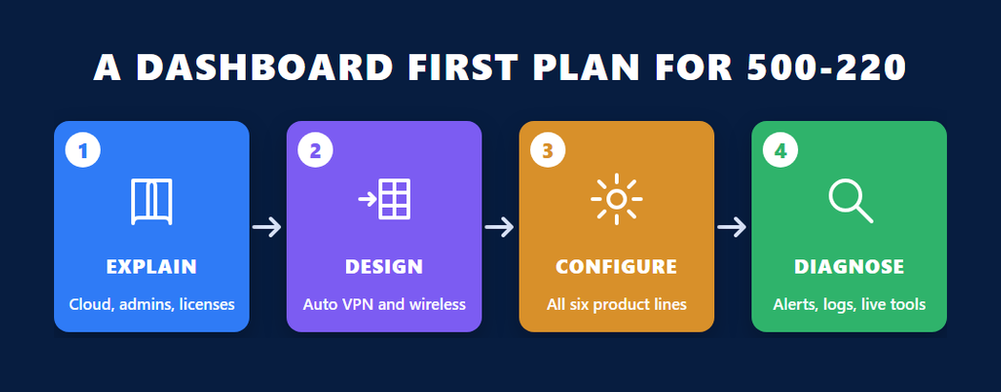
- Print the four domains and mark every objective you have never done in a live dashboard, so the plan starts from real gaps.
- Learn the cloud management domain first, including organization structure, administrator permissions and one co-termination calculation done by hand.
- Sketch an Auto VPN design for a company with two hubs and several spokes, then decide where a vMX and dynamic path selection would fit.
- Configure the MX, MS and MR tasks the syllabus lists, paying most attention to access policies and 802.1x because they repeat across domains.
- Spend a session each on Systems Manager, MV cameras and Meraki Insight so the three shorter product lines are not left to chance.
- Practise diagnosis by working from a symptom to the right tool, including the event log, Security Center and a device local status page.
- Sit timed practice sessions at 90 minutes and review every miss against the domain it belongs to.
If you have no Meraki hardware
Most of this exam can be studied without owning a device, because the syllabus is about decisions and dashboard locations more than cabling. The product documentation shows the dashboard pages in detail, and Cisco’s learning path is built around the same four domains. What you cannot replace is time spent reading real alerts and event logs, so take any chance to shadow a production organization, even read-only.
Pacing on the day
Ninety minutes for 55 to 65 questions gives you about a minute and a half each. The Explain and Compare items in cloud management should be quick. Bank that time for design scenarios, where several answers are workable and only one is the most scalable or the most secure, which is the wording the objectives themselves use.
For a broader look at where the credential can take you, the earlier CiscoPrep article on a Meraki career path covers the job market side that this article leaves out.
Frequently Asked Questions
What is the Cisco Meraki certification called?
It is the Cisco Meraki Solutions Specialist certification. You earn it by passing one exam, 500-220 ECMS, Engineering Cisco Meraki Solutions. Cisco describes it as the only available Cisco Meraki technical certification.
How much does the 500-220 ECMS exam cost?
Cisco lists the exam at $300 USD, and you can pay with Cisco Learning Credits instead. Training is separate and optional.
How many questions are on 500-220 ECMS and how long is it?
The NWExam syllabus page lists 55 to 65 questions, and Cisco gives the duration as 90 minutes. The exam is delivered in English.
What is the passing score for 500-220 ECMS?
Cisco publishes no fixed passing score and reports only a pass or a fail. The NWExam syllabus page describes the score as variable, approximately 750 to 850 out of 1000.
Are there prerequisites for the Cisco Meraki Solutions Specialist?
There are no formal prerequisites. Cisco expects familiarity with Meraki cloud management, design, implementation, monitoring and troubleshooting, and it recommends CCNA or equivalent networking knowledge before the training course.
What does ECMS stand for?
ECMS stands for Engineering Cisco Meraki Solutions, the name of both the exam and the Cisco training course that prepares for it. The same four letters are used by unrelated systems elsewhere, so search with Meraki or 500-220 alongside them.
Which domain is the largest on the exam?
Two domains share first place. Design and Monitoring and Troubleshooting carry 30 percent each, Implementation carries 25 percent and Cisco Meraki Cloud Management carries 15 percent.
Does the exam cover Meraki cameras and device management?
Yes. The Implementation domain includes configuring MV security cameras, SM endpoint management and MI application assurance alongside MX, MS and MR.
How long is the Cisco Meraki Solutions Specialist certification valid?
It is valid for three years. You can renew it with Cisco Continuing Education credits or by retaking exams before it expires.
Conclusion
The Cisco Meraki certification is simpler to describe than most Cisco credentials and broader than its reputation suggests. One exam, 500-220 ECMS, earns the Cisco Meraki Solutions Specialist: 55 to 65 questions in 90 minutes for $300, with no formal prerequisites and a three-year validity. Design and troubleshooting together make up 60 percent of the paper, and the configuration quarter reaches past wireless into security appliances, switching, endpoint management, cameras and application assurance.
Start with the cloud and licensing model, design before you configure, give the three shorter product lines a session each, and practise working from symptom to tool. When the sample questions linked earlier stop surprising you in any of the four domains, book the exam through Pearson VUE.


