Two official-looking documents describe the same exam, and they do not call its controllers by the same names. The 300-415 ENSDWI syllabus lists SD-WAN Validator, SD-WAN Manager and SD-WAN Controller, each with its older name in brackets. Cisco’s downloadable 2023 exam topics PDF for the same v1.2 blueprint says vBond, vManage and vSmart and nothing else. Same six domains, same weightings, two vocabularies.
That is the first thing to settle before studying the ENSDWI exam topics, because most of the course material, practice material and community threads a candidate will read use one set of names or the other. This article lists all six domains of Implementing Cisco Catalyst SD-WAN Solutions with their weightings, walks the objectives under each, explains the renaming, sets out what the exam costs and earns, and ends with a working order for the blueprint.
Table of Contents
- What Are the ENSDWI Exam Topics for 300-415?
- Why Does the Syllabus List Every Controller Under Two Names?
- What Does the Architecture Domain Expect You to Describe?
- How Do Controller Deployment and Router Deployment Divide the Work?
- Which Policies Does 300-415 Ask You to Configure?
- How Much Security and QoS Sits on the Exam?
- What Does Management and Operations Cover at 10 Percent?
- What Does 300-415 ENSDWI Cost and What Does It Earn?
- How Should You Work Through the ENSDWI Exam Topics?
- Frequently Asked Questions
- Conclusion
What Are the ENSDWI Exam Topics for 300-415?
The ENSDWI exam topics for 300-415 fall into six domains: Architecture at 20 percent, Controller Deployment at 15, Router Deployment at 20, Policies at 20, Security and Quality of Service at 15, and Management and Operations at 10. The exam runs 90 minutes, costs $300 USD, and tests the Cisco Catalyst SD-WAN solution from controllers and WAN Edges through policy, security, QoS and operations.
Those weightings come from the NWExam syllabus page and match Cisco’s own exam topics document for version 1.2 line for line. The question count and the passing score below come from the syllabus page only, because Cisco displays neither on its exam page.
| 300-415 ENSDWI exam fact | Value |
|---|---|
| Exam name | Implementing Cisco Catalyst SD-WAN Solutions |
| Exam code | 300-415 ENSDWI |
| Blueprint version | v1.2 |
| Number of questions | 55 to 65 |
| Duration | 90 minutes |
| Exam fee | $300 USD, or Cisco Learning Credits |
| Passing score | Variable, approximately 750 to 850 out of 1000 |
| Languages | English, Japanese |
| Registration | Pearson VUE |
| Credentials | Cisco Certified Specialist – Enterprise SD-WAN Implementation; CCNP Enterprise concentration |
| Validity | Three years |
| Domain | Weight | What it asks |
|---|---|---|
| 1.0 Architecture | 20% | Describe the planes, components, Edge platforms and Cloud OnRamp |
| 2.0 Controller Deployment | 15% | Describe cloud and on-premises controllers; configure certificates; troubleshoot the control plane |
| 3.0 Router Deployment | 20% | Describe WAN Edge onboarding; configure the data plane, OMP, TLOCs and templates |
| 4.0 Policies | 20% | Configure control, data, segmentation, application-aware routing and direct Internet access |
| 5.0 Security and Quality of Service | 15% | Configure service insertion and QoS; describe security features, cloud security and AppQoE |
| 6.0 Management and Operations | 10% | Authentication, monitoring, reporting, REST API monitoring, image management |
Notice the verbs. Four of the six domains open with Describe, and the configure objectives cluster in Router Deployment, Policies and the QoS half of domain five. Roughly half the blueprint rewards understanding, the other half rewards having built the thing.
Why Does the Syllabus List Every Controller Under Two Names?
The syllabus lists each controller twice because Cisco renamed the components of its SD-WAN solution and older study material still uses the original names. On the 300-415 ENSDWI blueprint, SD-WAN Validator is the orchestration plane (formerly vBond), SD-WAN Manager is the management plane (formerly vManage), and SD-WAN Controller is the control plane (formerly vSmart). The exam can refer to either.
The two-name convention matters more for this exam than for most, because the documents a candidate works from disagree. The 300-415 ENSDWI syllabus page carries the current names with the older names in brackets, across all six domains, and links the sample questions and the practice test that use the same wording. Cisco’s 2023 exam topics PDF for the same v1.2 blueprint uses only vBond, vManage and vSmart. Cisco’s live topics page on the Learning Network could not be read for this article, so the article does not claim which convention it currently shows.
| Plane | Current name | Older name | Role on the exam |
|---|---|---|---|
| Orchestration | SD-WAN Validator | vBond | First point of contact for a new device; NAT traversal |
| Management | SD-WAN Manager | vManage | Templates, configuration groups, monitoring, image management, REST API |
| Control | SD-WAN Controller | vSmart | OMP, control and data policy distribution |
| Data | WAN Edge | vEdge, cEdge | IPsec and GRE tunnels, BFD, local policy enforcement |
The practical rule is to learn both columns and to answer in whichever vocabulary the question uses. The sample questions linked from the syllabus still say vSmart in a control policy scenario, and that is realistic: a 90-minute paper written over several revisions will not be uniform.
What Does the Architecture Domain Expect You to Describe?
Architecture is worth 20 percent of 300-415 ENSDWI and is entirely descriptive. It asks you to describe the four planes and their components, the TLOC and vRoute constructs of OMP, the IPsec, GRE and BFD mechanics of the data plane, Multi-Region Fabric, the WAN Edge platform range, and Cloud OnRamp for SaaS, IaaS, colocation and multicloud. Nothing in this domain says configure.
Planes, TLOCs and vRoutes
A software-defined WAN separates the control plane from the forwarding plane and centralises policy. On the exam that means knowing what each controller owns and what it hands to the WAN Edge. A TLOC, the transport location, identifies one WAN Edge interface on one transport with a colour and an encapsulation, and OMP advertises TLOC routes, vRoutes for the service-side prefixes, and service routes. Questions in this domain tend to test whether you can say which plane a failure or a feature belongs to.
The data plane and BFD
The data plane objective names IPsec and GRE for the tunnels and BFD for liveness. BFD runs inside every tunnel between WAN Edges and feeds the loss, latency and jitter measurements that application-aware routing uses later in the blueprint. The protocol itself is defined independently of any vendor in RFC 5880 for BFD, which is worth a read because the exam expects the detection timers and the per-tunnel behaviour to make sense rather than be memorised.
Multi-Region Fabric and Cloud OnRamp
Multi-Region Fabric sits in the architecture domain as a describe item: regions, border routers and a core region that carries inter-region traffic. The syllabus sample questions reach for it when they ask about multicast replicators across regions, so expect it to appear combined with another objective. Cloud OnRamp has four named forms, SaaS, IaaS, Colocation and Multicloud for cloud and interconnect, and you should be able to say what each one connects and where its decision is made. The Catalyst SD-WAN Getting Started Guide is the shortest official route through the components and their bring-up order.
How Do Controller Deployment and Router Deployment Divide the Work?
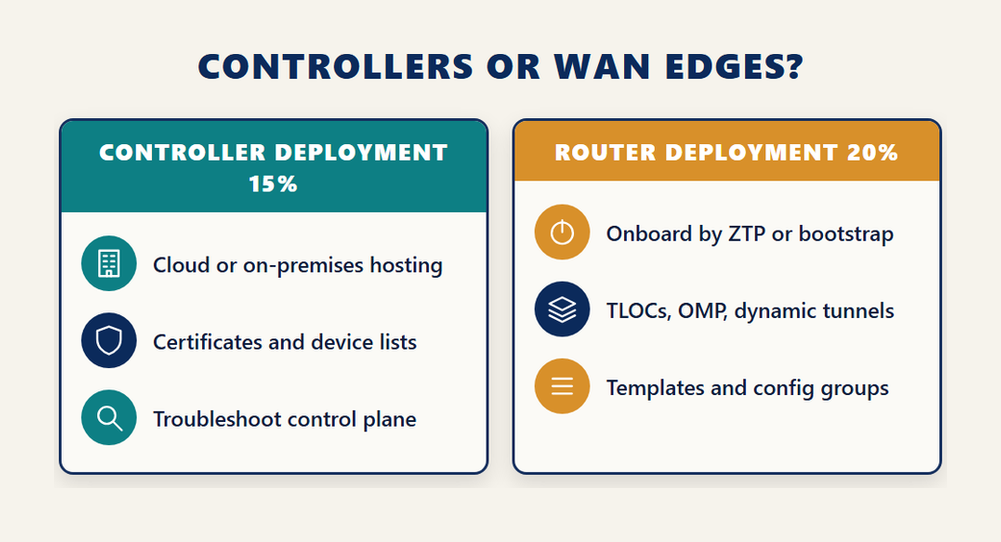
Controller Deployment at 15 percent covers how the Validator, Manager and Controller are hosted, installed, scaled and certified, plus troubleshooting control plane connectivity. Router Deployment at 20 percent covers how WAN Edges are onboarded and how their data plane, OMP, TLOCs and configuration templates are built. Together they are 35 percent of 300-415 ENSDWI, and most of the configure verbs live here.
Controller Deployment: four objectives
The controller domain asks you to describe cloud-hosted controllers and on-premises controllers, with the on-premises side broken into hosting platforms, installing controllers, and scalability and redundancy. Its two active objectives are configuring certificates and device lists, and troubleshooting control plane connectivity. Certificate flow is the classic question source: which component signs what, what a device needs before the Validator will admit it, and what a control connection failure looks like from SD-WAN Manager.
Router Deployment: onboarding to templates
The router domain starts with onboarding by ZTP or bootstrap and with data centre and regional hub placement. It then moves to configuring the data plane: circuit termination and TLOC extension, dynamic tunnels, and underlay to overlay connectivity. Configure OMP and configure TLOCs are separate objectives. The template objective names VRRP, OSPF, BGP and EIGRP as the service-side protocols you configure through CLI templates and SD-WAN Manager feature templates, and the final two objectives ask you to describe multicast support and to describe configuration groups, policy groups, feature profiles and workflows, which is the newer intent-based alternative to templates.
A reader with hands-on time will notice that the two domains follow the order of a real deployment: controllers and certificates first, then edges, then the service side. The exam does not require that you have built a full fabric, but the configure items are far easier to answer if you have watched a device join one.
Which Policies Does 300-415 Ask You to Configure?
The Policies domain is 20 percent of 300-415 ENSDWI and every objective in it is a configure item: control policies, data policies, end-to-end segmentation with VPN segmentation, membership and topologies, application-aware routing including AI-driven Predictive Path Recommendation, and direct Internet access. It is the domain where the architecture you described earlier gets turned into behaviour.
Control policy versus data policy
Control policies run on the SD-WAN Controller and shape what routes and TLOCs each site learns, which is how hub-and-spoke, regional mesh and other topologies are built without touching the edges. Data policies are pushed to the WAN Edges and act on traffic: match an application or a prefix, then set a path, a service, a NAT behaviour or a drop. Many candidates lose marks by picking a data policy to change a topology or a control policy to steer a flow, so practise deciding which plane a requirement belongs to before thinking about syntax.
Segmentation, application-aware routing and DIA
Segmentation is expressed as VPNs that stretch end to end across the fabric, with membership and topology policies deciding which sites participate in which VPN and how they reach each other. Application-aware routing uses the BFD measurements from the architecture domain to hold an application to an SLA class and move it between transports when a path degrades. The syllabus adds AI-driven Predictive Path Recommendation to that objective, which is the ThousandEyes-informed feature that proposes a path change before the SLA is breached rather than after.
“By integrating PPR, powered by Cisco ThousandEyes WAN Insights, with new closed-loop automations in Cisco Catalyst SD-WAN, Cisco helps IT proactively resolve network issues before they impact the application experience.”
Direct Internet access closes the domain: a data policy and NAT configuration that lets selected traffic leave a branch locally instead of backhauling to a hub. Cisco explained the predictive feature in a 2023 post on predictive automation, and the exam objective sits at the describe-and-configure boundary: know what it recommends and where in application-aware routing it acts.
How Much Security and QoS Sits on the Exam?
Security and Quality of Service is 15 percent of 300-415 ENSDWI and mixes two configure objectives with three describe objectives. You configure service insertion and QoS treatment on WAN Edge routers. You describe the security features on the edge, the cloud security integration through DNS security and Secure Internet Gateway, and Application Quality of Experience. The security list is long but shallow.
Edge security and cloud security
The security objective names six features: the application-aware enterprise firewall, IPS, URL filtering, AMP, SSL and TLS proxy, and TrustSec. Expect questions that ask which feature answers a stated requirement, not how to tune any of them. Cloud security integration is DNS security and Secure Internet Gateway, where traffic is steered to a cloud security service through a tunnel or a policy. Service insertion, the one configure item on the security side, is the mechanism for sending traffic through a firewall or other service that sits off the fabric.
QoS and AppQoE
QoS on the WAN Edge is a configure objective with six named parts: scheduling, queuing, shaping, policing, marking, and per-tunnel and adaptive QoS. The last of those is specific to SD-WAN and is where hub-side bandwidth is shared fairly among spokes. AppQoE is a describe item with five named techniques: TCP optimization, Data Redundancy Elimination, packet duplication, forward error correction and AppNav. The syllabus page also lists a next-generation firewall entry under AppQoE, so read that objective as a family of edge services rather than a single feature.
What Does Management and Operations Cover at 10 Percent?
Management and Operations is the smallest domain of 300-415 ENSDWI at 10 percent, and all four of its objectives centre on SD-WAN Manager. You describe authentication, monitoring, reporting and troubleshooting from the Manager, configure authentication, monitoring and reporting, describe REST API monitoring, and describe software image management. It is the domain most candidates under-prepare because it looks administrative.
The authentication objective covers who can log in to the Manager and with what role, including external authentication. Monitoring and reporting cover the dashboards, alarms and events that tell you a tunnel is down before a user does. REST API monitoring is a describe item: know that the Manager exposes the same data through an API and what a monitoring integration would call. Software image management is the upgrade workflow for controllers and edges from the Manager, including the activate and rollback steps.
Because this domain is small and concrete, it is efficient to study late and thoroughly. A single evening in the Manager interface, reading the monitoring pages and the maintenance menu, covers most of what the four objectives can ask.
What Does 300-415 ENSDWI Cost and What Does It Earn?
The 300-415 ENSDWI exam costs $300 USD, or the equivalent in Cisco Learning Credits, and is booked through Pearson VUE in English or Japanese. One pass earns two things: the Cisco Certified Specialist – Enterprise SD-WAN Implementation certification on its own, and the concentration exam requirement of CCNP Enterprise when combined with the 350-401 ENCOR core exam. Both are valid for three years.
That double return is the reason the exam is often the first concentration a CCNP Enterprise candidate chooses. Cisco’s CCNP Enterprise certification page lists 300-415 among six concentrations, marks each as valid for three years and usable toward recertification, and states that the certification renews with Continuing Education credits or by retaking exams. The Specialist credential arrives whether or not you ever sit ENCOR, so a WAN engineer who has no plan to finish the CCNP still gets a credential with the words SD-WAN Implementation in its title.
On cost, there is no cheaper path to the same credential: no bundle, no shorter exam. The fee is the same for the first attempt and a retake, which is the strongest argument for treating the objective list above as a checklist rather than a reading list. Our older 300-415 exam topics page lists the resources that go with each domain if you want them grouped by objective.
How Should You Work Through the ENSDWI Exam Topics?
Work through the ENSDWI exam topics in deployment order rather than blueprint order: architecture first, then controllers and edges, then policy, then security and QoS, then operations. That sequence mirrors how a Catalyst SD-WAN fabric is actually brought up, so each domain explains the next. Budget the most time for Router Deployment and Policies, which together carry 40 percent and most of the configure verbs.
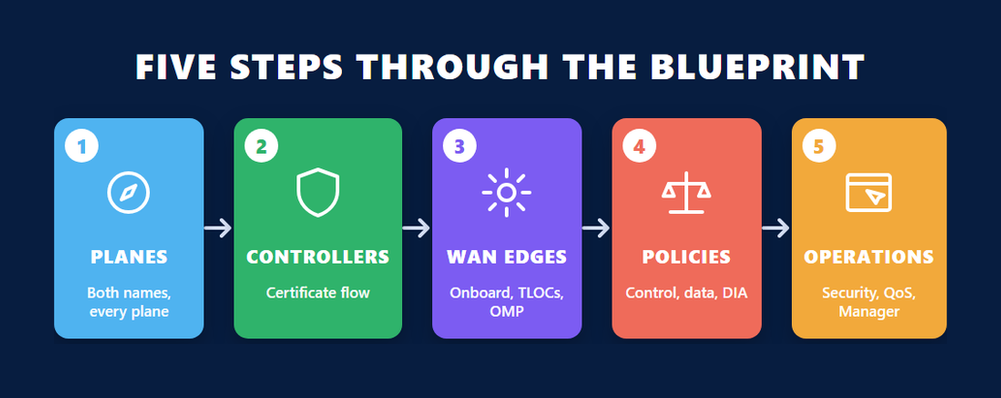
- Learn the architecture in both vocabularies: write each component’s current name beside its older name and say which plane it belongs to before reading anything else.
- Watch a controller set come up: follow the certificate flow from the Validator to the Manager and the Controller, then break a control connection on purpose and read the Manager’s view of it.
- Onboard a WAN Edge and build its service side: ZTP or bootstrap, then TLOCs, OMP, and a template or configuration group that carries OSPF or BGP toward the LAN.
- Write one control policy and one data policy for the same requirement: a hub-and-spoke topology, a VPN that spans three sites, an SLA class for voice, and direct Internet access for one application.
- Finish with security, QoS and the Manager: map the six security features and five AppQoE techniques to requirements, configure one QoS policy end to end, then spend an evening in monitoring and image management.
If you prefer a resource-by-resource plan, the 2024 ENSDWI study guide on this site pairs each domain with Cisco’s official reading. Whatever you use, finish with timed practice at the exam’s pace. With 55 to 65 questions in 90 minutes you have well under two minutes per item, and the scenario questions in this exam reward candidates who recognise which plane and which policy type a requirement names before they read the answer options.
Frequently Asked Questions
How many domains are in the 300-415 ENSDWI exam topics?
Six: Architecture (20 percent), Controller Deployment (15), Router Deployment (20), Policies (20), Security and Quality of Service (15), and Management and Operations (10). The weightings on the NWExam syllabus page match Cisco’s v1.2 exam topics document.
How many questions does 300-415 ENSDWI have, and what is the passing score?
The syllabus page lists 55 to 65 questions and a variable passing score of approximately 750 to 850 out of 1000. Cisco does not display a question count or a cut score on its exam page, so treat both as the syllabus page’s figures.
How much does the Cisco SD-WAN certification exam cost?
300-415 ENSDWI costs $300 USD, or the equivalent in Cisco Learning Credits, per attempt. There is no separate certification fee.
Does passing 300-415 give me the CCNP Enterprise certification?
Not on its own. 300-415 satisfies the concentration exam requirement; you also need the 350-401 ENCOR core exam. Passing 300-415 alone earns the Cisco Certified Specialist – Enterprise SD-WAN Implementation certification.
Is ENSDWI v3.0 a different exam from 300-415 v1.2?
No. The syllabus page names the recommended course as Implementing Cisco SD-WAN Solutions 3.0, so 3.0 is the course number. The exam blueprint is version 1.2, and the exam code is 300-415 in both cases.
Should I study vManage or SD-WAN Manager?
Both. They are the same component. The syllabus lists SD-WAN Manager (formerly vManage), SD-WAN Controller (formerly vSmart) and SD-WAN Validator (formerly vBond), and the exam and its practice material can use either name.
Is there a prerequisite for 300-415 ENSDWI?
Cisco’s exam page lists no prerequisite exam. The exam is written for engineers who already work with routing and WAN design, and the Router Deployment objectives assume you can configure OSPF, BGP, EIGRP and VRRP on the service side.
How long is the credential valid?
Three years, for both the Specialist certification and CCNP Enterprise. Cisco’s CCNP Enterprise page states that you renew with Continuing Education credits or by retaking exams before they expire, and that 300-415 can be used toward recertification.
Which languages is 300-415 offered in?
English and Japanese, per Cisco’s exam page. Registration is through Pearson VUE.
Conclusion
The 300-415 ENSDWI exam topics are six domains, 29 numbered objectives and one naming convention that every candidate has to learn twice. Architecture, Controller Deployment and Management and Operations ask you to describe; Router Deployment and Policies ask you to configure; Security and QoS does both. The weightings are unchanged between the syllabus page and Cisco’s v1.2 document, so the blueprint is stable even where the vocabulary is not.
Study it in deployment order, keep the old and new component names side by side, and give Router Deployment and Policies the 40 percent of your time they carry on the paper. Ninety minutes, $300, and a credential that counts twice is a fair exchange for a blueprint this well defined. Open the syllabus, work the objectives as a checklist, and book the exam when the configure items feel like things you have done rather than read.


