A dental practice with fourteen staff, two branch offices and one overworked office manager calls a Cisco partner. Nobody on that call wants a lecture on routing protocols. They want calls that reach the right desk, Wi-Fi that works in the waiting room, cameras that cover the back door and someone who can show them all of it working before they sign. The engineer who runs that conversation is exactly the person the Cisco Small and Medium Business Engineer exam, 700-750 SMBE, is written for.
The exam is a 90 minute paper tied to the Cisco Small and Medium Business Engineer Specialization, offered in English and Japanese, and its eleven sections read more like a presales playbook than a configuration guide. This article sets out how the exam is built, what each section weighs, where the cross-selling objectives sit, which demonstration tools and engineering programs you are expected to know, how to prepare, and how SMBE differs from its sales counterpart, 700-250 SMBS.
What Is the Cisco Small and Medium Business Engineer Specialization?
The Cisco Small and Medium Business Engineer Specialization is a Cisco credential for technical presales staff who design and demonstrate Cisco solutions for small and medium business customers. Its single exam, 700-750 SMBE, checks your knowledge of the market trends, strategies and solutions that shape Cisco’s approach to the SMB segment, from partner roles to security and application performance.
Cisco describes the exam as certifying knowledge of “the key concepts, strategies, and solutions” behind its SMB approach, including market trends, brand presence and inclusivity, and enabling technologies. That wording matters. The exam does not hand you a command line and ask you to build a VLAN. It asks whether you understand what a small business needs, which Cisco experience answers that need, and how a partner engineer turns the answer into a working proposal.
The official Cisco SMBE exam page lists the associated credential as the Cisco Small and Medium Business Engineer Specialization and names Small and Medium Business – Technical as the official course. The same page shows the two delivery languages, English and Japanese.
Who usually sits it
The typical candidate works for a Cisco partner: a systems engineer, a presales consultant, a solutions architect at a reseller, or a technical lead at a managed service provider. Several objectives refer to partner types, distributor presales support and Managed Service Provider opportunities, so the exam assumes you are on the selling side of the relationship rather than inside the customer’s IT team.
The exam it replaced
Cisco’s retired exams list shows 700-755 SBTO, the exam behind the older Express Specialization Small Business, with a last day to test of March 3, 2024, and names 700-750 SMBE as its replacement. If you hold material written for SBTO, treat it as background only: the current blueprint is organised around experiences such as hybrid work and smart IT rather than the older small business technology overview.
“Cisco’s goal is to give small businesses access to the same best in class technology capabilities as our enterprise customers, but also balancing with simplicity and usability so the customer can focus on what matters most, growing their business.”
How Is the 700-750 SMBE Exam Set Up?
The 700-750 SMBE exam runs for 90 minutes and contains 60 to 70 questions, according to the NWExam syllabus page, which also lists an exam fee of 80 USD and registration through Pearson VUE. The passing score is variable rather than fixed: NWExam gives it as roughly 750 to 850 out of 1000, so no single pass mark should be assumed.
| Exam detail | 700-750 SMBE |
|---|---|
| Exam name | Cisco Small and Medium Business Engineer |
| Exam code | 700-750 SMBE |
| Duration | 90 minutes |
| Number of questions | 60 to 70 |
| Exam fee | 80 USD |
| Passing score | Variable, approximately 750 to 850 out of 1000 |
| Languages | English, Japanese |
| Recommended training | Small and Medium Business – Technical |
| Registration | Pearson VUE |
| Associated credential | Cisco Small and Medium Business Engineer Specialization |
Ninety minutes for 60 to 70 questions leaves roughly 77 to 90 seconds per question, which is comfortable for a recall item and tight for a scenario that describes a customer and asks for the best Cisco answer. The safest way to learn that pace is to sit a timed 700-750 practice exam once your first pass through the topics is done, then return to the sections where your answers slowed down.
Cisco’s exam page shows the duration and languages but does not display a question count, fee or pass mark, so the figures above for those three fields come from the NWExam syllabus page. Cisco also notes in its exam topics document that the listed topics are general guidelines and that related topics may appear on any delivery.
What Do the Eleven SMBE Sections Weigh?
The 700-750 SMBE blueprint has eleven sections. Nine carry 10 percent of the exam each, and two, Exploring Platforms and Understanding Business Value Demonstrations, carry 5 percent each. No single section dominates, so a candidate who skips any one area gives away a tenth of the paper with nothing to compensate.
| Section | Weight | What the objectives cover |
|---|---|---|
| Partnership Opportunities with Cisco | 10% | SME market trends, partner roles and types, Cisco’s partner strategy, Managed Service Provider opportunities |
| Enabling People, Enhancing Workspaces | 10% | Enabling employees, physical and digital workspaces, empowering IT teams |
| Exploring SMB Experiences | 10% | Benefits of Cisco SMB experiences, the solutions inside them, how SMBs use them |
| Navigating Hybrid Workforce Experiences | 10% | Why hybrid work matters to SMBs, cross-selling and upselling, industry and vertical use |
| Adapting to Remote Workforce Experiences | 10% | Challenges of distributed teams, products and opportunities, remote cross-selling |
| Securing the Modern Workplace | 10% | Digital security for SMBs, physical security and environmental solutions, secure cross-selling |
| Implementing SMART IT | 10% | Turning data into decisions, Cisco’s smart portfolio, real-world smart use cases |
| Enhancing Application Performance | 10% | Application security, accessibility and resiliency, key SMB applications, positioning in SMB accounts |
| Exploring Platforms | 5% | Platform capabilities, deployment options, APIs and extensibility, SaaS impact and automation |
| Understanding Business Value Demonstrations (BVDs) | 5% | Why BVDs matter, presales tools, demo platforms, dCloud, Topology Builder and CML |
| Introducing Engineering Programs | 10% | Engineering resources, Sales Connect and Blackbelt, distributor presales support, Meraki CMNA, TAC, GVE and DevNet |
The section names and weights above match Cisco’s own SMBE exam topics PDF exactly. The first objective of the whole blueprint asks about market trends in the SME sector, so it helps to know what the term covers: the broad category of small and medium enterprises is defined differently by country, usually by headcount and turnover, and the SMBE blueprint itself uses both SME and SMB.
Why Does an Engineer Exam Keep Asking About Cross-Selling?
An engineer exam asks about cross-selling because SMBE tests presales engineering, where the technical recommendation and the commercial opportunity are the same conversation. Four sections, covering hybrid work, remote work, security and smart IT, each include an objective on cross-selling or upselling, and the application performance section asks about positioning Cisco offerings inside SMB accounts.
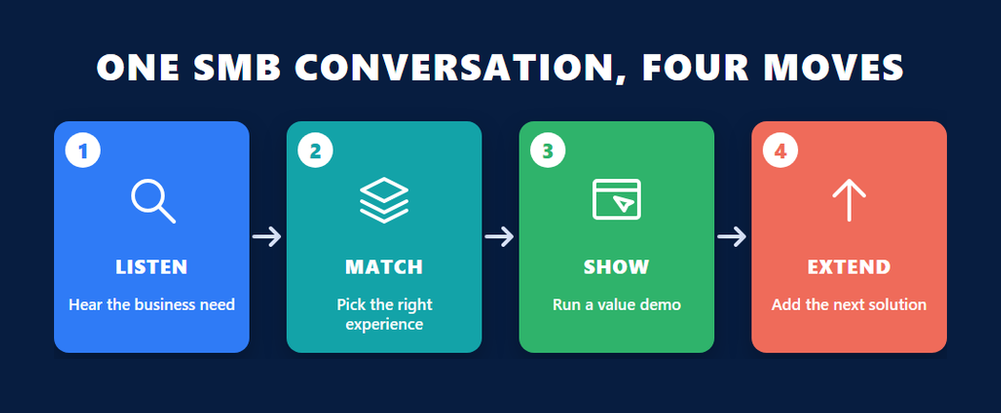
For a candidate from a pure operations background this is the biggest adjustment. A question may describe a customer that already runs one Cisco product and ask which additional experience addresses a new problem, or which industry the solution suits best. Knowing the features is not enough; you need to know which customer problem each one answers.
Workforce sections: hybrid and remote
Hybrid and remote work get a section each, and they are not duplicates. The hybrid section is about the importance of hybrid experiences and how they serve SMB needs across industries. The remote section starts from the problems of distributed teams and asks you to evaluate experiences, products and opportunities for them. Study them as two different customer stories: an office that is sometimes empty, and a team that never meets in one.
Security and SMART IT
The security section reaches beyond digital protection into physical security and environmental solutions, so expect cameras and building sensors to sit alongside network and endpoint security. SMART IT opens with interpreting data for decisions, which ties the smart portfolio to a business outcome rather than a device list. Cisco’s SME solutions overview is a useful place to see how Cisco itself groups these offers for smaller customers.
Application performance
The application section asks about Cisco’s role in application security, accessibility and resiliency, the key applications SMBs depend on, and the case studies that show results. Case studies are worth reading closely: an objective that asks you to recognise success stories rewards candidates who can match a story to the problem it solved.
Which Demonstration Tools Should You Be Able to Explain?
The 700-750 exam expects you to explain the demonstration platforms Cisco partners use in SMB presales: dCloud, Topology Builder and Cisco Modeling Labs (CML), within the section on Business Value Demonstrations. It also asks about platforms more broadly, including deployment options, APIs for extensibility, SaaS application impact and automation integration.
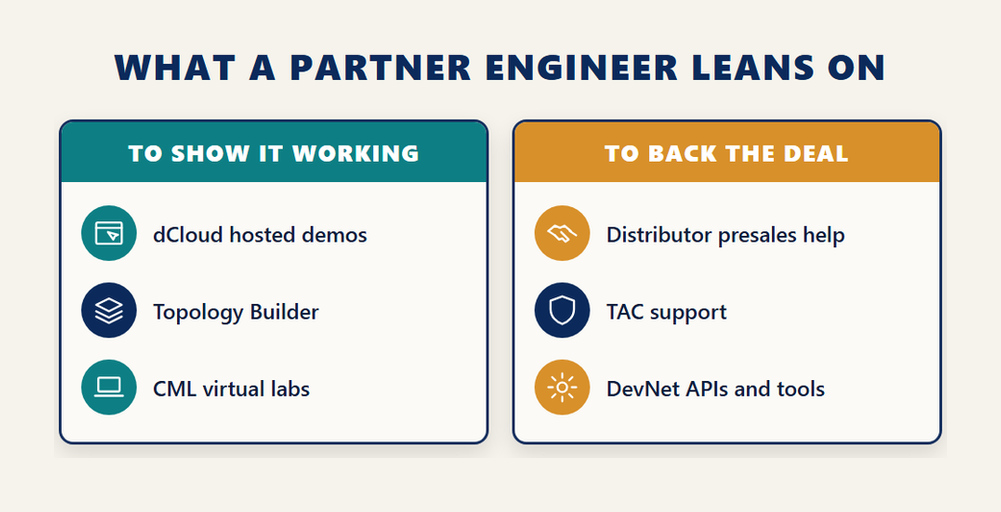
A Business Value Demonstration shows the customer an outcome rather than a datasheet. For an SMB buyer with no IT department, seeing a working scenario is often what moves a deal forward, which is why the exam treats demonstration as an engineering skill. The objectives ask why BVDs matter, which tools support outstanding presales engagements, and how demo platforms apply to SMB scenarios.
Of the three tools named, Cisco Modeling Labs is the easiest to explore on your own, since it is Cisco’s network simulation platform and runs topologies of virtual Cisco devices. dCloud is Cisco’s hosted demo environment and requires a Cisco account. Topology Builder is named in the same objective. Together these two 5 percent sections are worth a tenth of the exam, the same as any single 10 percent section.
Cisco Engineering Programs: the Support Behind the Sale
The Introducing Engineering Programs section, worth 10 percent of 700-750, covers the Cisco resources a partner engineer can call on: Sales Connect and Blackbelt for sales performance, distributor presales support, the Meraki CMNA program, the Technical Assistance Center (TAC), Global Virtual Engineering (GVE) and DevNet. It tests whether you know which resource to use and when.
These are names a working partner engineer meets every week, and a candidate new to the partner world may never have heard of them. Learn each one as a short answer to a question: where do I get training content, who helps me design before the sale, who supports the customer after it, and where do I go for APIs and developer tools.
- Sales Connect and Blackbelt appear together in the objective on enhanced sales performance.
- Distributor presales support and the Meraki CMNA program share an objective.
- TAC, GVE and DevNet share the final objective on their benefits.
Because Meraki is the only product family named in the program list, many SMBE candidates also look at the Meraki engineering track. Our guide to the Meraki 500-220 ECMS exam covers that credential if you want depth on the platform after SMBE.
How Should You Prepare for 700-750?
Preparing for 700-750 works best as a sequence: start from Cisco’s exam topics, take the official course, study the SMB experiences as customer stories, practise explaining a demonstration, learn the engineering programs, and finish with timed practice at 90 minutes. Because nine sections share the same 10 percent weight, coverage matters more than depth in any single area.
- Download the Cisco exam topics PDF and mark every objective that names a product, program or tool you cannot yet explain in one sentence.
- Work through the official course, Small and Medium Business – Technical, which Cisco names on the exam page as the course for this exam.
- Write one short customer story for each experience section, covering the problem, the Cisco experience that answers it and the cross-sell that follows.
- Build or walk through one simple demonstration in Cisco Modeling Labs so that the BVD objectives describe something you have actually done.
- List each engineering program with one line on when a partner engineer would use it.
- Finish with timed practice at 60 to 70 questions in 90 minutes, then revisit the sections where your answers were slowest.
If you already run SMB deals, the experience and cross-selling sections may feel familiar while the program names need work. If you come from operations, the balance is likely to be the other way round. Use your first pass through the topics to decide which group you are in, and weight your study time accordingly.
SMBE or SMBS: Which Cisco SMB Exam Fits Your Role?
Choose 700-750 SMBE if your job is technical presales: designing, demonstrating and supporting Cisco solutions for small and medium business customers. Choose 700-250 SMBS, the Cisco Small and Medium Business Sales exam, if your job is account management or selling. The two exams address the same SMB market from the engineer’s side and the seller’s side.
The difference shows in the objectives. SMBE spends whole sections on demonstration platforms, APIs and the engineering programs that back a partner’s technical team, which a pure sales role rarely needs. If your partner organisation needs the specialization for a program requirement, confirm with your Cisco partner contact which roles must hold which exam before you book.
If you are on the sales side, our earlier walkthrough of the 700-250 SMBS exam explains that exam’s preparation in the same practical way.
Frequently Asked Questions
What does SMBE stand for in Cisco 700-750?
SMBE stands for Small and Medium Business Engineer. Outside Cisco the same letters are often used for small or minority business enterprise certifications, which are unrelated, so search for the full Cisco name when looking for study material.
How many questions are on the 700-750 SMBE exam?
The NWExam syllabus page lists 60 to 70 questions in a 90 minute exam. Cisco’s own exam page shows the 90 minute duration but does not display a question count.
What is the passing score for 700-750?
The passing score is variable. NWExam gives it as approximately 750 to 850 out of 1000, so prepare to clear the upper end rather than aiming at a single fixed number.
How much does the 700-750 exam cost?
The NWExam syllabus page lists the exam fee as 80 USD, with registration through Pearson VUE. Cisco’s exam page does not display a fee.
In which languages can you take 700-750 SMBE?
Cisco’s exam page lists English and Japanese.
Is 700-750 SMBE a hands-on lab exam?
No lab is described in the blueprint. The objectives focus on understanding, positioning and explaining Cisco SMB solutions, demonstration platforms and engineering programs rather than configuring devices.
Which course does Cisco recommend for 700-750?
Cisco’s exam page names Small and Medium Business – Technical as the official course. The exam topics document also refers to the course as Cisco Small and Medium Business Engineer Specialization.
Did 700-750 replace an older Cisco small business exam?
Yes. Cisco’s retired exams list shows 700-755 SBTO, with a last test date of March 3, 2024, and names 700-750 SMBE as its replacement.
Which sections of 700-750 carry the most weight?
Nine of the eleven sections carry 10 percent each. Exploring Platforms and Understanding Business Value Demonstrations carry 5 percent each, so no single section dominates the exam.
Conclusion
The Cisco Small and Medium Business Engineer exam rewards a particular kind of engineer: one who can listen to a small business describe a problem, match it to the right Cisco experience, show it working and know which Cisco program to call on next. Its eleven sections are almost evenly weighted, so broad coverage beats deep study of a favourite area. Start from Cisco’s exam topics and the official Small and Medium Business – Technical course, turn each experience section into a customer story, practise one demonstration in Cisco Modeling Labs, and finish with timed practice at the real 90 minute pace. Book through Pearson VUE once every section feels like a conversation you could lead.


